Sector(s)
Team Members
Project Team
Chris Arlidge - designer
The Client
The Environmental Law Institute (ELI) is a nonprofit organization based out of Washington, DC that seeks to make the “law work for people, places, and the planet.” The ELI is committed to working with individuals, local communities, implementers of the law, and world leaders to educate and help develop well-informed, implemental environmental policies that benefit the community, the world, and the environment. They’ve been doing this internationally in a non-partisan capacity since 1969.
The Opportunity!
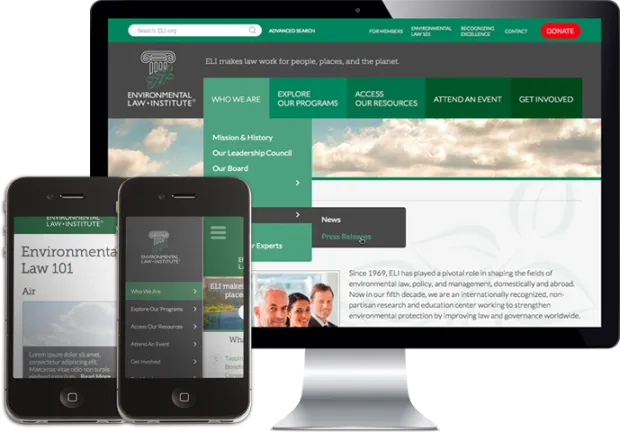
The ELI came to Cheeky Monkey Media because they found that their website was in desperate need of a significant redesign. The problem wasn’t so much the outdated design, though this was a concern, rather that their website had become difficult to navigate. As the ELI added more and more useful and relevant content to their site, users were finding it difficult to search and find articles, information, and publications. The result was a messy general flow and a poor browsing experience.
Since one of the ELI’s mandates is to educate and provide resources (event information, publications, and learning materials) this was a serious concern. The website needed a revised design and a more inclusive information architecture.
About the project
The ELI wanted their website to feel intuitive and to clearly lead their users towards their next step(s). After reviewing the proposal and meeting with the ELI team, we agreed on the following as the key goals and deliverables:
Goals
- Improve graphic design so that it is more visually pleasing
- Improve user experience through better navigation structures, advanced search, and better content organization
Deliverables
- Responsive Design
- Advanced Search
- Event Section and Calendar
- Improved Information Architecture
Process: How We Delivered on the Client’s Objectives
Though the look and feel of the site were ELI’s primary motivation when engaging in their RFP process, it became clear in the early stages of the project that significant work needed to be initiated to organize not only the navigation, but also the overall organization of topics, article types, and information.
Cheeky Monkey Media set to work on a full-scale card sort procedure that allowed ELI to clarify topic “buckets” that could then be used in the development of an intuitive and efficient Information Architecture (IA). From a well-organized IA, to the completion of the wireframe layouts, the strategy and user flow throughout the site were planned for optimal user experience.
With design concepts based on a solid, researched strategy, the creative team was able to put together an engaging, professional and sleek look for the Environmental Law Institute that encourages visitors to browse and review the site, and also locate specific information easily.
The Results
The ultimate objective behind this initiative was to allow users the ability to both easily browse through the website and to quickly find the information they were looking for. By taking a thorough inventory of the website, conducting a card sort to help simplify the content organization, then develop a well thought-out, user-informed information architecture and design, we were able to meet all of our deliverables and firmly establish a win by accommodating the ELI’s project goals.
Most impressive was the 33.67% decrease in the bounce rate across all devices and specifically a 36.08% decrease in bounce rate on mobile devices alone (we compared behavior on the site in the 3-month period after the new site launch to the same 3-month period the previous year for these stats). Since the ELI’s mandates include educating and serving as an online resource for members, we were also happy to see an increase in the time spent on site and pages viewed on both mobile and desktop devices.
Challenges and How they were Resolved
One of the bigger development challenges for this project surrounded the re-launch of eli.org. As there was significant changes made to the ELI site structure and menu system, it was imperative that we come up with a solution that would minimize any site downtime. Solving this challenge was critical as the ELI is a multi-site using the same database across several web properties (with domain access), so putting the site offline would ultimately take all of the multi sites down, and that was simply not an option.
Using a combination of features and context, we were able to put all of the structural changes into code. This covered all of the changes in views and block positioning. For menu changes, we built a custom menu export and import tool to map the new menu structure over to the production site.
To avoid unforeseen problems on launch night, we performed the deployment several times, documenting the process and making improvements along the way (after all, practice does make perfect!)
This allowed us to have a quick deployment while minimizing site downtime, thus making the transition to the new theme and structure seamless.
Why Drupal was chosen
Prior to the website redesign, ELI had just shifted all of their major sites from Cold Fusion to Drupal because they wanted to take advantage of everything Drupal has to offer. Specifically, since ELI is actually comprised of multiple websites, they needed a CMS (content management system) that would make it easy to handle that level of complexity. Since ELI has multiple websites and unique themes on the frontend, which share the same database in the backend, Drupal was a natural fit. In addition, the website is full E-commerce, selling memberships and resources. Leveraging Ubercart and Civic-CRM, would allow ELI to share a single user base across sites and manage paid memberships and donations.
Technical Specifications
Drupal version:
Key modules/theme/distribution used:
Ubercart was chosen as it allowed for both paid memberhips as well as phisical and downloadable products. It was a key module for selling resources to non members.
Domain Access was chosen to allow multiple websites to use the same database, while having diferent looking front end websites for different parts of the organization.
Civi CRM is used to handle the membership base, manage newsletters, donations and events.