Sector(s)
Project Team
Dev: Barry Meehan, Marios Loannidis, Toby Bushell, Andy Fowlston (contractor), Rich Hanson (for Pref Centre integration)
Design: Yasime El-Amery, Rich Williams
Testing: Kseniya Domorad
Project Management: Emilie Vaillant, Natalie Volichenko
Delivery: Vicky Stewart
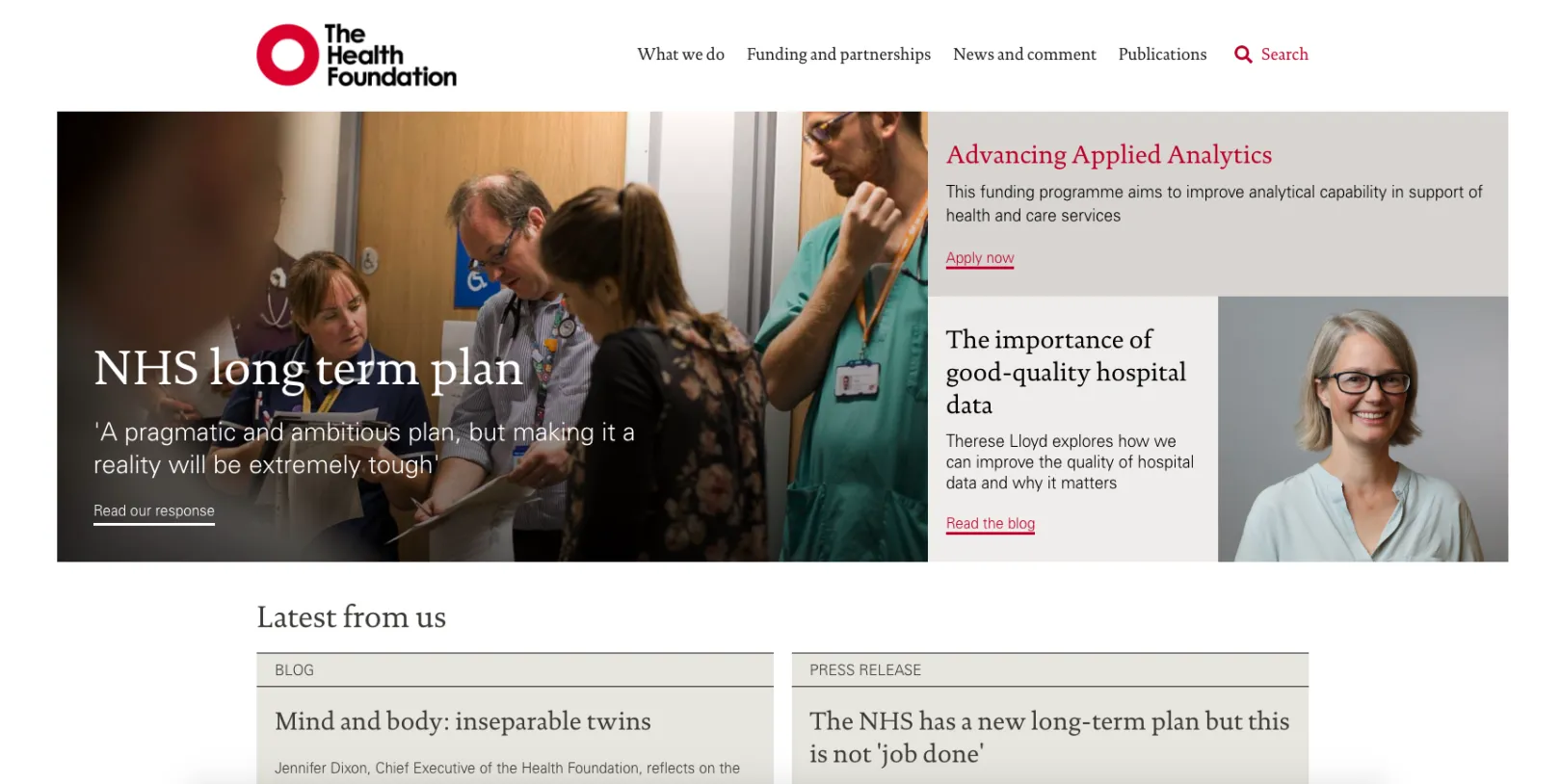
The Health Foundation is an independent charity committed to bringing about better health and health care for people in the UK. They needed help redesigning and rebuilding their website to both improve the user experience and better represent the organisation and its purpose.
The Health Foundation is the second largest endowed foundation in the UK. They spend around £37 million per year on four key areas of activity: promoting healthy lives for all; understanding the quality of health and care; supporting health care improvement; and making health and care services more sustainable.
Their website plays an important role showcasing research and analysis, and connecting health sector researchers and policy analysts with relevant grants. In-depth user testing and an internal review led the Health Foundation to believe that the user experience could be improved, and to seek out an agency with charity-sector expertise that could help the organisation realise a simpler, cleaner and more effective evolution of the site.
What we did
We collaborated closely with the Health Foundation on a 10-month project to rebuild the organisation’s website on the Drupal 8 content management system, taking over hosting and maintenance of their old Drupal 7 site in the interim period. As well as working with them to validate their new designs and taxonomy, we were able to utilise our considerable experience in the charity sector to add value during the rebuild process.
Simpler user journeys
Working in an Agile way, we collaborated with the team at the Health Foundation to turn their designs and site taxonomy into a transparent backlog of development tasks organised according to key user journeys. Our UX designers ensured that these journeys were simple and lightweight, and eliminated barriers to engagement and action.
Streamlined, intuitive search
Intuitive search
To make it easier for the Health Foundation’s various audiences to find the content they need from a huge repository, we rebuilt the site’s search functionality from scratch. Making use of Drupal 8’s extendability, we created a search results page that delivers results quickly and allows users to filter results by content type and topic.
Authentic photography
Photography
The new designs for the site demanded impactful, authentic and high-quality photography to communicate the Health Foundation’s values and purpose, and guide users to relevant content and features. We reviewed their existing photography inventory to create a shot list for required images, and then coordinated, produced and directed a location-based shoot for images to be used across the site.
Integrated Alumni website
The Health Foundation Alumni network supports fellows to develop and share their skills and knowledge beyond the life of their fellowship programme. We rebuilt the Alumni section of the website, accessible only to logged in Alumni, which includes a member directory, news, upcoming events and opportunities, and a range of resources to support continued professional development.
Client preference centre
We built a client preference centre using DotMailer APIs, which allows the Health Foundation’s audiences to easily update their contact details and communications preferences.
How it went
The Health Foundation’s new website launched on November 19th 2018, and was received with much acclaim from both internal and external stakeholders. Making use of the Acquia Experience Platform for security, stability and scalability, and benefitting from ongoing support from Manifesto, the new site provides a robust base to support the organisation’s evolving digital experiences.
”It’s been great working with everyone at Manifesto for the past ten months. We’ve tackled a number of different projects in that time, and the Manifesto team’s broad range of expertise has been invaluable across all of these. We’re really happy with the new Health Foundation site, and are looking forward to continuing to work with Manifesto more in 2019 as we continue to develop our digital offer to our audiences.” (Chris Carr, Senior Digital and Editorial Manager, the Health Foundation)
About the project
The previous Health Foundation website ran on Drupal 7 and, although it contained lots of relevant content, had a number of issues with design, usability and editor experience. There was a lack of flexibility for creating and grouping content, the search feature was inadequate and the taxonomies were over-complicated.
The aim of the project was to migrate the existing content from Drupal 7 to 8, and to create a D8 site that would address the above issues. The Manifesto team - consisting of a Project Manager, Web and UX Designers, Developers and Testers - worked closely with the Health Foundation's web team to identify and prioritise the organisation's needs, and to design and implement a new site that would meet those requirements. Client feedback was given at all stages of the project and was essential to its success.
Why Drupal was chosen
The Health Foundation as an organisation requires a powerful, scalable CMS with custom content types and fine-grained permissions for creating, editing and viewing content. Many site users are interested in very specific topics, so it's important that the search and taxonomy features are reliable and easy to implement and use. The site must also integrate with a mailing list platform and allow users to manage their preferences for this. Drupal is an ideal choice for meeting all of these requirements.
Technical Specifications
Drupal version:
Key modules/theme/distribution used:
Paragraphs provides an easy-to-use method for entry and display of content.
Search API, Search API Solr Search and Facets allows for site-wide indexing and search, including faceted search.
UI Patterns allows us to create reusable front-end components, and more easily distribute development work between front-end and back-end developers.
Structure Sync is not used on the production site but was useful during development for easily copying the large taxonomies between environments and developer VMs.
Migrate Plus, Migrate Tools and Migrate Upgrade were used as part of the content migration from D7 to D8 via custom migration scripts.