Sector(s)
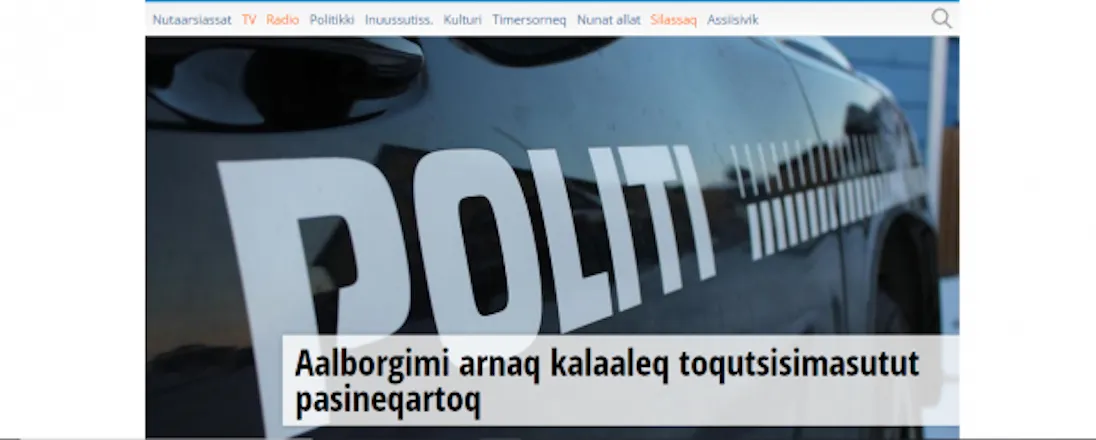
A TV and radio broadcasting agency of Greenland serves as a primary source of news and entertainment for the region. Originally built on TYPO3, their website was later identified as a strong candidate for redevelopment on Drupal to better meet evolving needs.
Key Highlights:
- Migrated over 60,000 news stories; and over 12000 photos to a Drupal database
- Multilingual website - available in Greenlandic, Danish and English
- Videos being served from Kaltura
- Advanced Search features using the Apache Solr search engine
About the project
The Goals:
To re-build and redesign the site for our client on Drupal.
The Outcomes:
We realised that our client's site was ideal case for a move to OpenPublish. OpenPublish is based on Pressflow, a performance-tuned implementation of Drupal, has Memcached and Varnish implemented by default, and an Apache Solr integration built in. It therefore, was a good choice for the likes of the agency's site.
We invested in a research team to work on OpenPublish. This took 3 weeks and then the migration from TYPO3 to OpenPublish took another 5-6 weeks.
The migration was a challenge for our team since the database structure of TYPO3 and Drupal are way different:
- An "Author" (internal users at the broadcasting agency) of a news story entry is a simple label entry. Therefore, while the same author may have entered several news items, the name of the same are stored multiple times simple as a field entry. The email entry of the same author could be different. However, while migrating this to Drupal, our team had to ensure integrity of data in terms of the author profiles being made for internal as well as for external users - Photographers who registered on the site to upload their photos.
- These photos were residing independently in folders, and had to be made available to the News editors for use in the News Stories in the website. Therefore a Digital Assets repository had to be implemented.
- In Drupal, however, an Author can be part of a Taxonomy and complete User Profiles can be made for these authors. Also, the photographs and photo-galleries they made, had to be associated with their profiles.
Intermediate Database design:
To handle the above challenges an intermediate database schema was prepared, which would allow a clean migration of content between TYPO3 and Drupal, according to their own structures.
Incremental Migration:
Since the agency's webite (TYPO3) was in production, post UAT, the content would have to be continually migrated; the new Drupal website would have to start serving with the live real-time content. For this an incremental migration process had to be followed for News stories (including images) and for the Photo Gallery and any new photographer user registrations.
Converting Latin1 charset tables with UTF8 data set:
The TYPO3 site was multilingual - English, Danish and Greenlandic. The TYPO3 DB had Latin1 charset tables with UTF8 data stored which needed to be converted to UTF8 for a Drupal database. The solution was to convert the fields to BLOB, and then the BLOB field to UTF8.
Why Drupal was chosen
Drupal was chosen over TYPO3 for this project because of the following reasons:
- TYPO3 had no concept of "Taxonomy", which is very central to Drupal. These could be a "tag library" which is used for tagging all stories written in a website
- Availability of Apache Solr integration module which was not in TYPO3 then. The Taxonomy concepts could be easily hooked onto Apache Solr for filtering based on meta-information, such as Tag library, Authors, Publications, etc.
- The TYPO3 Backend from for a News publishing website with hundreds and thousands of articles, added a level of usability complexity
- Meta information such as "Authors" are simple entries to make in TYPO3, however, for Drupal, an Author can simply be part of a Taxonomy and complete user profiles will made for these authors - by default
- Creation of Article/News by way of simple forms along with easy publishing/unpublishing of news in bulk
- Complex news-news and news-article relations can easily be managed using in-built relationships in Drupal
Technical Specifications
Business Benefits:
- We worked like a true partner to our client, enabling them to move the platforms that would serve their needs better, even incurring costs to ensure that they received the Drupal implementation that would work better
- Our client saw a smooth migration of a huge number of photographs and news stories, even with the TYPO3 website being live till the OpenPublish version was ready
- We enabled an end-to-end solution for our client by bringing in design partners to handle concepts and wireframes