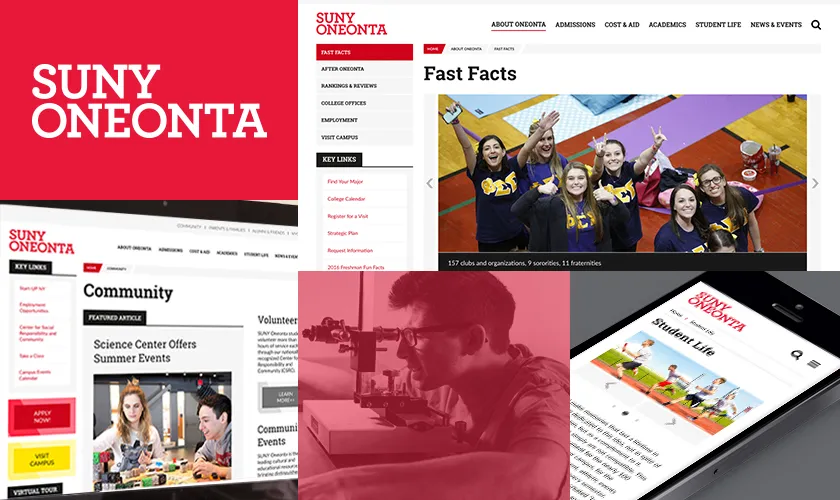
SUNY Oneonta is a member of the State University of New York, the largest comprehensive university system in the United States. Many of SUNY Oneonta’s strategic priorities revolve around student recruitment. As graduating high school student cohorts become smaller, future institutional success will depend on maintaining market share of traditional-age students and attracting graduate, transfer, international, and online students in greater numbers.
SUNY Oneonta’s public-facing site operated on the base of a Drupal 7 installation. Though built in Drupal, the site adhered to neither best practices nor standards in architecture, coding, or theming. The site was highly customized with several uniquely designed modules and database structures. This customization made it difficult to scale and add enhancements. In addition to making it difficult to make changes via the Drupal interface, the customization created an architecture that resulted in severe performance issues, causing frequent service interruptions.
Because the college’s website is its biggest recruitment tool, service interruptions, downtime, and the inability to migrate key pages into the responsive Drupal environment hampered the college’s recruitment efforts.
It was time for a change.
About the project
SUNY Oneonta consistently gains recognition for delivering excellence and value. The college sits 13th on the 2018 U.S. News and World Report list of the best public institutions in the region and is ranked 166th in the Northeast on the Forbes magazine list of "America's Top Colleges."
Goals
SUNY Oneonta’s primary goal was to revise and enhance its public-facing website (while upgrading from Drupal 7 to Drupal 8) hosted on the Acquia platform, with a focus around the stability and flexibility of the website. It also wanted to be able to use more of the capabilities and opportunities that Drupal 8 offers (e.g. less custom code).
Supporting goals for this migration and redesign project included:
- Retain Drupal 7 website design with some enhancements and modifications
- Upgrade to a functional responsive design with the concept of mobile first as a guiding principle
- Retain the majority of the Drupal 7 navigation structure with some editorially controlled enhancements and modifications
- Configure and develop a website that has no or very little down time
- Through a templated and structured approach increase flexibility; allowing for future enhancements and changes to the website content and structure
- Improve the workflow, user experience and underlying architecture
- Broaden the visitor base by providing improvements in translatability and accessibility
- Launch five months from the date the contract is awarded
Achieving these goals would allow SUNY Oneonta to add and edit content, build new features, and modify and support new site architectures including additional academic and administrative units.
Approach
For SUNY Oneonta to get the best from Acquia Cloud and achieve its goals of accessibility, stability, and scalability, Northern planned for the migration of the website from Drupal 7 to Drupal 8 and the upgrade to a fully responsive and accessible site design.
To meet SUNY Oneonta’s goals, Northern:
- Worked with the college’s project team to itemize the sources of data and clearly define the specific information and fields needed on the site.
- Ensured the development process would accommodate SUNY Oneonta’s existing team processes in order to help reduce the IT team’s workload.
- Determined how often each set of data was updated and needed to be synchronized to the website.
- Agreed to, and kept, a strict implementation and delivery plan timeline. Weekly project status updates via teleconference and summary status reports kept client abreast of the project.
Results
Faster, better search results, and on-point informative content is what a site user notices. Second to this, broadening the visitor base by making improvements in translatability and accessibility were key goals of this project and Northern achieved this by adhering to Drupal 8 best practices. SUNY Oneonta site administrators realize an improved Drupal interface with access to better backend processes and code.
Other highlights:
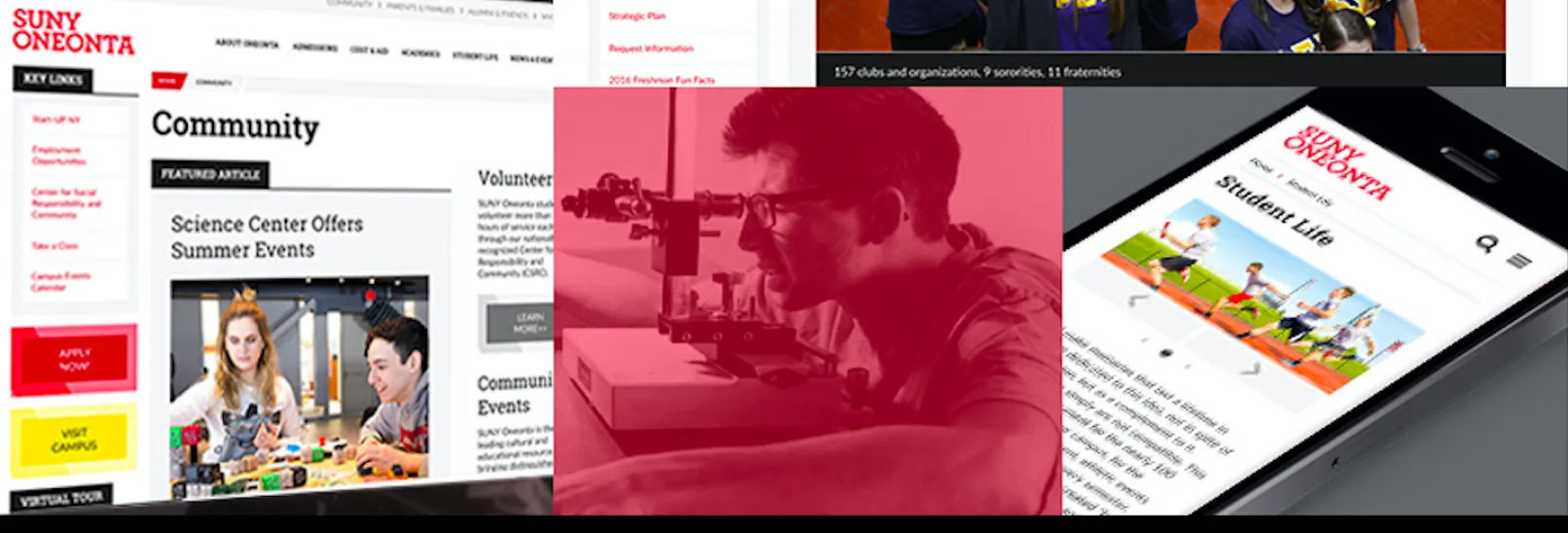
- Kept within budget by retaining current brand and general site design but with enhancements and modifications to workflow in order to accommodate today’s higher education UI/UX expectations. This included a redesigned/modernized homepage -- panels, top carousel properly displays photos on all devices, profiles and fast facts are views (fast facts have pagination), flyout menu on right.
- Updated colors and (Google) fonts to align with SUNY Oneonta’s style guide.
- A templated and structured approach increased flexibility to allow for future enhancements and changes to the website content and structure.
- Reduced the number of content types from 21 to 10, and the number of nodes from 3,000 to < 1,100.
- Reduced the redundancy of template files functionality by moving approximately three-dozen custom modules storing content associated with specific nodes in custom database tables which output content directly into over 50 custom templates via SQL, to nodes or blocks as appropriate.
- Used views and other standard Drupal implementation methods for lists of items and featured content.
- Purged a substantial amount of test content (and some published content) prior to migration.
- Delivered an accessible product, as governed by Federal Section 508 Standards and New York State Policy NYS-P08- 005, by building the site to W3C and Drupal 8 standards.
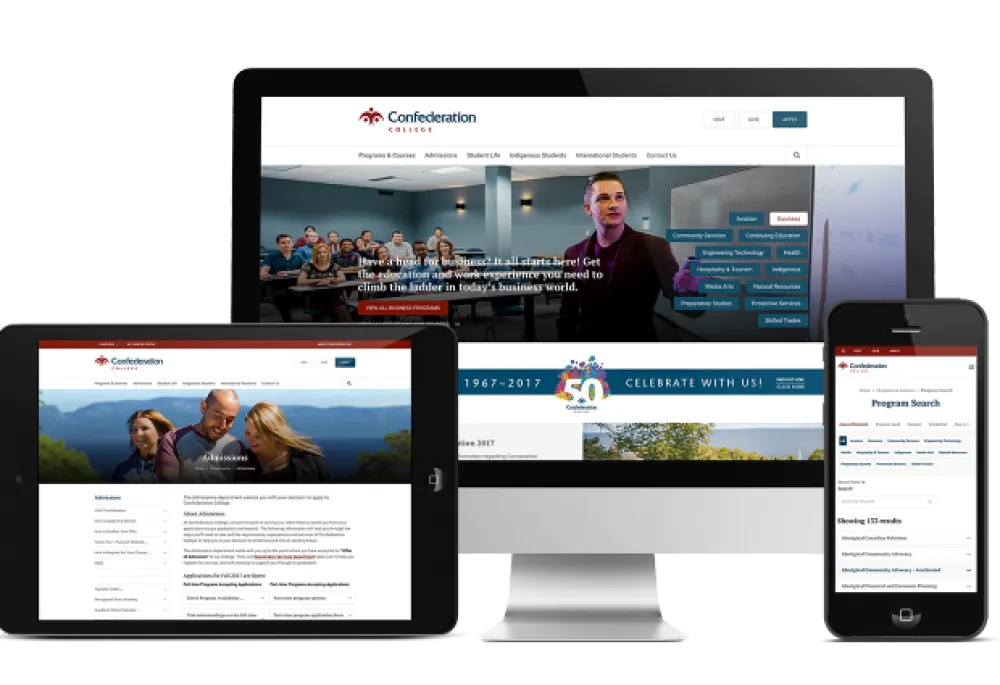
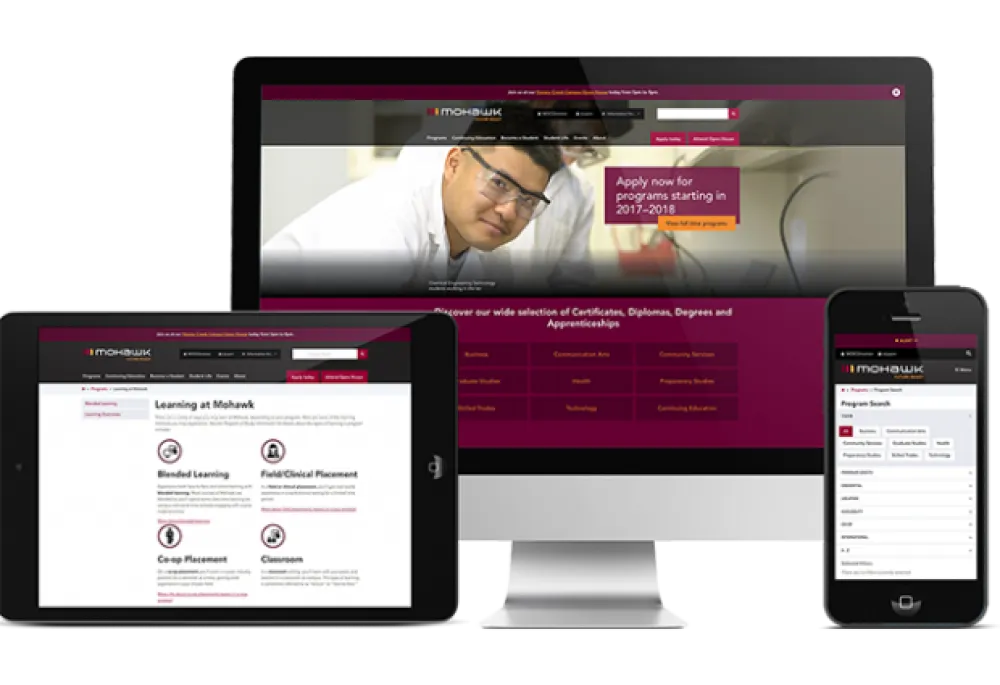
- Upgraded to a fully functional (Note: Drupal 7 was responsive, but menus, etc. never functioned correctly on other devices) responsive design with the concept of mobile first as a guiding principle. The site is now fully responsive, displaying appropriately on smartphones, tablets, desktop, and for printing.
In conclusion, remember that even with Drupal, too much customization and breaking from best practices, can cripple your CMS!
This site was recognized as a 2017 Acquia Engage Award Finalist (Higher Education Category)
Why Drupal was chosen
Following a recommendation from another Drupal development firm, Mediacurrent, SUNY Oneonta moved to Acquia Cloud. Though this did help create a more stable environment, the move failed to address the underlying architectural limitations.
SUNY Oneonta was Drupal savvy, and keen to migrate from Drupal 7 to Drupal 8.
Technical Specifications
Drupal version:
Key modules/theme/distribution used:
Administration links access filter
Provides a workaround for the common problem that users with 'Use the administration pages and help' permission see menu links they don't have access permission for.
Chaos Tools Suite
This suite is primarily a set of APIs and tools to improve the developer experience. It also contains a module called the Page Manager whose job is to manage pages.
Migrate Plus
Enhancements to core migration support
Migrate Tools
Tools to assist in developing and running migrations.
Draggable Views
Complete rewrite of D7 draggableviews
Panelizer
Allow any entity view mode to be rendered using a Panels display.
Workbench
Provides convenient dashboards and shortcuts for editors.
Workbench Access
Hierarchical access control module.