Sector(s)
Team Members
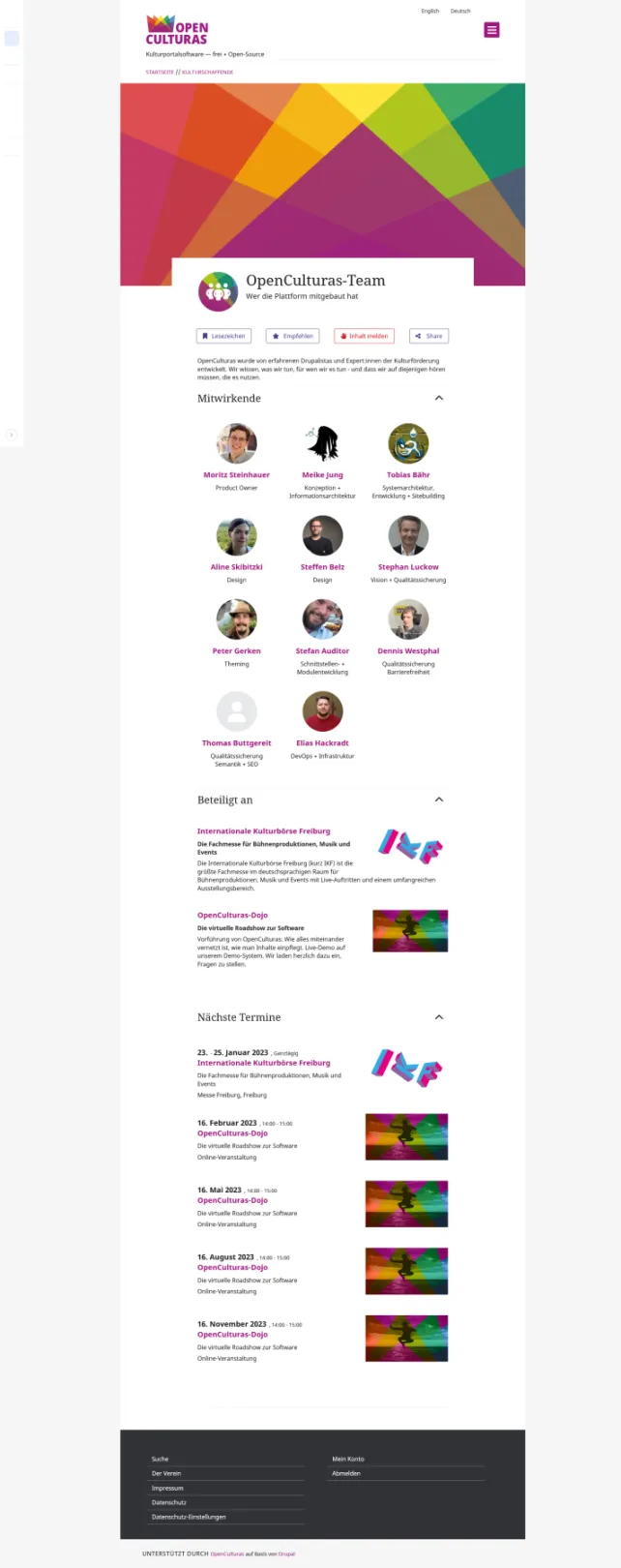
Project Team
At CoWAIN we see customers as part of the team. With only a few people still lacking a Drupal.org profile and not fronting intended, we'd like to say special thanks to both teams of Landschaftsverband Südniedersachsen and Landeszentrum Freies Theater Sachsen-Anhalt (LanZe), you are all awesome!
Credits to Adam Whitlock at Unsplash for the header image.
Visit the site
Visit the siteOrganizations Involved
Community contributions
- The OpenCulturas distribution itself
- The Swiffy Slider module
- Training site-owners to become contributors themselves
- Enhancements of the attribution module
- Contributions to Tour UI, Smart Date, References, Custom Language field, Accessible Autocomplete Element/Widget, and more (see list of issue credits)
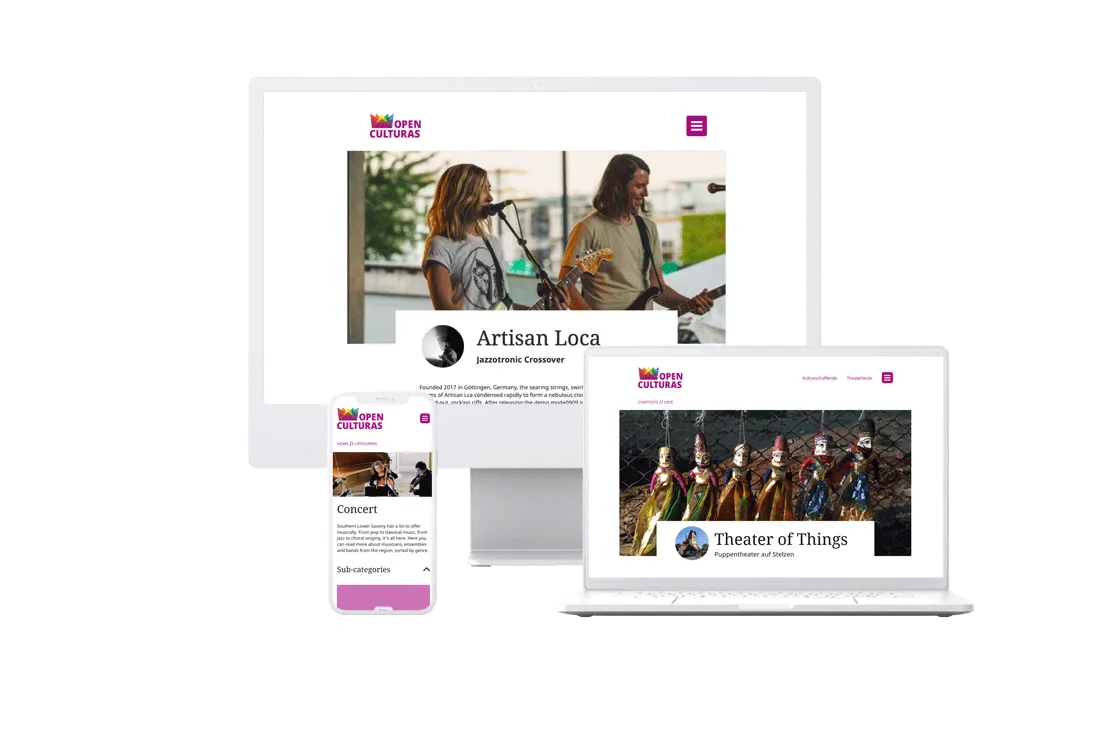
OpenCulturas is the distribution to create arts + culture platforms from.
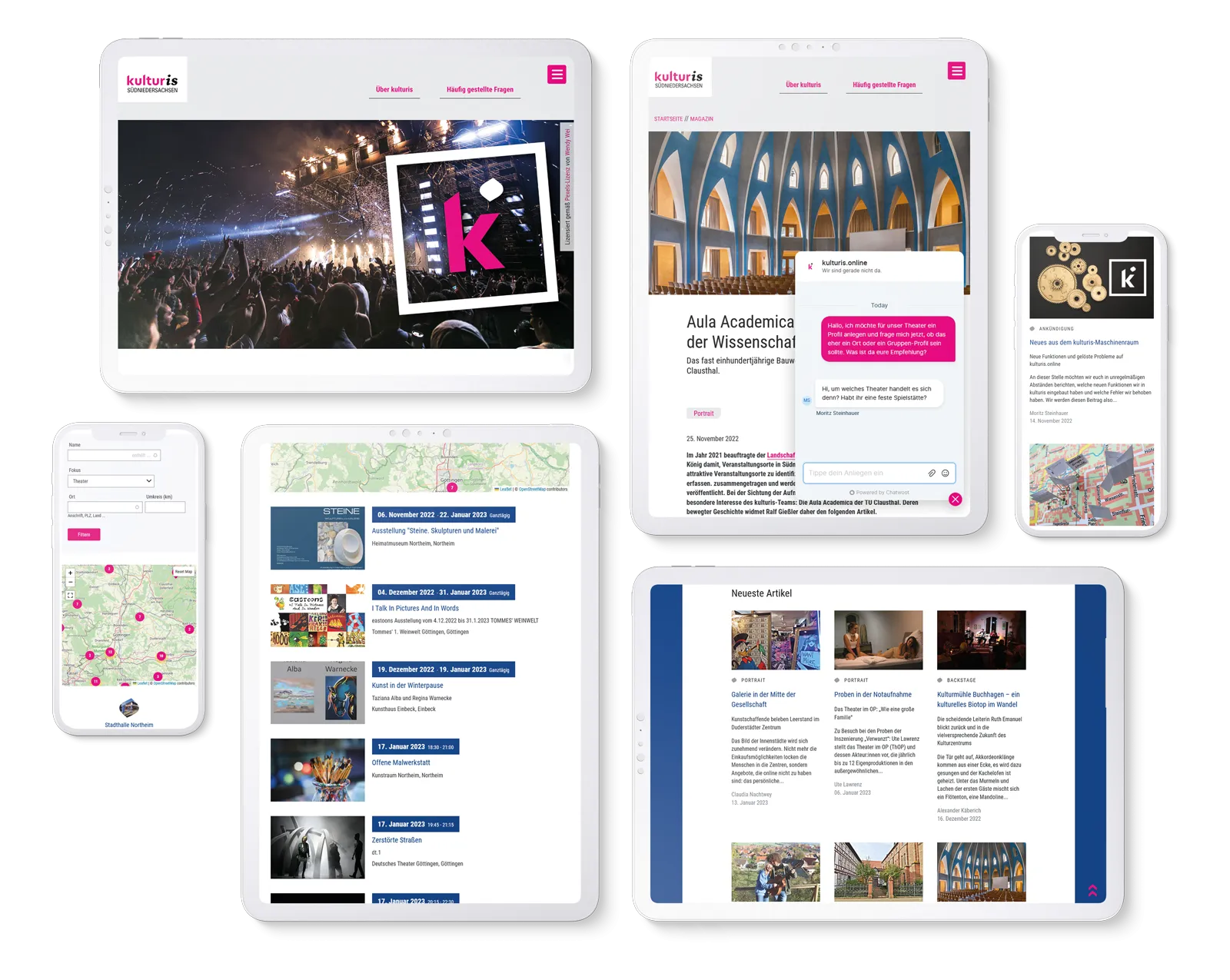
The Landschaftsverband Südniedersachsen is a non-profit organization in the public sector with the objective to foster arts and culture in Germany's region of Southern Lower Saxony.
The platform kulturis was originally launched on WordPress, as a minimal viable product. Learnings included that content had to be much more interconnected, and much more focused on user-generated content. Above all, the new version should be designed with a generic arts and culture platform approach and to be officially released as a FOSS solution. "Public money - public code!"
That's why, before starting to work on the implementation for kulturis, the Drupal distribution OpenCulturas was developed. The governance for further development will be in the responsibility of a dedicated OpenCulturas Association.
About the project
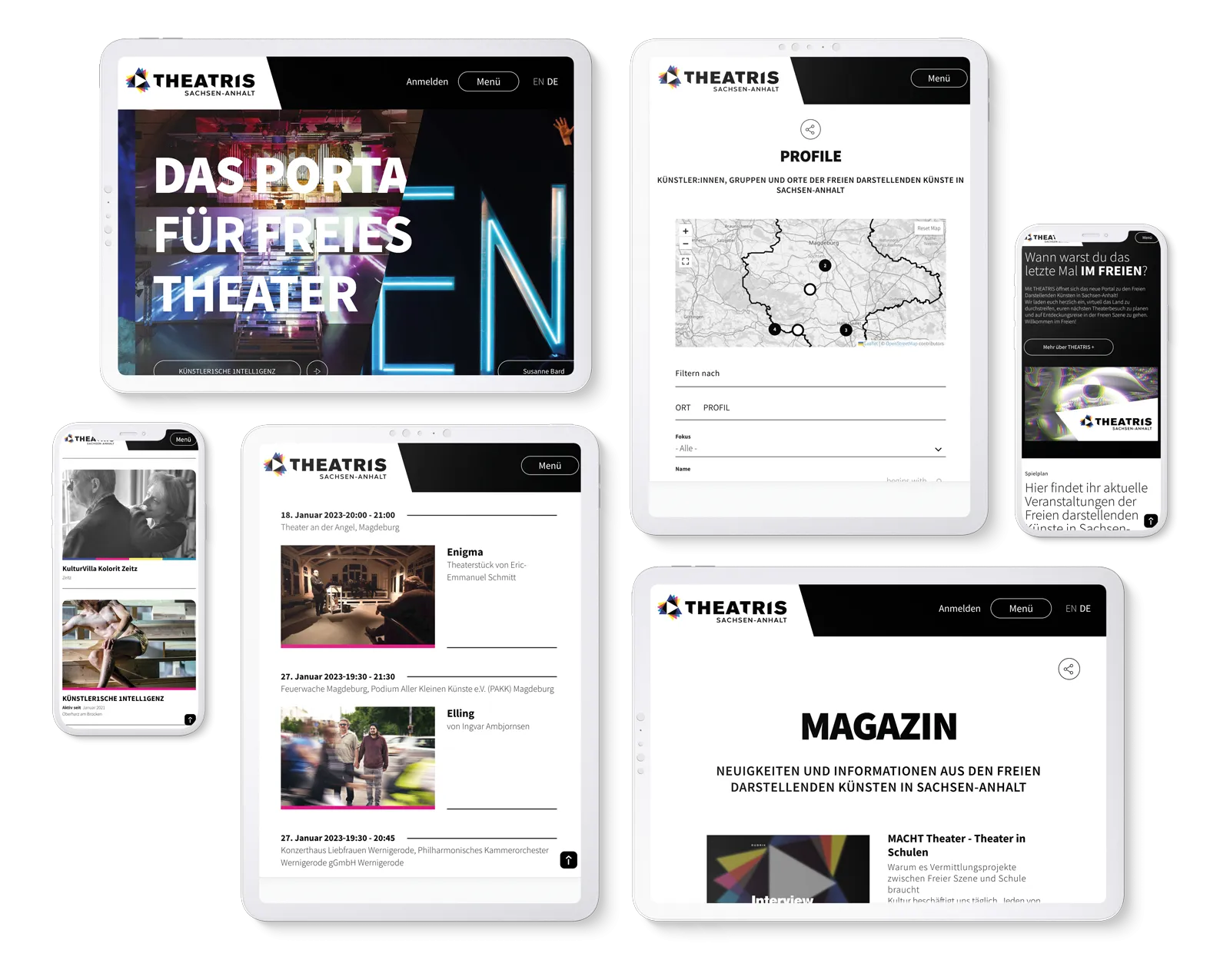
While developing OpenCulturas (OC) with the first application kulturis in mind, a second player entered the stage: THEATRIS was contracted to be launched on OC als well. While kulturis' scope is the promotion of the whole arts and culture spectrum in a rural region, THEATRIS is meant as a bilingual living archive for the independent performing arts in a federal country (and beyond). This means that the OC development benefitted from two different perspectives.
Infinitely interconnected content and aggregation
- Profiles for people in the cultural sector
- Locations where events can take place
- Events and dates
- Magazine
- Cross-type tagging
Both projects had similar requirements here. Since people in the cultural sector are often part of different groups (besides maybe being solo artists), we made the "one to many" relationship a major part of content creation: Personal profiles can be referenced by several group profiles (theater ensembles, bands, non-profit initiatives etc.) and locations can reference regular performers on premises.
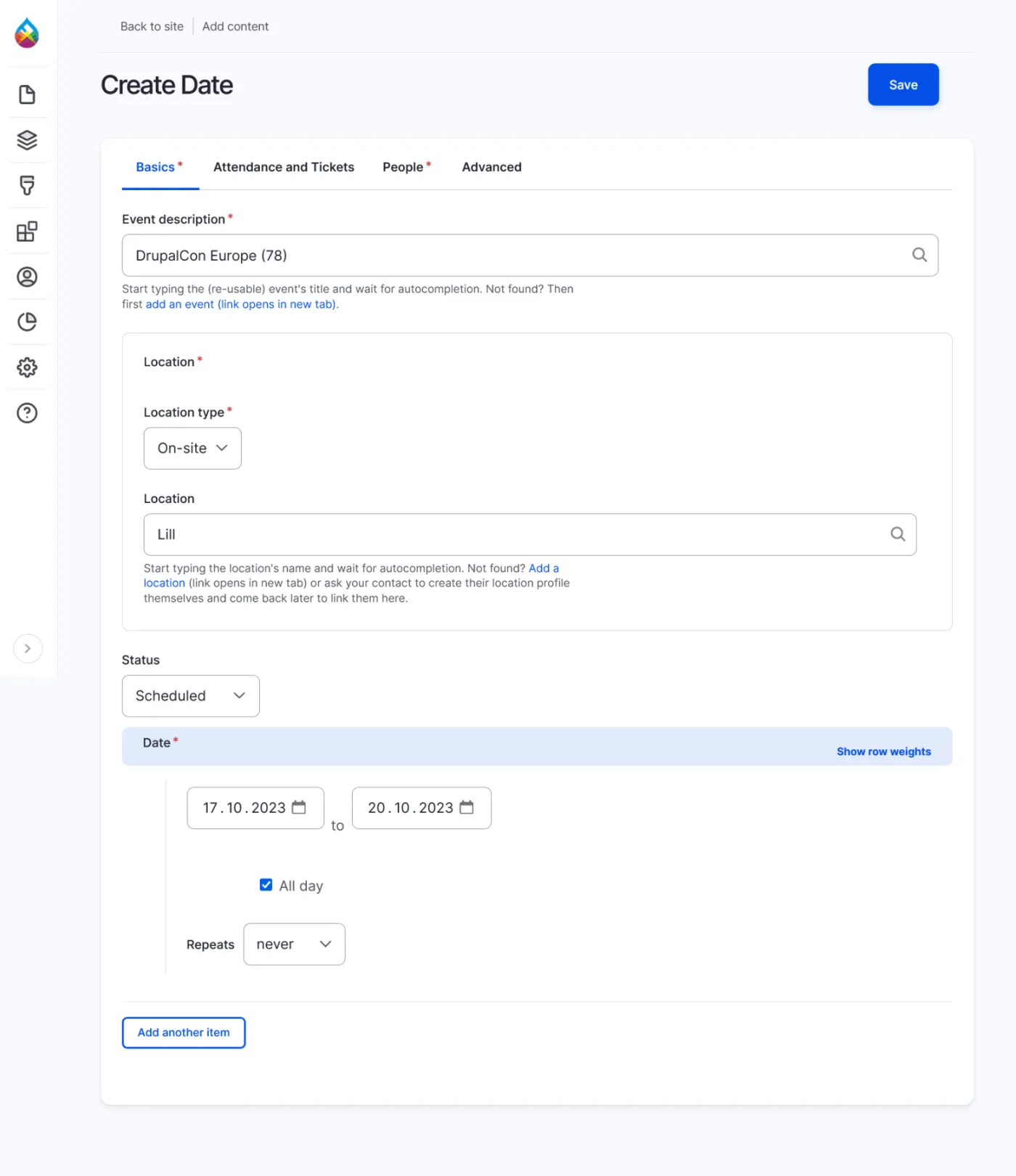
Re-usable event descriptions can reference all people involved with their specific context-related role. Dates hold only the respective information (event, location, date + time, optional repeat rules, accessibility + safety information).
Magazine articles can reference any content mentioned in the text, resulting in a teaser below the article as well as a reverse reference teaser on the profile's or location's page.
All content can be tagged with a common "focus" taxonomy and will be aggregated on its taxonomy page (grouped by type). Pre-built views blocks aggregate content on typical landing pages, along with a map where useful. Namely: event calendar, locations overview, artists and event catalogues.
THEATRIS contributed a color-coding by individual "sections" which allows defining individual color codes for a separate taxonomy that allows multi-color-coding of teasers and content pages.
All content can be moderated, i. e. be saved as draft or be enqueued for review. Trusted roles can publish directly. The two projects revealed that intended workflows can be very different (pre vs. post moderation), depending on the user base and the number of staff available.
User interaction
kulturis intends to motivate users to become influencers by allowing them to publicly recommend profiles, locations, events, or even a "focus" category. Since users can have several profiles (see above), recommendations are made on behalf of a profile. Teasers show on both ends of the recommendation.
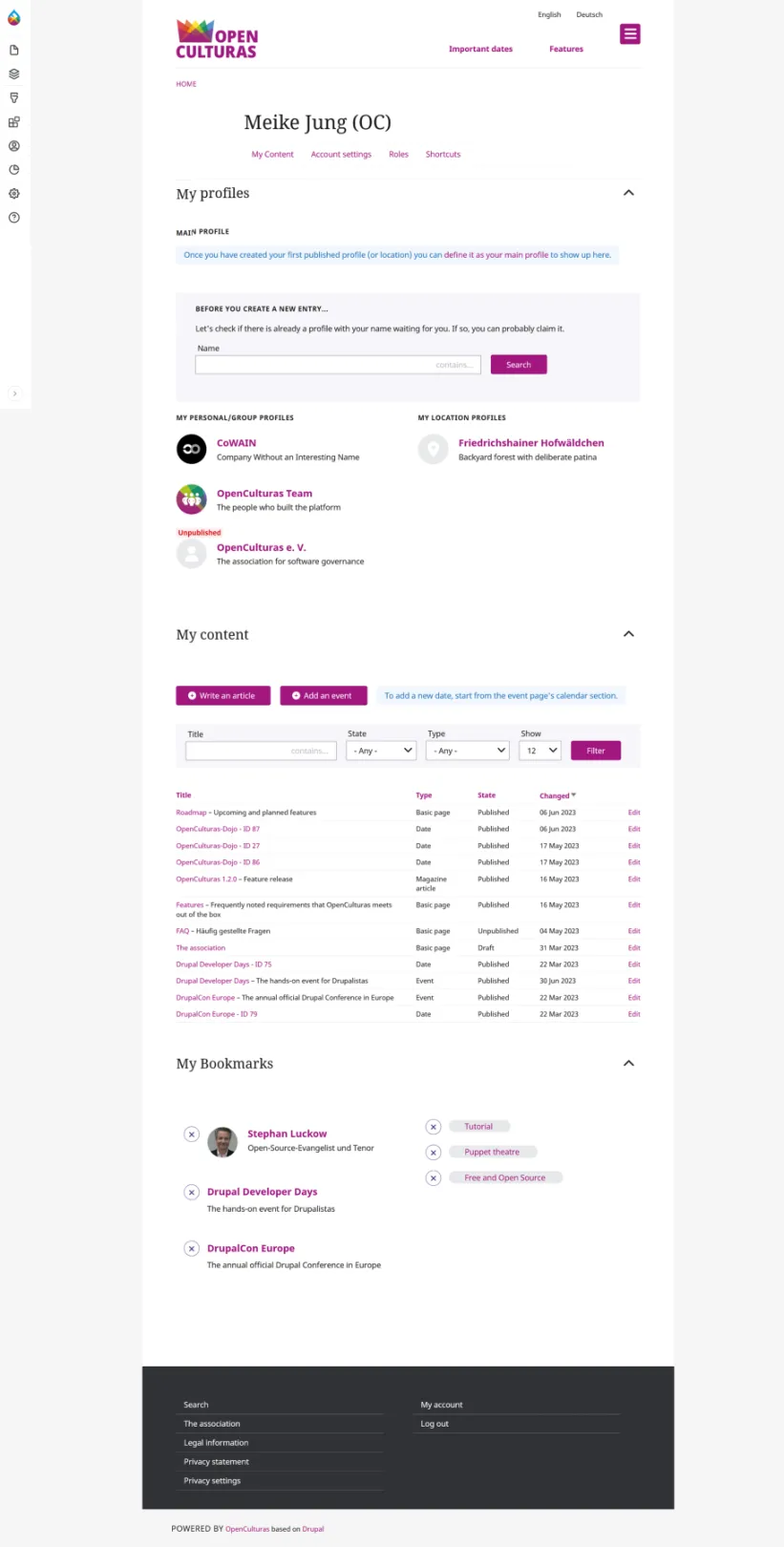
Guilty pleasures: not every preference is suitable for the public. Users have a separate option to privately bookmark focus categories or content which will only show on their personal dashboard.
The upcoming version of OpenCulturas allows users to comment on any content as well as discuss in a forum.
Accessibility
We mean it. All of the stakeholders do. And we are proud of the outcome.
- The OpenCulturas development was accompanied by screen reader tests which helped to avoid piling up technical debt.
- Locations and event descriptions use a dedicated taxonomy with accessibility features like "wheelchair accessible", "sign language interpreters", "assistive listening systems", "service animals welcome". When adding a date, users can add/remove features depending on information from both sources.
- The option to add trigger warnings was added sort of last minute but just in time.
- Press quotes can be added in their original language, which can be indicated to serve screen readers.
Media
Users will find their own uploaded media in the media browser. And not other people's copyrighted material. Since kulturis already had an archive with Creative Commons licensed professional photography, we added a new filter allowing the selection of any open source licensed media on the platform. Licenses can be indicated by the user during media upload (defaulting to "all rights reserved"). Since header images are also used in different teaser sizes, users can set a focal point.
A media gallery can be equipped in almost any content, allowing local images and external videos for the time being (with external audio/podcasts and other oembed compatible media on the roadmap). Cookie consent can be given on a per-asset base.
For an elaborate feature list, the roadmap or a live demo, visit the OpenCulturas web site (of course, built with the distribution itself).
Why Drupal was chosen
The product owners are all very fond of Free and Open Source Software.
Several CMS with different approaches had been pitched and Drupal won because of its flexibility, modularity, and the number of core/contrib modules already meeting the requirements.
OpenSocial had subsequently been considered but despite its awesome solutions for community interactions, it lacked some major features. It was eventually decided to built a standalone distribution with full focus on generic requirements in the cultural sector.
Technical Specifications
Drupal version:
Key modules/theme/distribution used: