Visit the site
Visit the siteOrganizations Involved
Community contributions
Patches:
FortyTwo - Several enhancements
Epsacrop - Patch to add support for Media Module. https://www.drupal.org/node/1943384
Path Breadcrumbs - Adds support for Schema.org https://www.drupal.org/node/2476089
CER - Exception thrown when deleting an entity with a field collection https://www.drupal.org/node/2352783
Responsive Table Filter - Regex Fix https://www.drupal.org/node/2558209
CKEditor - Fixes some performance issues with CSS Filter https://www.drupal.org/node/2578271#comment-10454385
Semantic Views - Removes a colon https://www.drupal.org/node/1438724
Modules:
Social feed field - This module makes it possible for editors to create a list of social media posts in a entity that are combined and ordered by created date from several different social media channels.
Search API Fast - Provides drush commands to index fast with search API (using all your CPU cores). It's an effective multi-process approach by spawning new drush commands that handle queues.
Token Insert - Multiple patches to make the module behave and work better. https://www.drupal.org/node/2394135 and https://www.drupal.org/node/2455649
File Entity (fieldable files) - Patch to fix an issue with wrong filenames when downloading files. https://www.drupal.org/node/2203831
Replicate paragraphs - Fixed an issue with empty object not being cloned. Now skip that ones.
The University of Maastricht is known for its unique education system: problem based learning (PBL). In addition, the UM is profiling through strong international orientation. An increasing number of students from both the Netherlands and abroad choose the Maastricht system. Maastricht University is the youngest university in the Netherlands and is growing rapidly. There are currently around 16,000 students and 4,250 employees. Education and research of the UM is mainly organized on the basis of faculties and schools.
About the project
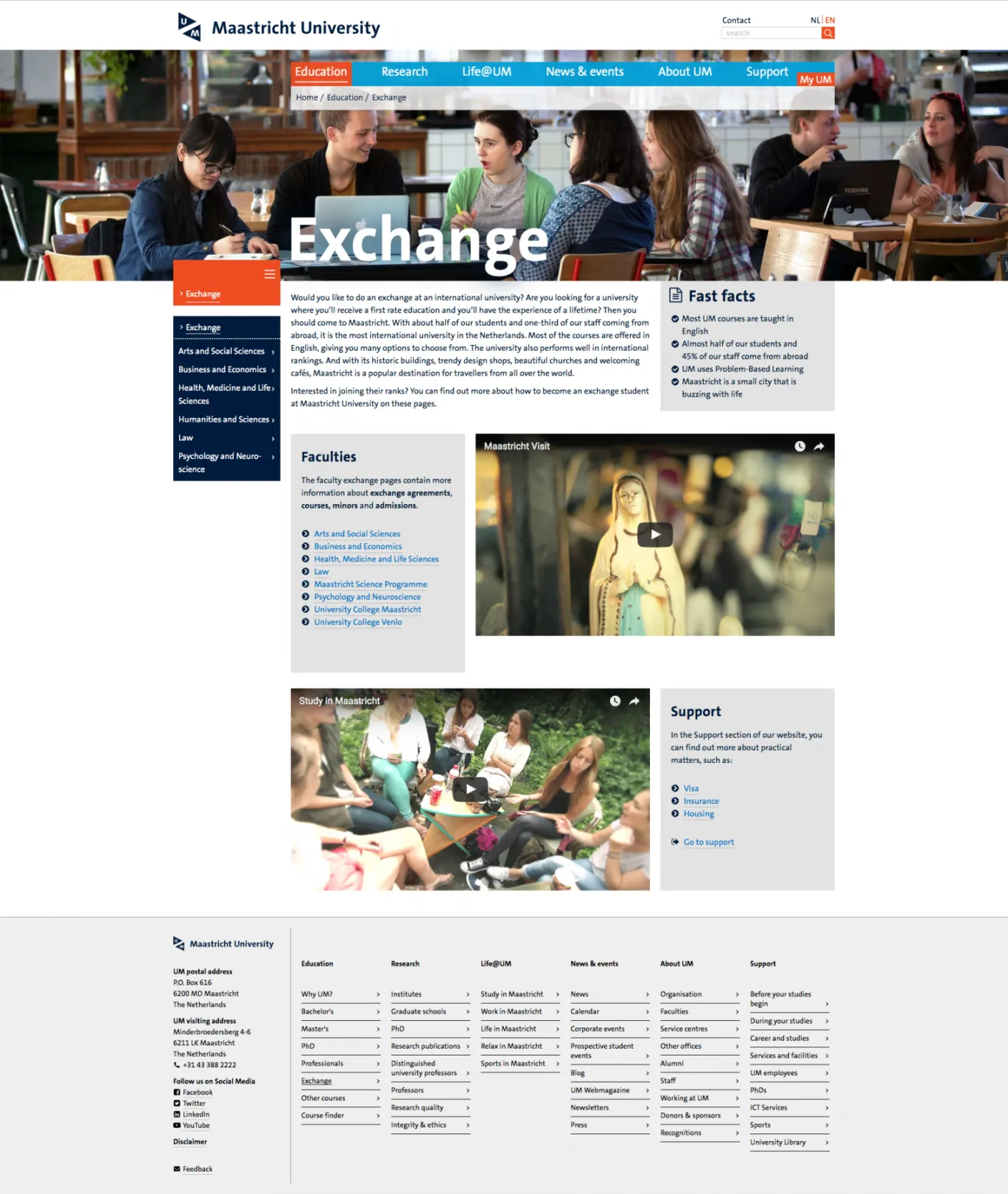
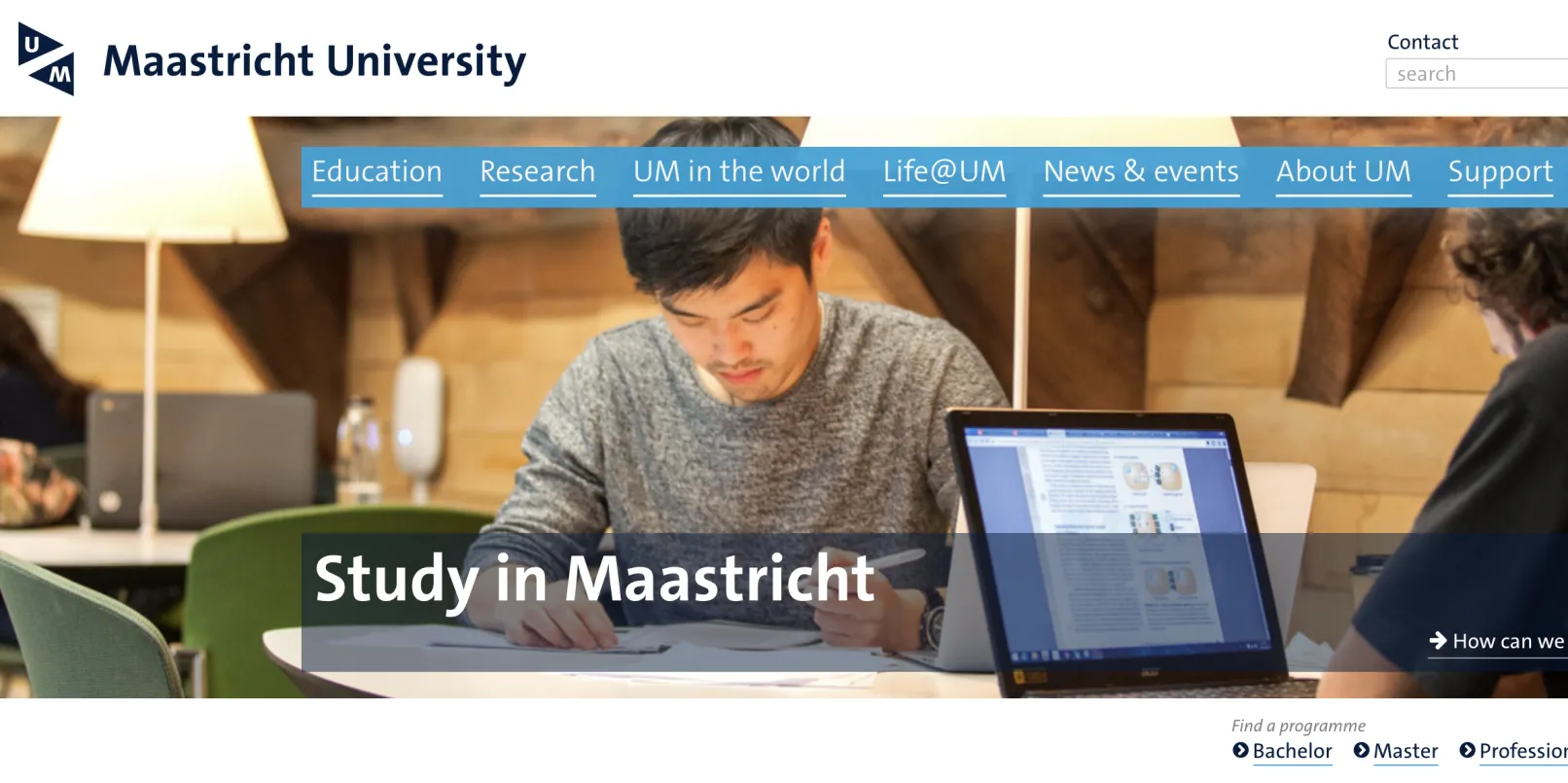
The UM website needed to be renewed. Students, staff and externs indicated that they could not find the information they were looking for due to the unclear menu layout and the inadequate search engine. The purpose of this project was to provide the visitor with the right information, at the right time, in the correct language and the correct format for the device he/she is browsing with. Ultimately, satisfaction with the UM's digital information will result in sharing this information with others.
In co-operation with two parties, one for an extensive communications strategy and another who developed a new corporate visual ‘language’ for Maastricht University, we started the discovery phase of this project.
Working together with the design team, the communications team and various stakeholders from the university we embarked on a journey towards a new digital strategy to build upon for the coming years.
Dozens of editors will be working to keep the website up to date. 8 workshops were held to find out what requirements the new website had to meet. After this initial inventory, we launched the implementation in October 2014. Due to the different nature of digital information that the University has to provide in the website, a connection was required with many systems, such as SAP, Hodex, Tripolis, UMAPI (enterprise service bus), Personal Profile Pages (PPP), Pure and SSO/ADFS. This technical challenge has been solved through the use of different interfaces based on web services. For the search of the various systems: we have used SOLR and Nutch on the website, affiliated websites and newsletters.
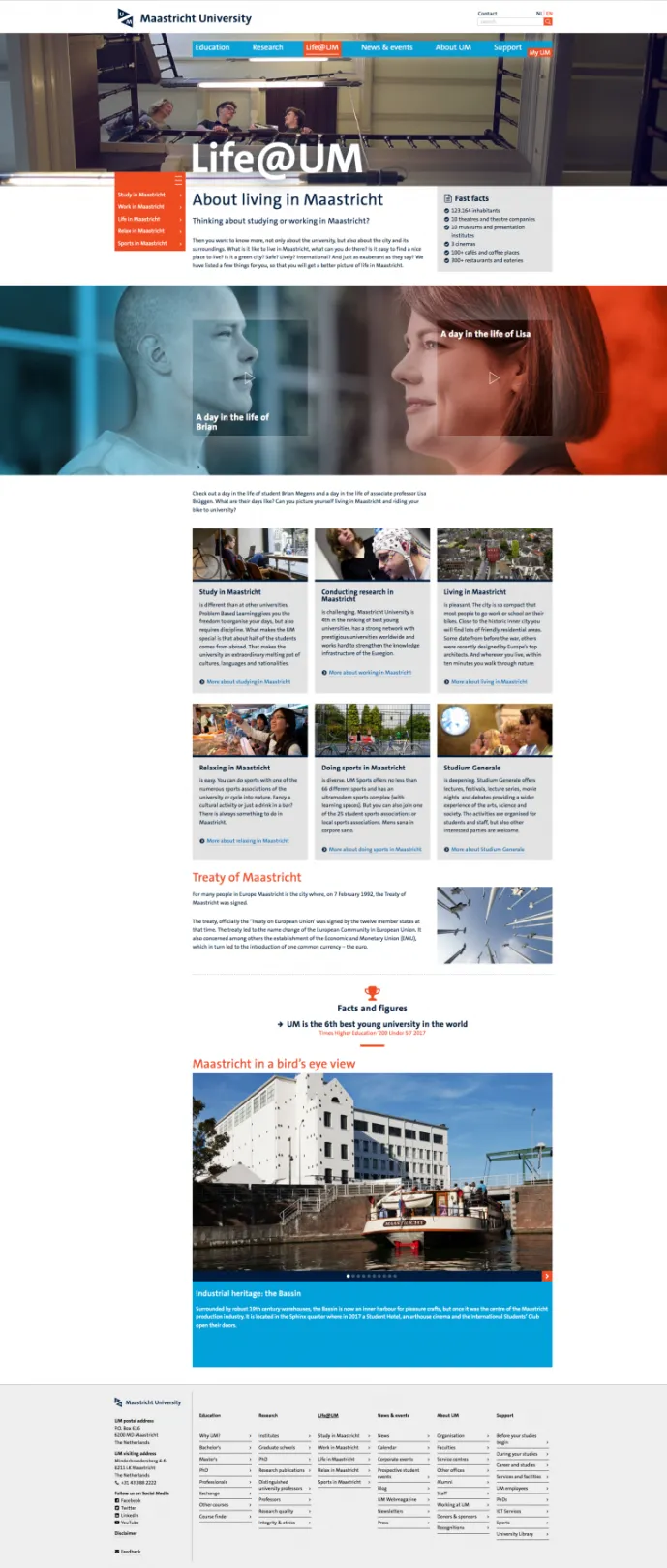
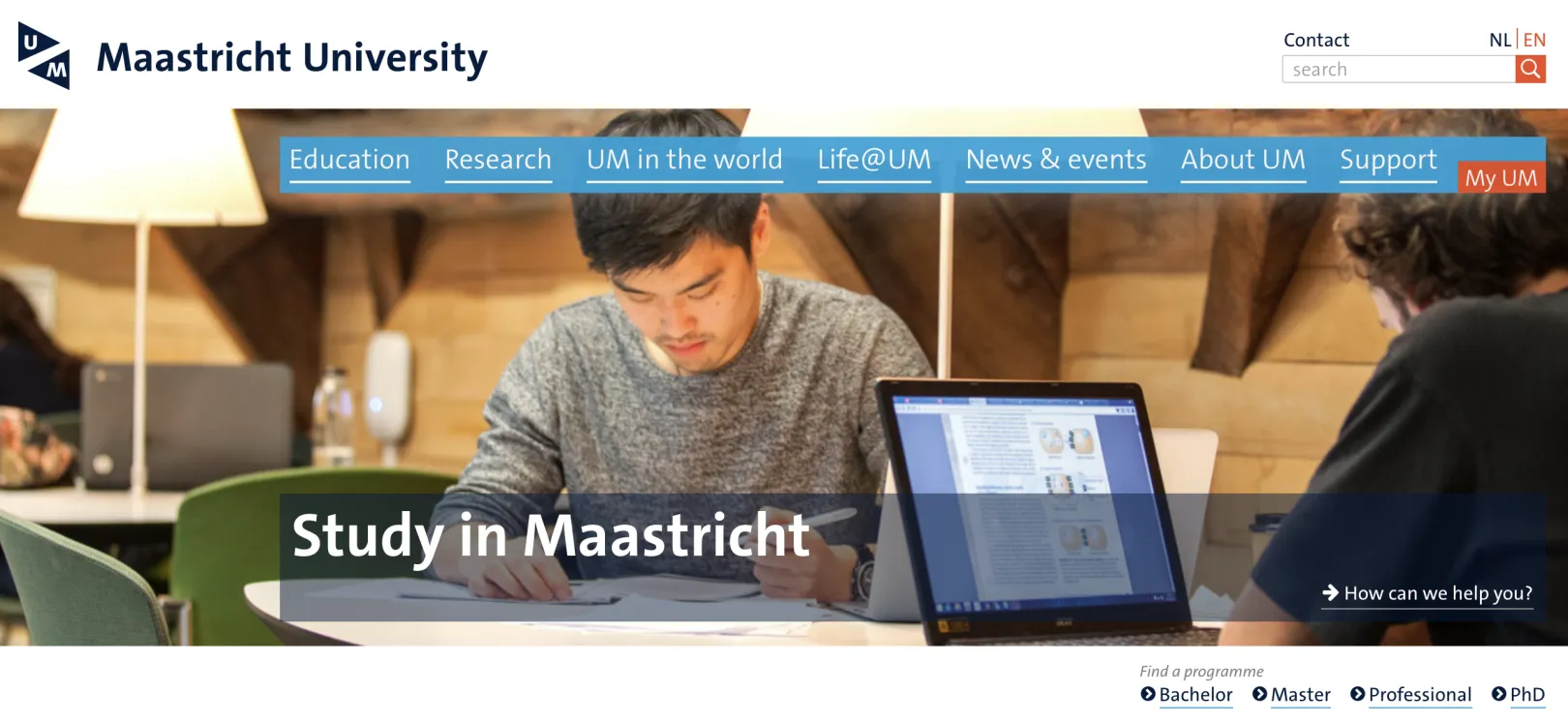
As a result, all the Maastricht University information is easily accessible through a logical menu structure and an adequate search engine. This includes extensive information on education (80 programs with 2400 courses), the organization units (faculties and service centers such as the university library) and research (research units, researchers and publications). The new website contains news, events and blogs. The old site with over 55,000 pages has been replaced by a new, more compact and customer-friendly site containing about 4,000 pages. The site is responsive and fluid for desktop, tablet and phone. In addition, editors can customize the pages with sections such as text, video, highlighted, publications, social media, personal profiles and photo carousel.
“What is different after two years of hard work? The site is ‘leaner’ with some four thousand instead of 55 thousand pages. And not unimportantly, it is visitor-driven. ‘Nobody goes to our website just for fun, there is always a reason, and for a prospective student the reason is different than for an alumnus or benefactor,’ says project leader Manon Gorissen.”
Gorissen is also proud of the way education, the members of staff and research have been woven together. If you go to a bachelor’s study programme, you get an overview of all subjects. At a glance, you see who is the block co-ordinator, while another click will reveal all personnel information and publications. ‘Together with the library, we have started the PURE project, which lists researchers’ publications. We have managed to link that to the website.’” Source: Observant Online
Why Drupal was chosen
The previous website consisted of approximately 55.000 pages where the correct information was hard to find. Cutting down to a lean 4.500 pages and presenting those in a clear concise way, connecting to various systems like SAP, HODEX, Tripolis, UMAPI, Personal Profile Pages and Pure, giving users access through an ADFS connection, those were only some of the challenges put before us. Searching these and associated websites was another.
Technical Specifications
Drupal version: