Sector(s)
Team Members
Project Team
One Project Manager
One Technical Lead
One Usability Specialist
Two Designers, one of which was the Creative Lead and directed the strategy of all themes
Two Drupal Developers
One Quality Assurance Specialist
One Systems Engineer
In November and December 2011, New Target, Inc. officially launched a suite of websites implemented in Drupal 7.9 for the Legal Services Corporation (LSC) – an independent government agency that is the single largest funder of civil legal aid for low-income Americans in the nation.
About the project
Introduction and Background
LSC envisioned their website to be the comprehensive resource for low-income individuals to find legal assistance – yet their one-stop website was actually a collection of 6 unique websites. The multi-site aspect served not only as a technological hurdle to overcome but also as a stakeholder consensus hurdle because website ownership was spread across multiple program offices. To achieve LSC’s vision, the websites needed to be simple to navigate, easy to update by LSC staff, and integrated closely in navigational flow as well as branding to provide a seamless user experience. Internally, the websites needed to encourage efficiency, communication and collaboration among Board Members and staff by providing a unified content repository from which to manage all websites.
To best understand the needs of each user (external and internal) and properly architect the websites, New Target undertook the facilitation of an in-depth requirements gathering and information architecture process with staff members, stakeholders, and site users, who gave diverse, yet valuable, insight on content priorities, design elements, work flows, user roles, and more.
Design and Functionality
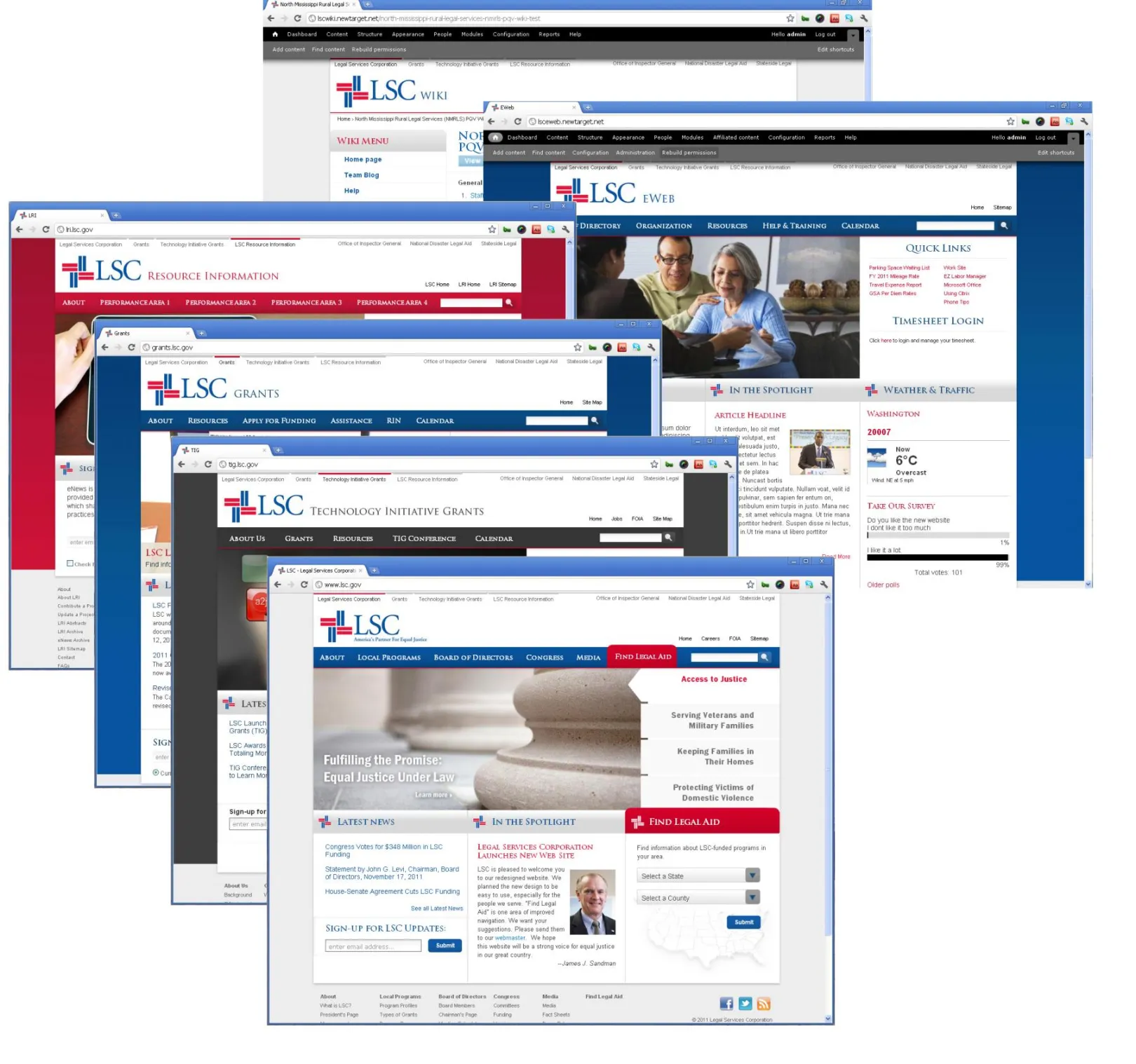
The following sites were architected, designed, developed, tested, and deployed under one Drupal 7 installation, giving each LSC Web administrator the ability to manage the collection of websites from one CMS with one login:
Four external public sites
- LSC.gov
- Grants.lsc.gov
- TIG.lsc.gov
- LRI.lsc.gov
One password-protected intranet site
- LSC eWeb (not publically available)
A working group model for select users operating as an internal, password-protected “wiki”
- LSC Wiki (not publically available)
The sites leverage multi-language support and are compliant with Section 508 of the US Rehabilitation Act. Additionally, they are optimized for search engines.
External SQL Database Integration
New Target utilized the standard internal MySQL databases as well as integrated a Custom SQL Server database to render information dynamically. This legacy 3rd party SQL database maintained the statistics and other data relevant to their programs and is a critical part of providing a comprehensive experience to users seeking legal aid. New Target was tasked to implement a search-able widget that queries the SQL database and retrieves data. Both the ‘Find Legal Aid’ block on the Home page and Find Legal Aid page are integrated and populate from the SQL database (http://lsc.gov/find-legal-aid). Additionally, the Program Profiles page uses views to query SQL database and retrieve state specific data (http://lsc.gov/local-programs/program-profiles). This SQL integration is yet another example of Drupal 7’s evolution as a platform for web development and the interoperability efforts well underway at Microsoft (http://www.microsoft.com/en-us/openness/default.aspx).
Taxonomy
New Target organized the entire LSC Resource Information website using a controlled taxonomy module. LSC administrators of the site have the flexibility to add to the vocabulary list and tag content as needed. The menu structure is based on Taxonomy vocabularies and it is auto generated each time new vocabulary terms are added with projects. This module gave LSC a simple way to organize the content and allow for accurate searching by site users who need a comprehensive, intuitive legal resource.
Infrastructure
The website is installed on a VMWare ESX 4.0 quest running Centos 5.6. LSC has allocated 2 CPU cores, 12 GB RAM, and 60 GB disk space. Originally, New Target provided LSC with a VMWare image, which they simply converted and loaded onto the LSC VMWare system allowing them to point the DNS to the new IP addresses. During the launch New Target assisted LSC in trouble shooting common issues in their network that were impeding site functionality.
Lessons Learned & Conclusion
Building this site required a significant level of effort on the technological and project management fronts. We learned new things and were reminded of timeless aspects of all web projects. Those we’ll keep in mind on future projects include:
- We chose Drupal 7 to have the most recent, stable version of core Drupal features; however several of the modules functioned best on Drupal 6. This didn’t prevent us from using the modules; it simply added a layer of complication and additional time to configure the modules correctly. We watched Drupal 7 mature rapidly during the course of the project but were reminded that software matures as well.
- The level of information architecture strategy needed for coordinating URL paths and breadcrumbs on deep level navigation can’t be underestimated. This small technological quirk of Drupal 7 and the infrastructure needs reminds us that hurdles always arise that no one could have anticipated and, after a check of all forums and groups, no one at the time had experienced either!
- Migration, migration, migration or content, content, content. When evaluating a website the content that is present is not just an entry in a database. It may have been stylized and created just for the “wrapper” of the old web templates or the overall messaging strategy manifested in the Information Architecture. Trying to fit a square peg in a round hold never quite works and sometimes a client’s content needs to be rewritten and reformatted extensively.
- No matter how far we think web technology has progressed there is always a creative friction present between form and function. A great deal of ink and pixels has been dedicated to this issue over the years in web industry magazines and we’re sure it will continue, but there will always be tough choices to be made in web projects that should always give the client the best possible solution for their needs.
The websites are a strong voice for equal justice in our country and play an integral part in supporting LSC’s mission “to promote equal access to justice in our Nation and provide high quality civil legal assistance to low-income persons.” New Target is proud to have been a part of this important government web project and looks forward to supporting many more government agencies with Drupal powered web properties for years to come.
Why Drupal was chosen
Drupal was chosen because of it's multisite functionality.
Technical Specifications
Key modules/theme/distribution used:
Mobile Tools: Through the use of this module, New Target was able to feed select pages of the sites for customized display on iOS and Android mobile devices. This module allows the mobile version of the site to be manageable from the administrative panel of LSC’s Drupal 7 CMS. Additionally, given LSC’s and the federal government’s utilization of Blackberry mobile devices, New Target created custom style sheets for Blackberry devices.
Books: New Target faced a business requirement to create a collection of working groups, each of which allowed only a select set of individuals to access and contribute to the group’s content. Although originally conceived as a Wiki module implementation, once requirements gathering was complete and the business needs defined, the Wiki was deemed unsuitable to meet LSC’s unique needs in this area. New Target researched several solutions and chose the Books module as the best fit to accomplish the necessary functions for LSC. With the Books module, New Target was able to provide an outline-style content organization that satisfied LSC’s expectations. More importantly, New Target was able to seamlessly extend user access settings managed at the book level to its various content pages or “chapters”.