Sector(s)
Team Members
Project Team
The site was built by DesignHammer staff: development by @amandahart, theming by @Frank Yonnetti and project management by @Michael.Nicholson.
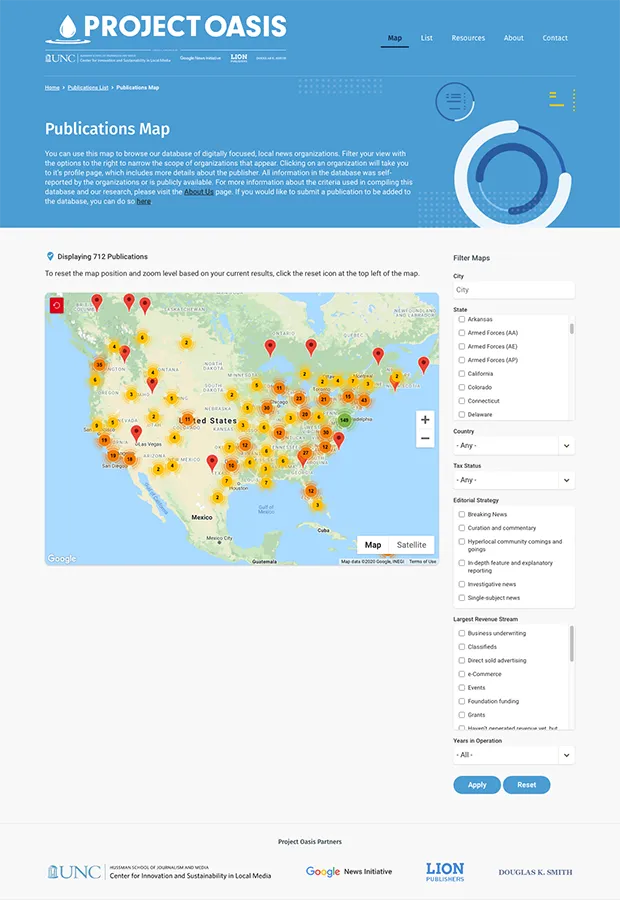
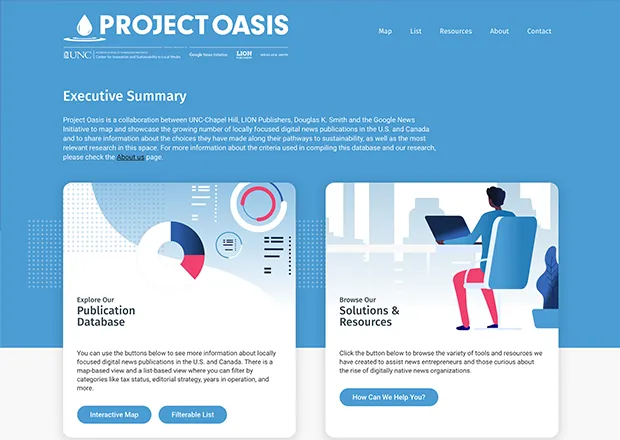
Project Oasis is an initiative designed to showcase the location of surviving independent digital news organizations across North America and to document their growth. The project is a partnership between The UNC Center for Innovation & Sustainability in Local Media (UNC-CISLM) an initiative of the UNC Hussman School of Media and Journalism, The Google News Initiative, LION (Local Independent Online News) Publishers, and Douglas K. Smith.
In 2018, DesignHammer collaborated with UNC-CISLM to update and maintain the precursor to News Oasis: US News Deserts, a resource website dedicated to identifying geographical gaps in local news sources across the United States and Canada. With a focus on sustainability, the Project Oasis partner organizations were interested in designing a website that would ultimately help locally-owned digital news organizations grow and thrive.
About the project
Goals
The goal of Project Oasis was to create a publicly accessible industry database of local independent news publications through which peer organizations could identify and contact one another to share useful business practices and apply newfound knowledge to the growth of their own organizations.
Requirements
The main requirement of the Project Oasis database was that it needed to be readily filterable, granting users the ability to view lists of organizations that adhered to various qualifying attributes, such as location, communities served, products offered, distribution methods, and editorial strategies, among other criteria.
Outcome:
Of the 700+ organizations that responded to UNC-CISLM’s request for organizational information, 273 individual publications responded with enough data to build out a comprehensive profile for each organization. Profiles were still created for the remaining publications, but only included information sourced from the IRS and the organization’s official website, including organization name, location, website link, tax status, and number of years in operation.
Due to the large amount of information that needed to be displayed in all three custom UI elements (Publication profile, Publication list, Map view), DesignHammer built and designed a custom theme for the project. The look and feel of the Project Oasis site was inspired by the original US News Deserts website, but was modernized to provide an improved user experience.
DesignHammer deployed a “soft release” of the new Project Oasis website to allow organizations that contributed data to review the site before it was publicized by the project’s sponsors. The new Drupal 9 website delivered design and functionality that exceeded UNC-CISLM’s expectations. After the soft release, 80% of the 273 new organizations that had contributed to their publication profile provided a positive rating in response to a survey of how useful they considered the site to be for their organizational research needs.
Why Drupal was chosen
Drupal 9 was selected to be the Project Oasis CMS for a number of reasons, including the ease of importing CSV data of previously acquired and future organizational data to populate and update the dataset. Drupal's Views system also allows for complex data sets to be displayed and filtered in a variety of ways and was utilized in the Project Oasis site to build both the list and map of publications.
Technical Specifications
Drupal version:
Key modules/theme/distribution used:
Drupal 9 Core
Based on project requirements, Drupal Core was selected as no distribution offered a significant return on investment over Drupal Core.
Feeds
The Feeds module allowed for importing new or updated datasets in bulk to update the database, and was mainly used to import data from Google Sheets where the Project Oasis staff had already collected information.
Views Data Export
Views allows administrative views for the News Oasis staff to perform data analysis and/or edits on the data collected. The Drupal Views module was also used to present and sort the filterable criteria available to be displayed in a geographic visualization supported by the Google Maps API, in addition to a filterable list view.
Google Maps API
The Google Maps API was used in conjunction with the Views module to support placement of map pins, map pin content, clustering, and interactive map elements.
Better Exposed Filters
The Better Exposed Filters module was used to allow for fully exposed lists of taxonomy terms in scrollable boxes to make it easier for a site visitor to understand the filtering options.
reCAPTCHA v3 and CAPTCHA
The reCAPTCHA modules were used to reduce spam submissions of contact forms and the publication update form in a manner that is less intrusive for site visitors.
Webform
Webform was used to build out the contact form and publication update form to allow for site visitors to submit normal contact requests as well as submit changes to their organization's profile (or submit new organizations) for the Project Oasis staff to review for inclusion in the database.
GoogleTagManager
GoogleTagManager was used to integrate the site with Google Tag Manager (GTM). GTM will be used to track a variety of analytics events for the Project Oasis site.
Metatag
The Metatag module is used to allow more control over various SEO-relevant settings and metadata. This allows the Project Oasis staff to better represent the content on the site for more accurate listings in the various internet search engines.