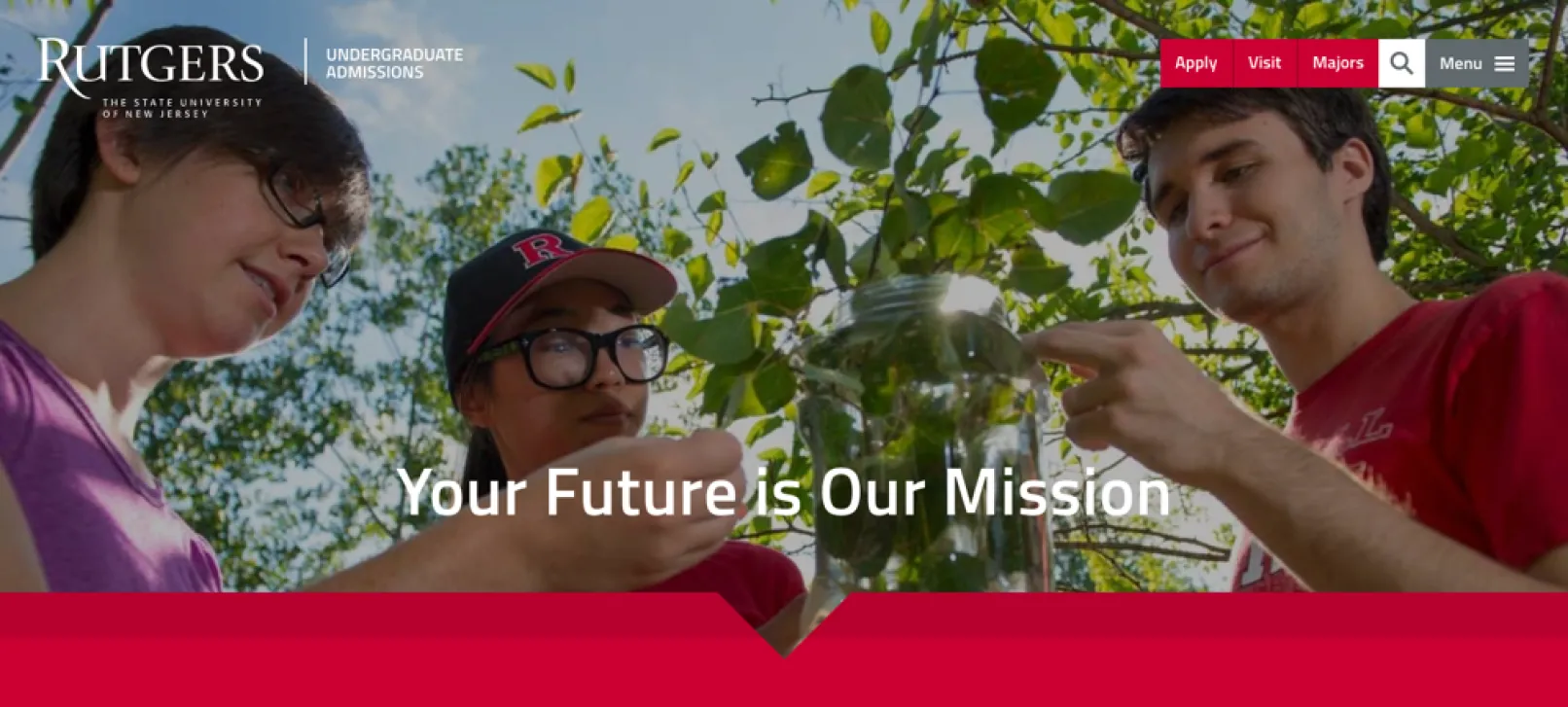
Visit the site
Visit the siteThe Rutgers University Undergraduate Admissions website serves as an application portal that prospective students can use to apply to any of the three Rutgers universities -- Camden, Newark, and New Brunswick. By providing distinctive information about what each school is like and what each school has to offer, the website guides students to apply to the right school for them.
Rutgers University chose iFactory to develop a streamlined, fast solution that made it easier for prospective students to apply to the Rutgers University of their choice on both desktop and mobile -- and that led us to Drupal 7.
About the project
Goals and requirements:
Rutgers University Undergraduate Admissions (UUA) came to iFactory for help with a redesign and rebuild because the site had earned a reputation for perpetuating the "RU Screw," in which students learned too late that they applied to the wrong school. The existing site infrastructure led to confusion because the three universities and the admissions office all lived on separate admissions sites. Our task was to merge all the admissions sites into an experience that would seem like a single site to the user but would exist as four separate Drupal 7 sites, all hosted on Pantheon. The final result needed to showcase each university's brand while still directing students to the academic, student life, and application information they needed.
Our developers had to consolidate four separate sites. Two were on Sitefinity (the Admissions office and Rutgers University—New Brunswick), and two were on Drupal (Rutgers University—Camden and Rutgers University—Newark). Bringing the four sites together was one thing, while reorganizing, restructuring, and redesigning the content was another. To improve Rutgers' ability to recruit students, we architected and designed a Find Your Major tool, a fully responsive menu, and a new Applying landing page.
To create the Find Your Major tool, our developers had to merge program data from all three Rutgers universities into a single display that showed one program and color codes indicating which universities offered the program.
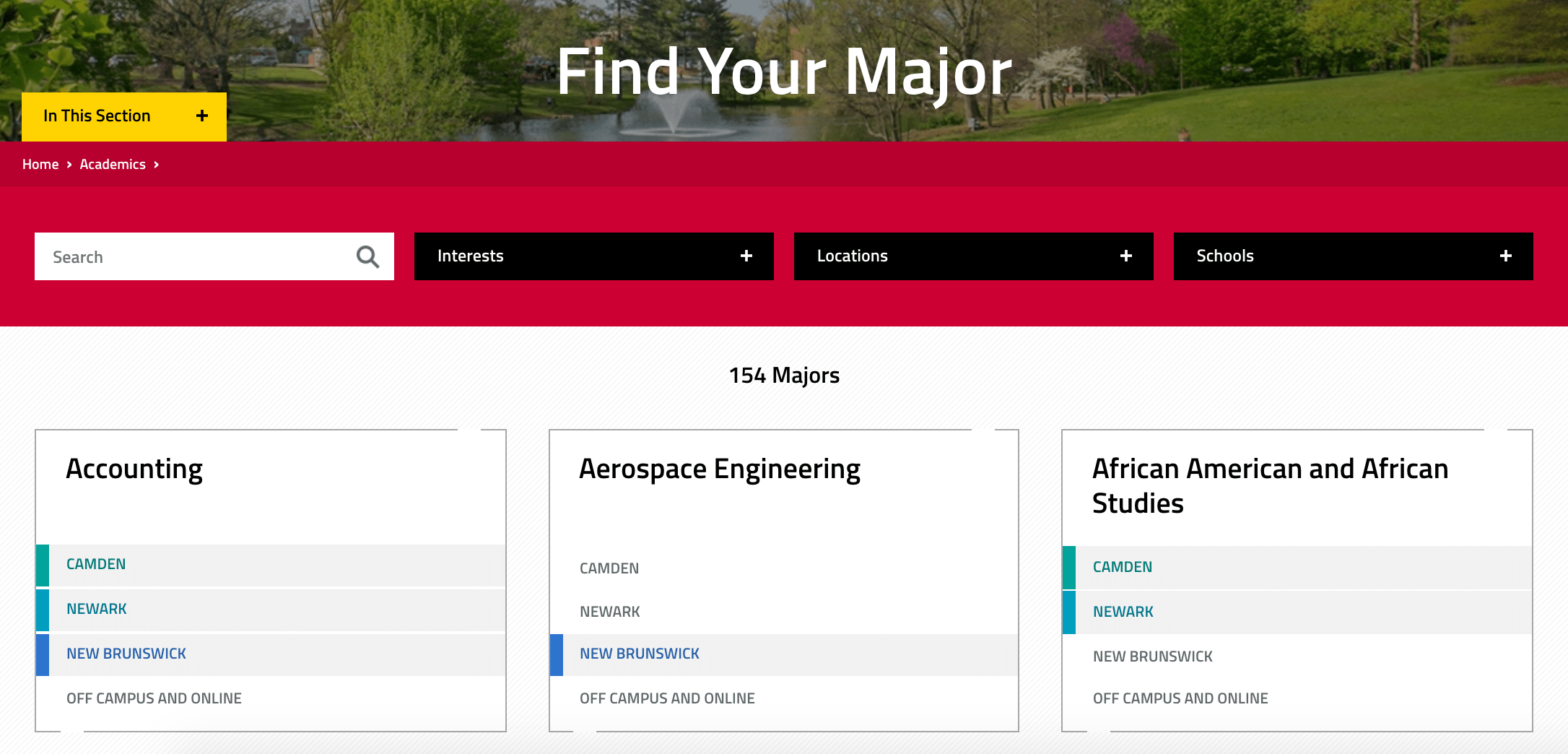
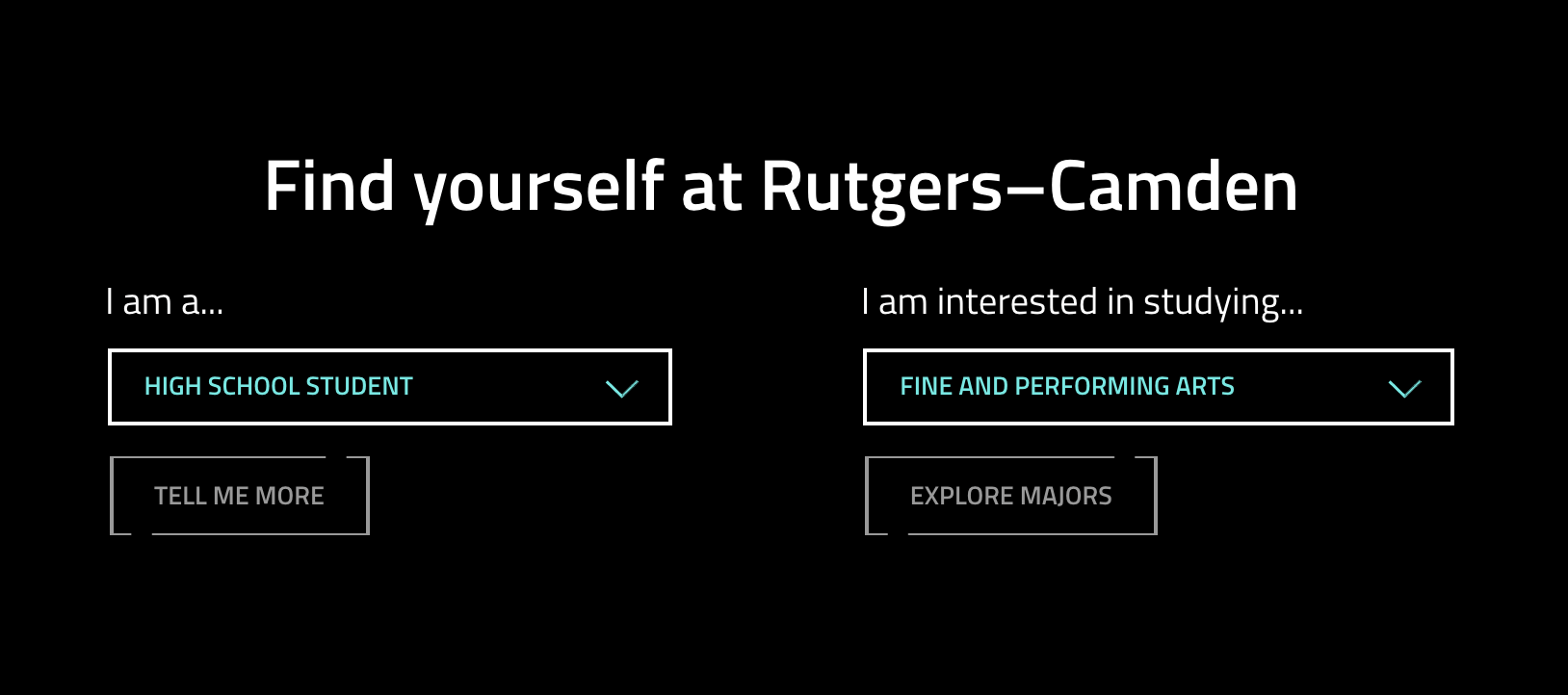
Students who visited the university sites first could also access the Find Your Major information, which lived on the admissions site, by selecting an interest. Then the university site would redirect them to a set of results from a feed filtered by interest and university.
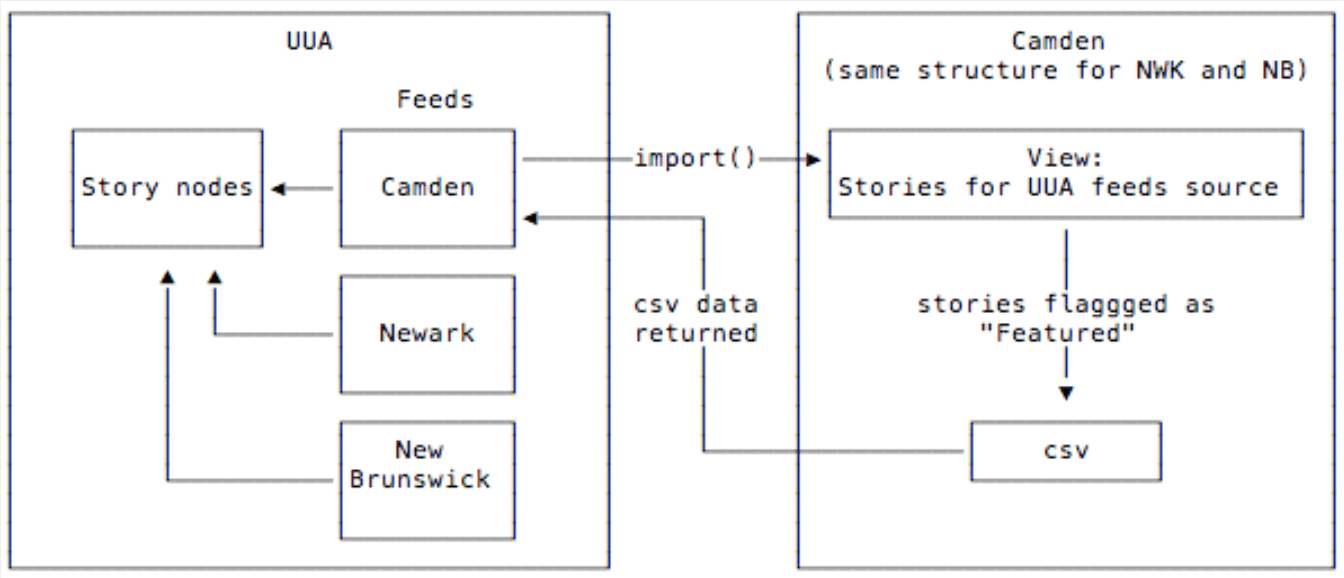
The site also included student stories that would display on individual university sites, some of which would need to be fed into the main admissions site whenever an editor indicated that the story should be featured. The Views system, which is built into Drupal 7, generates .csv data from the stories on the individual university sites on the fly, and the UUA website's feeds draw on this .csv data to populate the student stories on its pages.
As our team worked, we also needed to keep in mind that we had four clients, not just one. All three universities and the admissions office wanted to evaluate our progress separately, which meant each site had two remote repositories and each site had four server environments.
The entire project is evidence of our development team's considerable organizational skills.
What we learned and outcomes:
Given the complexities of four server environments, three universities, two separate repositories, and a partridge in a pear tree, our team advised spending additional time early in the project determining whether or not the content should share a codebase and a database. They also recommended locking down the host before development, as a change in hosting affected the repository structure.
Through the Rutgers UUA project, our developers also took a crash course in accessibility since it is critical that university websites meet WCAG 2.0 accessibility standards to avoid potential lawsuits or OCR complaints. iFactory makes accessibility a priority and weaves best practices into every step of its design and development process. Our front-end designers and developers test the code of our Drupal developers, and our Drupal developers go back and make the changes.
This project was a complicated endeavor that resulted in a tremendous payoff. Rutgers UUA reported the following metrics:
- Greater than 30% combined improvement on recruiting results for this year over last year
- More than 1.5 million sessions on the core website since launch, a huge improvement over the past year
- A 40% reduction in the bounce rate from the old site
Beyond the numbers, the site won a GOLD Award with CUPRAP, a professional organization for college and university marketing professionals.
Why Drupal was chosen
To recreate a design that looked good on all devices and clearly distinguished the three universities, we needed the most flexible CMS we could find. We also knew that Drupal 7 would deliver a consistent experience and site performance. This hadn't been happening before because students had to jump from one site, one design, and one content management system to another.
Technical Specifications
Drupal version:
Key modules/theme/distribution used:
Our front-end developers were already fans of AdaptiveTheme thanks to its clean markup, and the way the pre-defined regions aligned with the Rutgers UUA design meant we could get going quickly.
Display Suite provides an unbelievable amount of flexibility while enabling site builders to do a lot of heavy lifting. It's extensible in ways that fit "The Drupal Way" like a glove.
Features was helpful for deployment and replication of a few critical components on the site.
Feeds and Feeds Tamper provided the best balance of developer control and usefulness for the client, and these modules also made the periodic delivery from the three University sites to the main UUA site much more manageable.
Paragraphs have become the building blocks of our sites. While we do a lot of custom paragraph work, the out-of-the-box paragraphs system gives us the ability to let clients build pages with more flexibility.
Search API lets us tailor the search results and indexing to our clients' needs, with relative ease.
Breakpoints, Focal Point, and Picture give developers ultimate control over the rendering of media on the site.