Sector(s)
Team Members
Project Team
In co-operation with Branding-Agency Scholtysik & Partner AG
Paul Scherrer Institute (PSI)
Visit the site
Visit the siteOrganizations Involved
Community contributions
Extensive performance tests were executed to handle the considerably larger and more complex content pages and menus. This resulted in performance related contributions to the Group, Tokens and Menu Trail by Path projects as well as Drupal core, specifically around multilingual modules.
Several improvements were also contributed to the BS Base project, the Bootstrap base theme that MD Systems uses for all projects, among other things to improve accessibility.
The earlier, initial relaunch of the psi.ch project on Drupal also resulted in many contributions to various projects, most importantly the Paragraphs project.
Our clients with service level agreement like PSI allow us to continuously maintain our contrib module ecosystem and release updates timely for compatibility with the latest Drupal core updates.
About the client
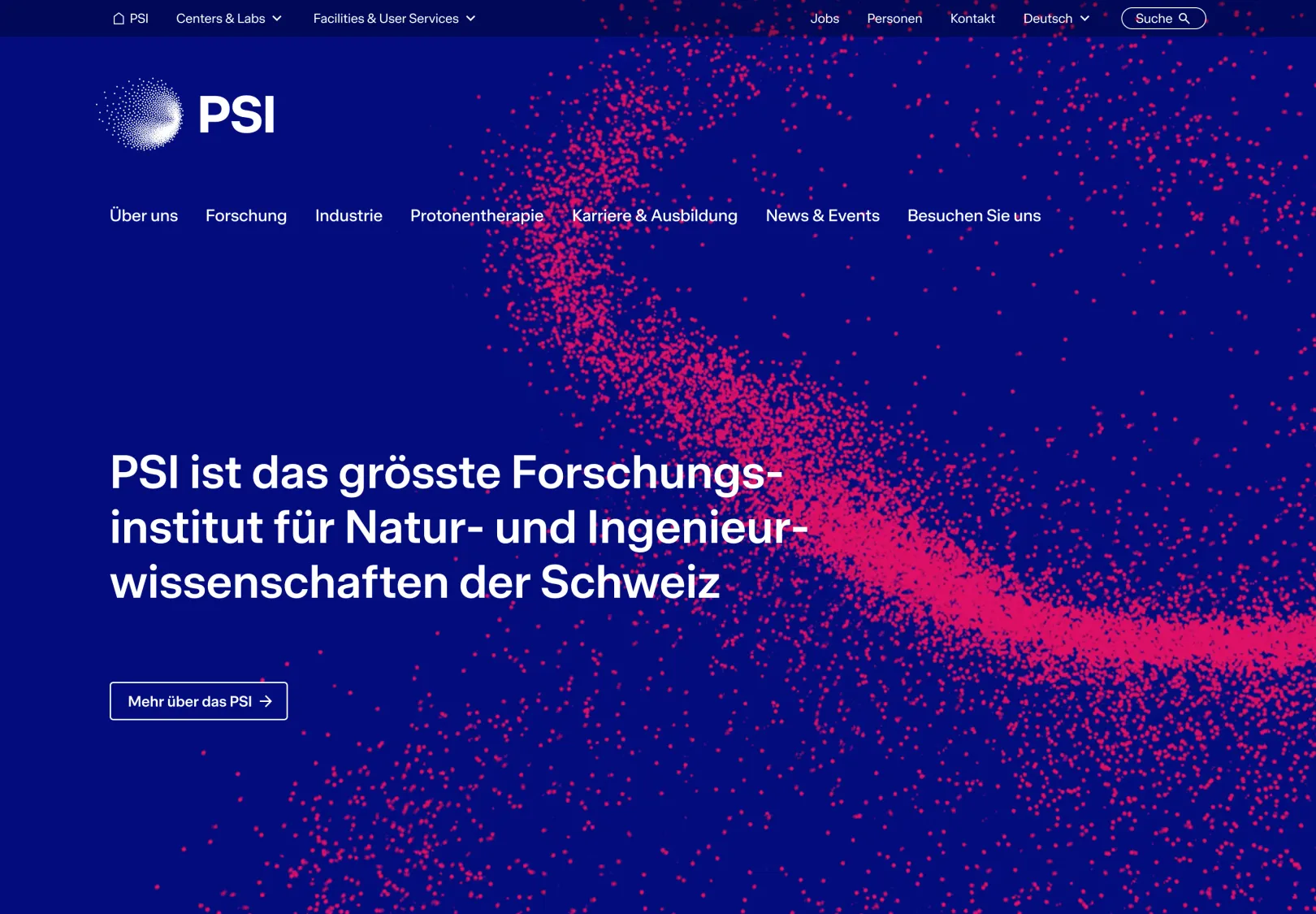
The Paul Scherrer Institute (PSI) is the largest research institute for natural sciences and engineering in Switzerland. It is the central location of Switzerland's largest research facilities and conducts cutting-edge research in the areas of future technologies, energy and climate, health innovation and the fundamentals of nature.
Prelude
MD Systems was chosen in 2018 in a public tender as a service provider for the relaunch of psi.ch and the system was migrated to Drupal. The relaunch project came with the strict requirement that the previous design needed to be reimplemented exactly as before.
This was followed up by a rebranding project that did not only cover the website but the whole organization, from office document templates to street signs. The branding agency Scholtysik was chosen in the public tender to provide the new brand while MD Systems remained responsible for the implementation and also consulted PSI during the whole process, from preparing the public tender, selection and supporting the transition to the new brand on the website.
About the project
Goal
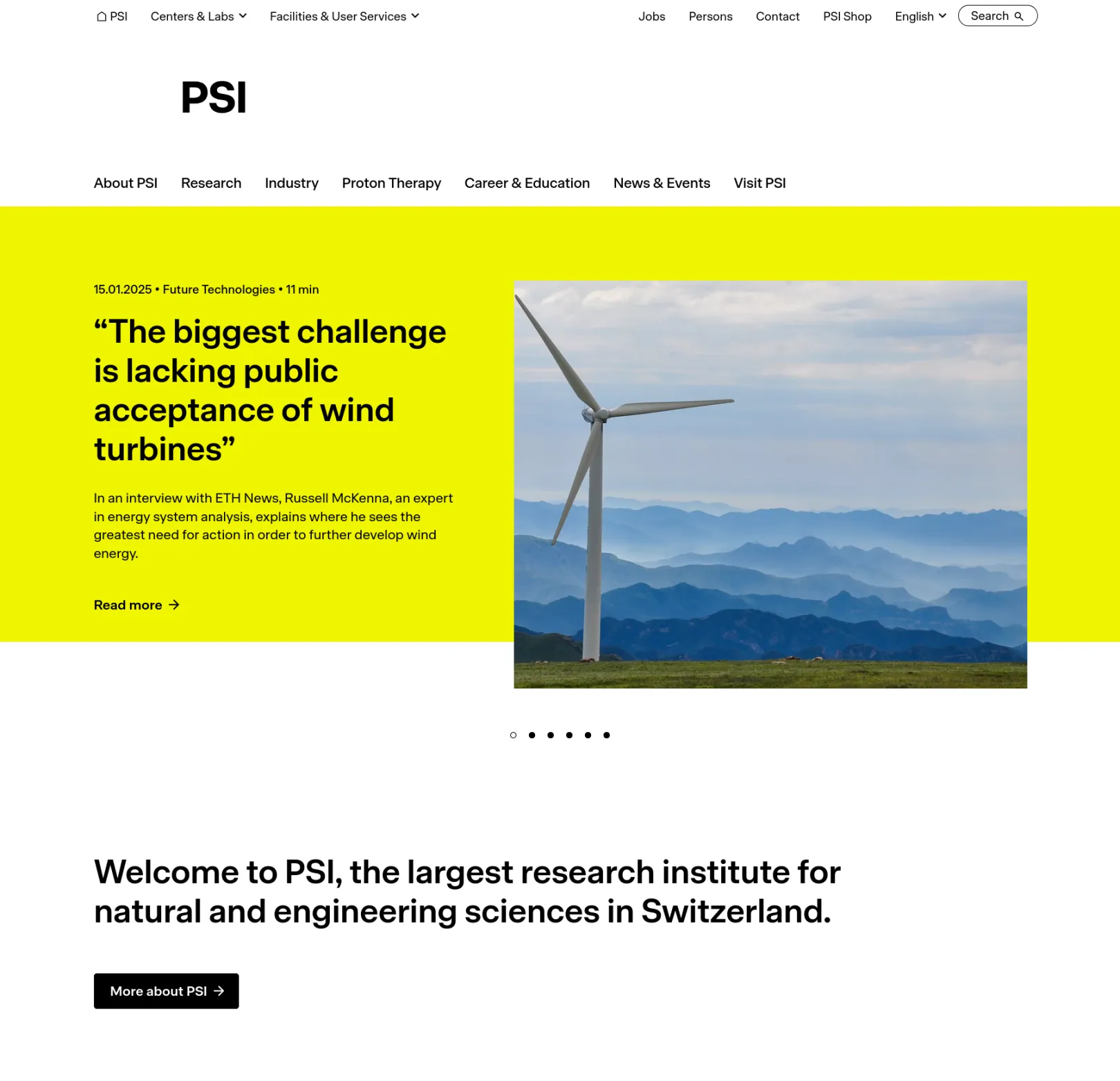
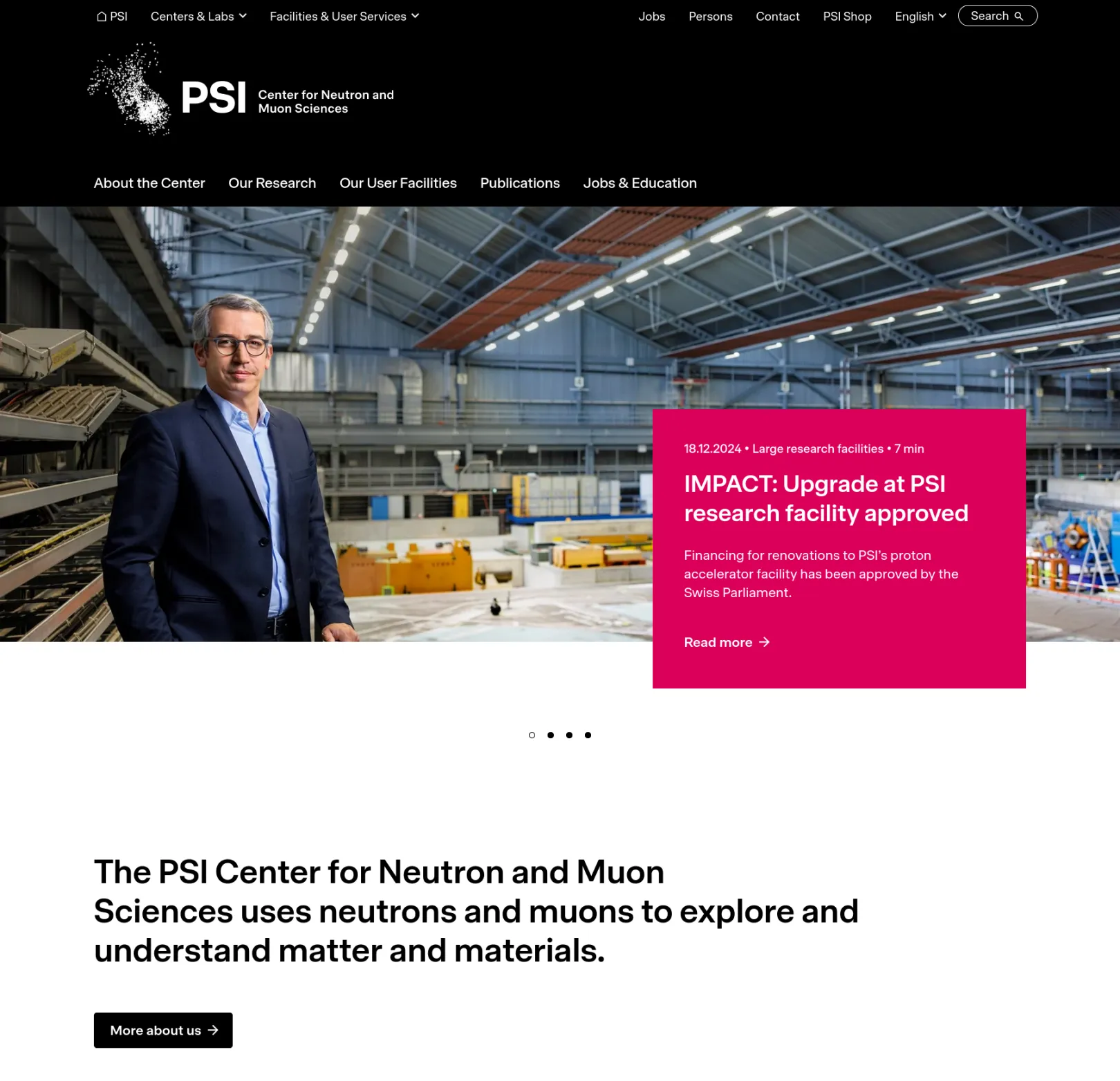
The goal of the rebranding was to visually distinguish the PSI from other research and development centers in Switzerland. Strong, clear and in permanent movement but as a clear unit. The difference and modernity should be noticeable in every logo and on every subpage of the PSI. The navigation on the website should be intuitive (for students, developers and interested parties, short; for everyone) and the structure should be memorable. The website should be as clear and structured as the logos of the individual centers. Creating a unity with all the individual centers and their characteristics and needs. The scientific aspect is perfectly staged and rounded off by the precise language, clean typography and high-quality photography.
Content Transformation
The rebranding required content changes at a large scale. Many public-facing content pages were completely replaced with new text and media assets, the new center overview pages were introduced, navigations of many sub sections were redone and many of the 15’000 pages required smaller and larger changes to account for new design elements and the overall layout of the page.
At the same time, the 200 organization units and hundreds of editors needed to be able to continue working with the website, there are thousands of scientific content pages by researchers for researchers as well as their personal research profiles.
Editors worked on the production environment, some changes could already be published, others were prepared as new pages.
In frequent intervals, from the start of the project, all content was synchronized to a test environment. There, the automated transformation scripts applied the prepared reorganizations, pages were published, links updated and automated redirects set up to ensure that all pages were still found by external search engines. 3000 scientific and general news articles were retagged, their content restructured to adapt it to the new design and moved into different organization units. Various content elements were updated at scale, such as replacing the previous mostly grey highlight elements with the new branding colors, possible intro texts were automatically identified, media assets adjusted to the layout changes.
Why Drupal was chosen
PSI evaluated possible CMS solutions as part of its tender to replace the previous website and already decided on Drupal as part of that process. MD Systems won that tender in 2018 and relaunched the website within a year.
The successful project and resulting improved editor experience and flexibility confirmed that Drupal was the right choice for this website.
The current platform was re-assessed to verify whether it could be used as the basis for the rebranding project or if a new platform should be developed and the content migrated.
We were able to confirm that the existing platform was still a solid foundation and the strong API capabilities and stable content structures of Drupal allowed us to support the client with an automated in-place transformation process. This was considerably faster than a complete migration into a new site, resulting in a faster review cycle and fewer constraints for editors during the project phase.
Technical Specifications
Drupal version:
Key modules/theme/distribution used:
Key modules + reason
-
Paragraphs: Complex and varied content pages, high flexibility for content editors. Paragraphs provides the necessary flexibility while retaining content structure that allow various integrations from and to integrated third party sites such as importing job offers, dynamic research papers listings and exposing articles to a shared research news website.
-
Group: Website is structured into ~200 organisational units, editors are restricted to editing content of their groups. Content, Media Library, Paragraphs Library and partially Taxonomy is split by its primary group assignment. The group module provides a flexible framework to manage access and configuration for each of those units.
-
simpleSAMLphp Authentication: Editors authenticate through SAML Identify provider of the client, editors are automatically assigned to their groups based on their organization unit.