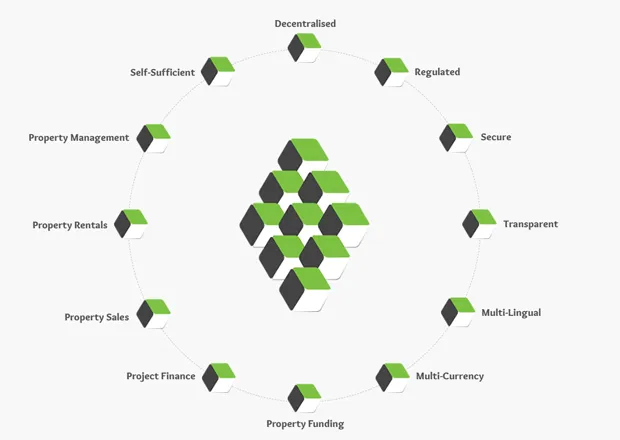
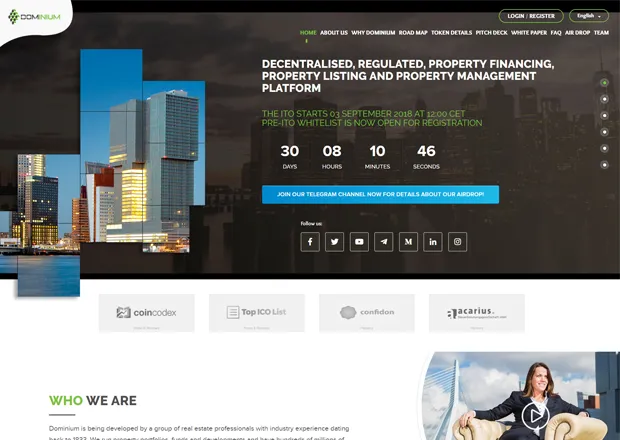
Dominium is a website based on crypto currency. It is being developed by Munte Immobilien and Max Property Group(Netherlands). It is a blockchain-based platform. . As the assets are created on the blockchain ,they will of course be 100% transparent and liquid. The Dominium childchain decentralises the trade of assets and places rental agreements, purchase agreements, property management tasks and more on the blockchain. Through this website, a user can create his/her account and buy DOM tokens and enter in to the world of Crypto currency market. The user can also earn referrals by introducing others to this platform, by providing them with his/her unique referral link. Moreover, Dominium is underwritten by a portfolio of property assets generating an income and ensuring the future development and maintenance of the platform.
About the project
Goals
This project was not a simple one dimensional project. This project had multiple layers and staged roll out plans. The initial goal of the project was to set up a basic platform for people to register and put in all their details, complete and submit KYC and then be able to browse some data like properties, charities etc. They also get access to the dashboard they showed them the key matrices. At this point, the client planned to start in depth and extensive advertising campaigns reaching out to as many users as possible across the globe and get them on board. For this they needed an email newsletter campaign builder, capable of sending 20,000 emails per day, based on customised templates and selecting recipients based on certain criteria. Also, they needed an extensive translation system, which was simply not possible with Drupal's native translation interface, though it definitely was a good base. Next in line was an in depth referral system. The client wanted to further reach out and lure users to refer others who would then join the platform using the referral. Referral benefits were provided in the form of DOM tokens, which later once the currency went live, users will be able to withdraw. While these things were happening and user registering and referral programme was becoming more and more successful day by day, we started to work on the main aspect of the site, the DOM token order sell. The Pre ITO and ITO phases were upcoming, and we allocated a section of the team to dedicatedly work on the these aspects. We devised out well thought out sell procedure based on extremely complicated conditions and restrictions. Pre ITO arrived and ITO arrived, both a huge hit. Next up, was the blockchain integration, which is at present underway. We are discussing the architecture and integrating the ARDOR API for this, and making steady progress day by day. In addition, there are constant monitoring work going on behind the scene, and a section of our team is steadily working making small fixes and maintenance polish ups, ensuring the site remains perfect and performant.
Detailed Requirements
Phase I
The purpose of this phase was to get us a basic platform. The main site was to be designed and then followed by dashboard. Following that basic registration and AML / KYC procedures needed to be set up.
Design of the Front end site and the backend platform
The main challenge was to design an extremely impressive landing page. The client was concerned because, he needed to put in and convey a lot of information, but he din't want to make the design boring. He wanted to make it extremely appealing and trendy, while not loosing out on the opportunity to display the necessary information. Our designing team did an excellent job on this, and after a lot of deliberation, discussion and going back and forth, finally we came up with a design that was appealing, interactive and informative. Next began the dashboard design. This needed to be simple, easy flowing and readable without too flashy elements and complications. Our designing team worked tirelessly on this and we were able to come up with a great layout. This would be modified time and again in the coming days, as more and more sections would be built.
User registration & initial steps
The main target at this point was to get people to start registering as soon as possible. We needed to have 2 registration types, company and individual. Each of them will have a separate set of fields to fill out later on. As soon as user register, a verification link would be sent over through email. Once confirmed, they would log in and set password. As soon as password is set, they would be asked to so mobile verification (this would be changed later on in favour of 2FA). This was mandatory step, and user would not be allowed to navigate to elsewhere without completing this. SMS code would be sent to their mobile number and user needed to add the code and validate it. Once done, the user would be redirected to their dashboard and asked to so AML/KYC.
Support Ticketing System
The next very important step was to make users submit their AML / KYC. But before that, we needed an in depth support ticketing system, since the AML/ KYC submission and approval would be tied to this. We built this system from the grounds up and implemented every single thing that was needed as per plan for this AML / KYC procedure, as well as for it's general functioning. This included the admin tools, like statistics on the ticket movement and an in depth status system for easy manipulation of the submitted tickets. once the registration was live, the client foresaw what this will be very crucial for his data team and we needed to make this absolutely flawless.
AML / KYC Procedure
Finally the last main bit for Phase I - AML / KYC Procedure. First of all, this would have 3 stages - Clearance Level I, II and III. Each having an extensive number of fields. The users would submit for one Clearance Level and then admin would be able to review and approve, reject or request change, based on what they have submitted. If any change was requested, then users would be notified and they would have to re submit the documentation. Once approved of one Clearance Level, user can apply for next clearance and so on. This entire process was tied to the support ticketing system and the entire system was a pain to build and test. But we were really amazed how good it turned out to be, once this was all completed, and people started to use it.
Phase II
The purpose of this phase was to build ourselves some very necessary tools before actually starting to implementing ITO and Pre ITO features which were next in line. The three main extensive requirements for this were an in depth translation system, a solid notification system and an extensive referral system.
Translation Mechanism Enhancement
With registrations flowing in from all over the world, thanks to client's ambitious marketing efforts, we soon had users from almost 120 countries. With this, became the need to be able to translate the site in all possible languages. And this was no one man's job. The client wanted to appoint translators from various countries, who would be given charge of a language and they would translate everything in the site to that language - website content, document links like pitch deck and white paper, email contents etc. Going forward this needed to be extended to other things that are built like newsletter, order for etc. We looked at the Drupal's core translation system. Though it was an excellent base, it was nothing compared to what was needed in order to achieve this. We understood we needed to come up with extremely creative and robust solution by using what was available and then build the remaining on top of it. After months of work, we did it, and it was really a proud moment for the entire team. We are using that system everywhere for last 8 months and it's functioning perfectly. With almost 110 translators using the system everyday, translating each new content into hundreds of different languages.
Newsletter & Notification System
Next in the line was the development of an in depth notification and newsletter system. The client wanted to build this system from the grounds up, in order to be able to send newsletter notification to all it's registered users, which by now, in just a span of few months has grown to over 40,000. He wanted to send almost 2 batched of newsletters daily, which means almost 80,000 emails going out. He wanted to also achieve a send out rate of 20,000 per hour. We after due research agreed to use Amazon SES service as SMTP. We were already using AWS for hosting and this served as a perfect fit. We did extensive coding for the entire newsletter system ensuring it was smooth to use by the client's data team and they could create newsletters and easily choose through interface the target recipient groups based on wizard and then send the newsletter out. We used the concept of multi concurrency queue in this case and used it as a drush command. Another mission well accomplished!
Referral Programme
Next and last bit, before we could move ahead with the ITO and Pre ITO sale set up was implementation of an in depth referral programme. Even though client's marketing campaigns have been super successful, he really wanted to push the pedal and wanted to spread out as much as possible. One great way of doing this was an extensive referral programme. The referral programme would work by giving an unique referral link to each user and once other users registered using that link, a certain DOM tokens would be awarded as referral bonus. Once the blockchain would go live, users would be able to withdraw these DOM tokens. The referral programme though look simple outwardly, behind the scene we coded two other major aspects of it. One was an in depth statistics report which would show which referrer referred how many users and then charts showing per country and per timeframe divisions so that client's backend team would be able to track the progress and take various corrective measures. And last but not the least, we needed to devise out an in depth mechanism of withdrawal mechanism for the amount that users got. We did a solid foundation work for this, but postponed it for later, as we realised this would be used more only after Pre ITO and ITO sales.
Phase III
Pre ITO and ITO sales mechanisms needed to be coded, so users could actually purchase DOM tokens.
Asset Creation and Sub-account creation
We detailed out the entire flow and then started with the asset creation steps. Though initially, only Dominium asset needed to be created, but for later, this would be used by others to create their own assets. Hence it was important to get this foundation right. We also needed to set up the approval process of this. Finally through the implemented mechanism we created DOM. With asset creation, we needed to create concept for sub accounts. So in a nutshell, the total coin offering would be broken down into sub accounts, like Pre ITO, ITO etc and then a price would be attached to it. Some sub accounts were created which was not sellable, and only admin could transfer tokes from and to that sub account. These were all accompanied by detailed logs , support tickets and email integration.
Order Forms
The next step was to set up order forms where users could purchase the DOM tokens. This needed an in depth currency conversion mechanism we we implemented a 3rd party API for this. This also needed a dynamic price switcher, as the sell was on, from pre ITO to ITO Phase I to ITO Phase II and so on, the prices of the DOM would change and the pay out needed to be calculated dynamically. This involved huge amount of complexity and an extensive handling of cub cases that branched out as we were going forward with the flow. Finally, after quite a few months of extensive effort all were sotted, and we finally made Pre ITO live, which was a huge success. Son ITO phases were launched and they were success as well.
Phase IV (ongoing)
This is the most important phase. Now that people have purchased DOM tokens and all going well, we are in the process of connecting the system to the blockchain. The client entered into an agreement with ARDOR and we would be implementing the ARDOR API. Starting from waller creation to node handlers all will he handled through the API. Extensive work is in progress regarding this, and we are hopeful in coming days this will be released out to public.
Outcome
We have overseen the project right from it's inception days, when this was just a pen and paper concept. And today, after 9 months of extensive work, the site has almost 45,000 users have have sold exceptionally well, for it's pre ITO phases and ongoing ITO phases. Needless to day, this has been a very strong bond with the client and his team, and we are still growing strong. Just like any big task, we have had our share of challenges, but we together, with hard work, dedication, talent and clear communication, have kept moving forward. This project is a huge success and so are we!
Why Drupal was chosen
When the clients came to us with the requirement set, we had a detailed review of the present requirement as well as the future plans for the product. We immediately realised that this product is going to be huge and needed to scale according to the needs. Not only the present feature set which was extremely complicated and demanded a solid foundation, the remaining roadmap was full of challenging features and client needed to quickly develop these in order to capitalise the market situation. Backed by an extensive and ambitious marketing plans, the client was looking for an extremely fast growing user base of this platform. Drupal was obviously a choice owing to it's history with some of the largest and most popular platforms in the world right now. According to us Drupal's awesome community including it's vast array of contributed modules would help us to develop things faster on one hand, and it's powerful developer's API would enable us to create necessary intricate features required for this project. Client wanted us to give a presentation on why Drupal would be suitable for their platform. We explained them in detail and finally upon doing some research themselves, we reach a consensus to develop this platform in Drupal
Technical Specifications
Drupal version:
1. Chaos tool suite -CTools is used by Views, Views Slideshow, Webform. It's also required by popular layout modules such as Panels and Display Suite.
2. Views - Views is the way to organize content in Drupal.
3. Token - allows to create re-usable patterns across your site.
4. Libraries API- it is a foundational module. It's an essential part of the WYSIWYG and Colorbox module and powers several Views Slideshow features.
5. Pathauto - combines with Token to allow to create default patterns for your URLs.