Sector(s)
Team Members
Project Team
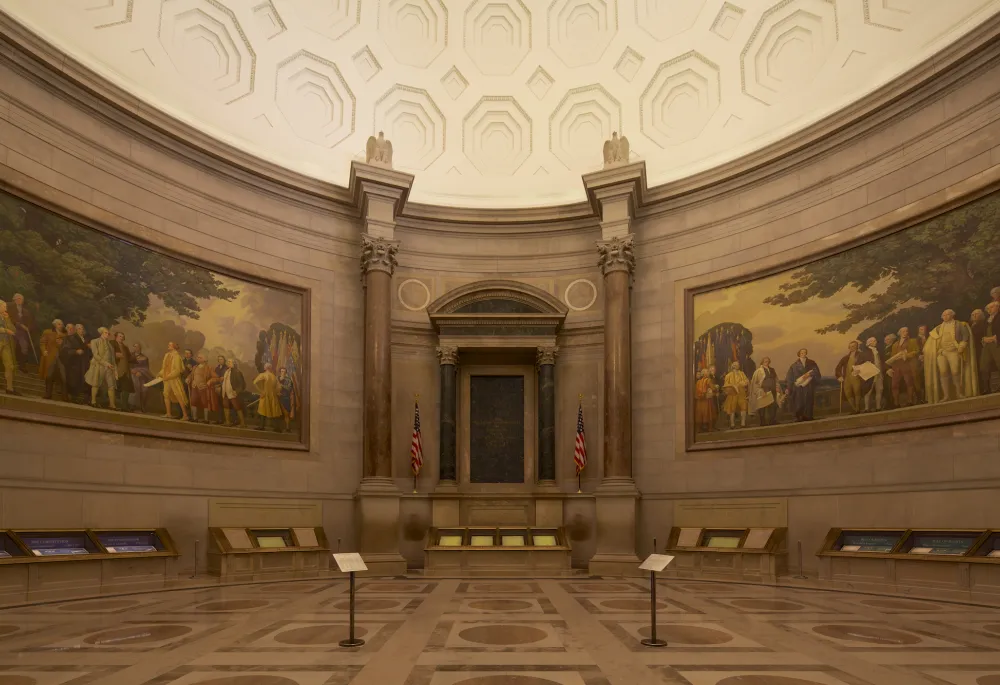
The National Archives and Records Administration (NARA) holds the records of the United States Government.
At the National Archives, “records” can include any type of document (textual or electronic), as well as photographs, recordings, and even 3-dimensional artifacts created or received by the Executive, Legislative, or Judicial branches of government. Some records are personal, like census schedules that describe how people lived, like a personal letter tucked into a soldier’s Civil War pension file, while others illustrate how the government works, like a memo to the President discussing a policy decision.
The Executive Office for Legislative Archives, Presidential Libraries, and Museum Services, within the NARA, works closely with the Director of Presidential Libraries to administer a nationwide network of Presidential Libraries. Presidential Libraries are not libraries in the usual sense. They are archives and museums, bringing together in one place the documents and artifacts of a President and his administration and presenting them to the public for study and discussion without regard for political considerations or affiliations. Presidential Libraries and Museums, like their holdings, belong to the American people.
The Donald J. Trump Presidential Library is the 15th Presidential Library administered by NARA.
About the project
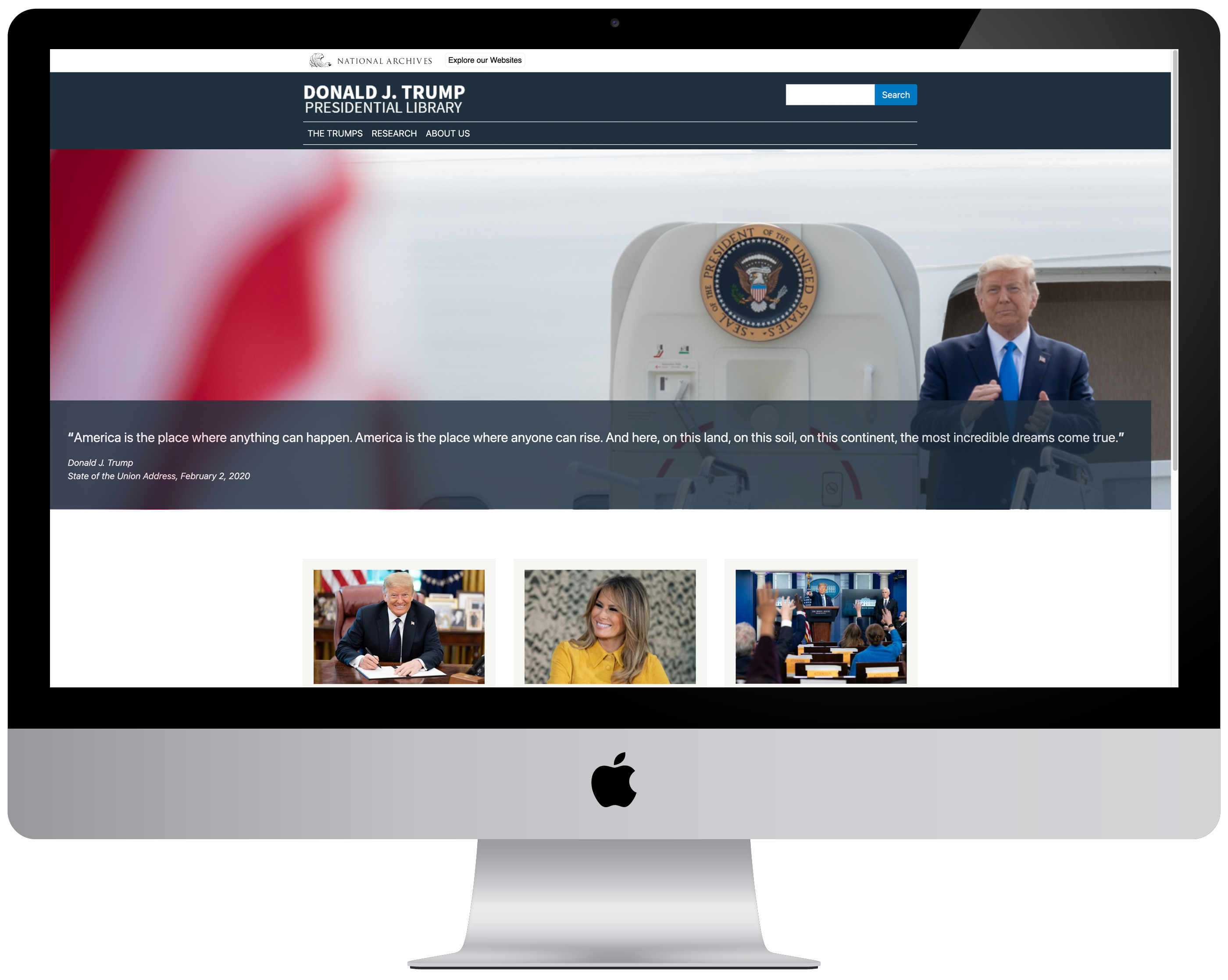
The long-term vision for the Trump Library website is that it successfully reflects the centrality of digital engagement to the Trump Administration's interaction and communication with the public. The website will offer opportunities to engage the public by making archival holdings available and providing access to online exhibits and educational resources. Website users will include the general public, researchers, educators, the media, Congress, the President, former presidents and other government officials.
Scope of work included:
-
Stakeholder and audience research to determine the user experience and design direction for interactive/multimedia features (i.e. interactive timeline, dynamic finding aids, virtual exhibits, audio-visual galleries.
-
Enhance the content authoring experience and capabilities of the website’s current web editor (i.e. Gutenberg custom blocks), e.g., develop a user-friendly editing interface using Drupal content type and Gutenberg custom blocks to enable data entry and editing of the above reference features (i.e. interactive timeline, dynamic finding aids, virtual exhibits, audio-visual galleries) where all images and files used should be uploaded as a media item.
-
Enhance the capabilities of the website’s current global website search engine (i.e. ElasticSearch).
-
Conduct user acceptance testing and resolve reported issues prior to the launch of the website.
-
Develop the enhancements in such a way that it can be used as a prototype for other National Archives websites in Drupal 9.
-
Ensure that all design and user experience recommendations adhere to the U.S. Web Design System.
-
Develop an Interactive Timeline Module that may be used to display photographs, videos, images of scanned documents, social media accounts (i.e. Twitter, Facebook, Instagram, Flickr, and YouTube), related text/metadata, and links from external sources within a timeline visualization format.
-
Develop an audio-visual gallery module that provides a user interface through which website editors may create, edit, or delete individual galleries containing audio and/or video content.
-
Ensure that no site specific logic or dependencies are developed into the module which may prohibit it from being installed on other Drupal 9 websites that are maintained by the National Archives.
-
Assess content compliance with WCAG 2.0 AA and Section 508 specifications, provide test results documentation with the periodic reviews, and remediate as necessary. Enhance Gutenberg with 508 Compliance Check Capabilities. Implement a 508 Compliance checker into Gutenberg that automatically alerts content creators of 508 Compliance issues. The check can leverage ANDI (https://www.ssa.gov/accessibility/andi/help/install.html) or any other open source code to do the check.
-
Develop functionality that will allow content creators to build 508 compliant accordions. The accordions must have the ability to open and close individual items, enable selecting one or more items to start open, and allow users to open/close all accordions with a single click.
-
Develop functionality that will allow content creators to build tables based on the U.S. Web Design System from CSV files or spreadsheet-based documents (i.e. Google Sheets and MS Excel). The file is imported through a public url and/or local file then displayed as an html table.
-
Implement Card and/or Cards into Gutenberg Functionality. The Vendor shall develop functionality that will allow content creators to build cards based on USWDS. The creation of cards can be manual or from an existing view. The content creators should be able to create cards that are text only, image only, text and image, choose image orientation, and the ability to do default and flag layout.
-
Implement Views Module into Gutenberg. The Vendor shall develop functionality that will allow content creators to use views inside the Gutenberg editor. Each view should be a configurable block that can be inserted into the layout of the page.
-
Implement Data Visualization into Gutenberg. The Vendor shall develop functionality that will allow content creators to build bar graphs, pie charts, and line charts. The data can be entered manually or uploaded from a local csv, or MS Excel.
-
Implement Modal capabilities into Gutenberg. The Vendor shall develop functionality that will allow content creators to insert modals with text only, text and images, image only, video, and audio.
-
Implement Process List into Gutenberg. The Vendor shall develop functionality that will allow content creators to insert process lists that are either numbered or alphabetical. The process list should follow USWDS (https://designsystem.digital.gov/components/process-list/) styling.
-
Implement Summary Box into Gutenberg. The Vendor shall develop functionality that will allow content creators to insert a summary bow that is styled and functions like the one on USWDS (https://designsystem.digital.gov/components/summary-box/).
-
Implement Automatic Table of Contents into Gutenberg. The Vendor shall develop functionality that will allow content creators to insert a table of contents that automatically lists out headings on the page and links to those sections.
-
Image Caption and National Archives Catalog Referral Link. The Vendor shall develop functionality to allow website editors to add captions that may be displayed with images that are added to a web page or gallery. The Vendor shall develop functionality to allow website editors to add a “View in National Archives Catalog” referral link that may be displayed with images that are added to a web page or gallery.
-
Implement Reusable layouts into Gutenberg. The Vendor shall create a new “Layout” section in the main create bar of Gutenberg. The layout section shall allow users to select predefined layouts on any page. The layouts are created by saving the basic elements of any page into a reusable format. An example would be a hero section, two columns, gallery, and then these items can be saved into a reusable layout.
Why Drupal was chosen
Drupal is the CMS of choice by the National Archives and Records Administration (NARA), which is an independent federal agency. It was chosen for several reasons, including the fact that Drupal is the favorite among thirteen of the fifteen federal Departments within the executive branch of the United States including the Department of Agriculture, Commerce, Education, Health and Human Services, Homeland Security, Housing and Urban Development, Interior, Transportation, Treasury, and Veterans Affairs. The federal government chose Drupal because of its security, scalability, flexibility, global acceptability, open source modules, API, multilingual support, mobile-first architecture, headless architecture, and the object oriented programming language used to build it.

Technical Specifications
Drupal version:
Key modules/theme/distribution used:
The National Archives chose Gutenberg as its editor and required most of the components specified by the U.S. Web Design System (USWDS)