Sector(s)
In recent years, the viewpoints of promoting the utilization of public data, transparency of administration, improvement of reliability, promotion of public-private cooperation, efficiency of administration, and information possessed by the administration are in a data format suitable for opportunity reading and secondary usage to disclose with possible use are under way. These efforts are promoted as a part of the Government's e-Government open data warfare and are called "open data".
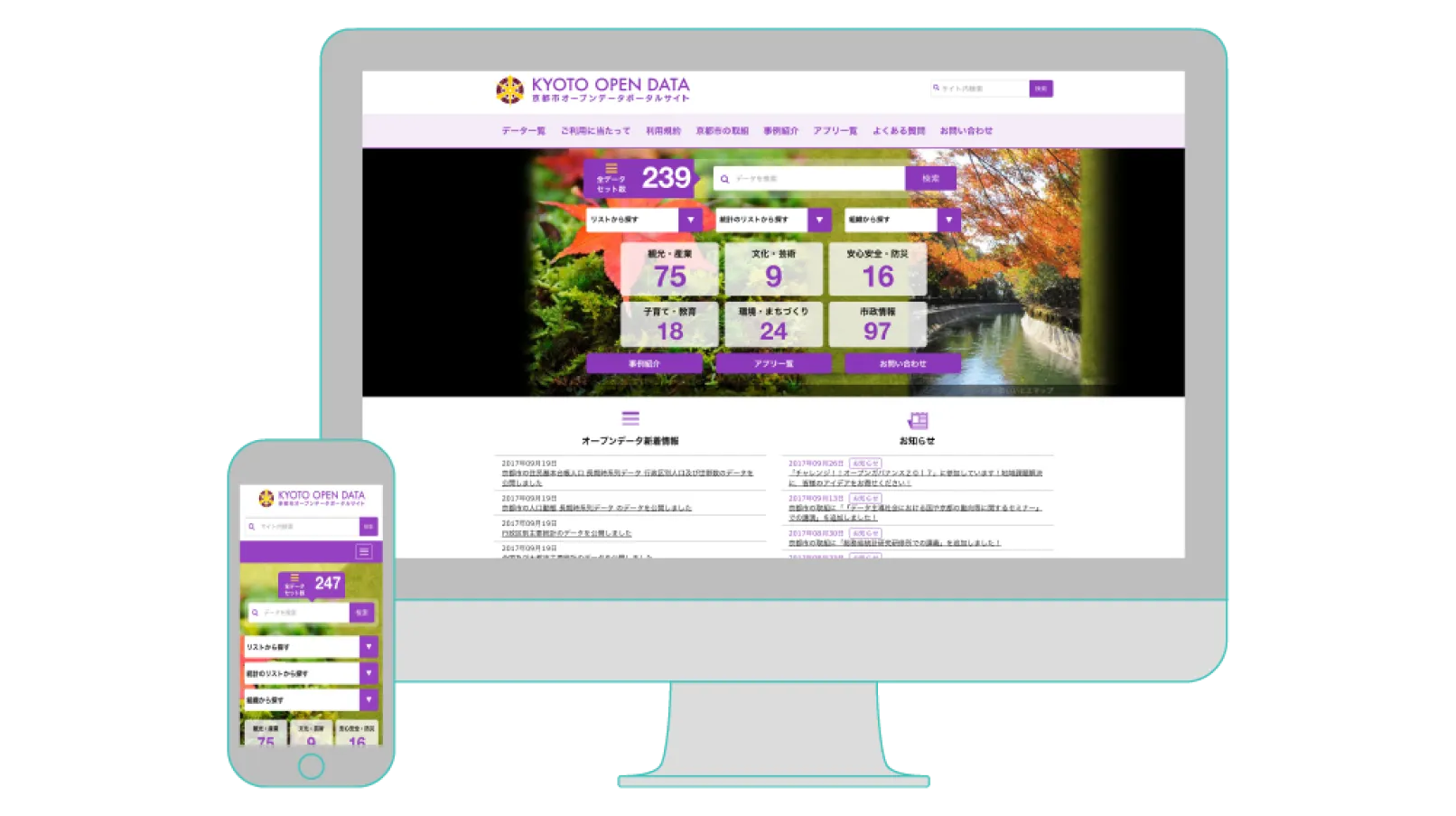
"KYOTO OPEN DATA" is an open data portal site that has easy-to-understand and convenient data retrieval functions and as an initiative of Kyoto City's promotion of the use of open data.
About the project
Function introduction
Search function
In "KYOTO OPEN DATA", the search function is substantial. In regular data portal site searches, you can only search on datasets, data resource titles, tags, etc, but with "KYOTO OPEN DATA", it supports full text search. With the full text search function, you can search and display the content of CSV data registered in the data portal site and the content of the PDF file containing the specified keyword. With this function, it is possible to reduce the cases where it does not produce any search results due to phrases peculiar to a particular municipality. In addition, it is possible to provide a field of information that can be easily be retrieved by the general public.
Preview Function
"KYOTO OPEN DATA" has enhanced the preview function that allows users to browse data on the site without downloading. In return, people can easily browse data. On a regular data portal site, preview of CSV is mainly used, but "KYOTO OPEN DATA" corresponds to the preview of the following data format.
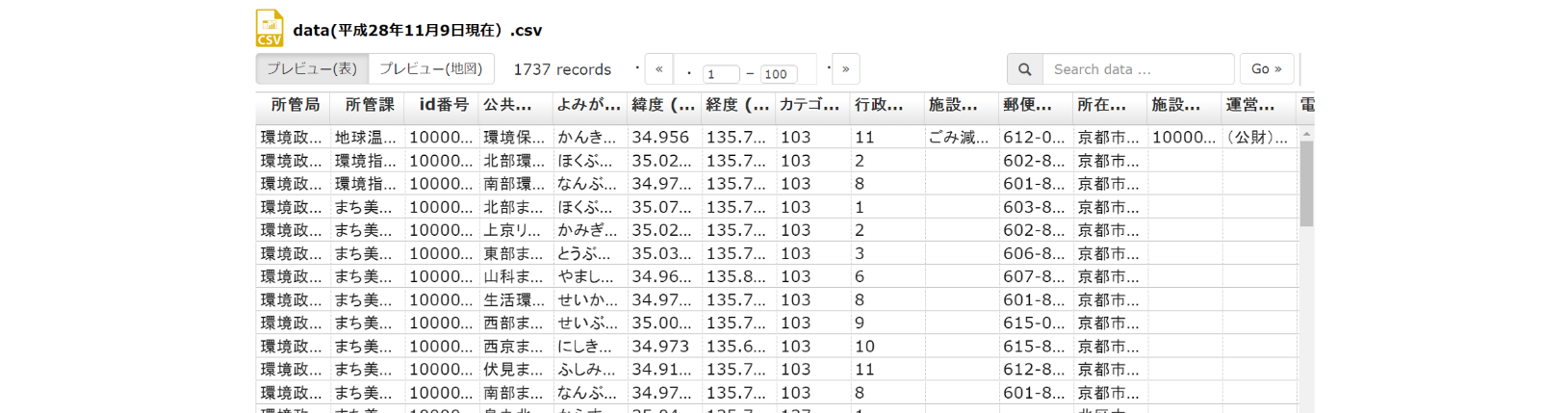
- Tabular preview (csv, excel)
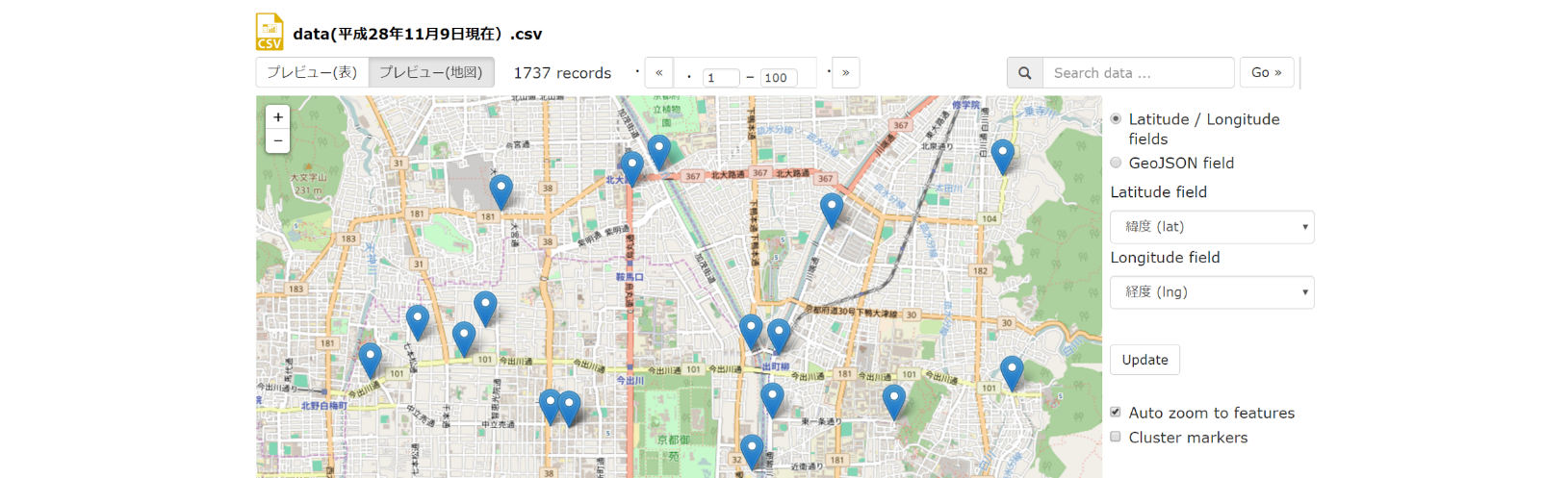
- Map format preview (csv, kml, shp including latitude and longitude information)
- Graph style preview (csv including horizontal and vertical axis data)
- Image preview (jpg, jpeg, gif, png)
- Document preview (pdf)
- HTML preview (html) · JSON preview (json)
Map format preview
Tabular preview
Batch Registration Function of Data
We have also built a tool to simplify data registration so that not only easy-to-understand expressions are kept for the general public but also for staff members. We have developed a function to register all together by loading CSV which summarizes information in data sets and data resources in the system. This is a useful tool for registering large amounts of data, such as in the initial registration. In addition, by adding a function to instantly preview when registering CSV data, workers can register while checking whether there are garbled characters or incomplete information in the data to be registered. By creating an easy-to-register environment, it is possible to enhance open data.
Vocabulary Conversion Function and API Provision Function
With regards to the CSV data registered in "KYOTO OPEN DATA", it is possible to acquire the contents of CSV data by API of XML · JSON · JSONP format by utilizing the mechanism of DKAN. API is the abbreviation of Application Programming Interface, which defines a procedure and data format for calling program functions and data to be managed from other external programs. This will lead to secondary use of open data. "KYOTO OPEN DATA" has the function of converting the header item of CSV data to the common vocabulary base (English) formulated by the Ministry of Economy, Trade and Industry, and disclosing it when publishing data with the API. Access by the API is also aimed at commonality of properties.
Linked Open Data and SPARQL Endpoint
In "KYOTO OPEN DATA", SPARQL endpoint will be released in the future. "KYOTO OPEN DATA" has the mechanism to automatically convert the registered data set and data resource to LOD (Linked Open Data) as a first attempt in Japan. Just register the data set and data resource, LOD is then automatically generated. The generated LOD can also be retrieved from the SPARQL endpoint, further promoting the utilization in each direction. For SPARQL endpoints, you can also register not only LODs that are automatically created, but also data of the main forms of RDF (.ttl and .n3), which can also be searched.
※ What is LOD (Linked Open Data)Using the technology of the Web, it is a mechanism that the computer exposes data in a form that is easy to process, so that you can express the information by connecting the data with a link. By publishing these information on the Internet, it is possible to easily refer from other computers and data.
Why Drupal was chosen
Because Drupal based solution was something that Kyoto city was considering.
Technical Specifications
Drupal version:
For more info, please contact below
https://annai.co.jp/en/contact