Sector(s)
Team Members
Visit the site
Visit the siteOrganizations Involved
Community contributions
InterCEPT - https://www.drupal.org/project/intercept
InterCEPT Base (theme) - https://www.drupal.org/project/intercept_base
Tally - https://www.drupal.org/project/tally
Polaris API - https://github.com/RCPL/polaris-api (version 2.x)
Polaris - https://www.drupal.org/project/polaris (version 2.x, not completely committed yet)
VotingAPI - committed patch and used for event rating storage
Track. Engage. Evolve.
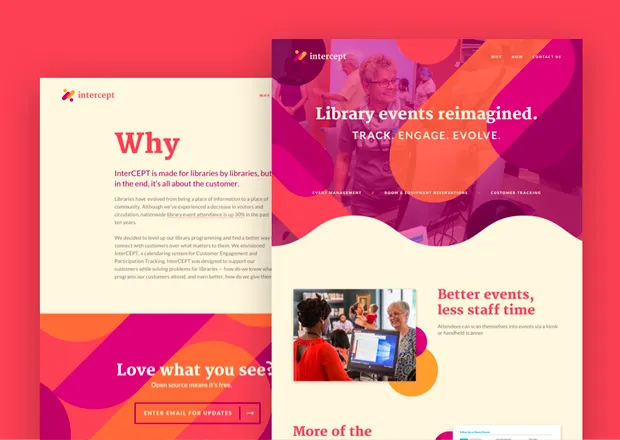
Richland is a 21st century public library. Their programs and events are a critical, much-loved service for communities throughout the South Carolina Midlands. Providing stellar programming for their customers was the utmost importance to Richland, but updates were based solely on instinct and memory of previous events. Richland needed to collect meaningful data to know precisely how their customers perceive and participate with their programs, what works best and what can be improved. From that need, Richland developed the idea for Intercept: an events management system and engagement tracking tool for libraries.
Made for Libraries, by Libraries
Frustrated by event management systems that didn’t track attendance or engagement, Richland began considering alternatives. Staff conducted user research and tested simple prototypes, defining requirements for an ideal solution. Equipped with real customer data and a clear sense for their reporting needs, they developed the concept for Intercept: an event management system tailor-made for libraries, specifically focused on Customer Engagement and Participation Tracking.
Richland was awarded a grant from the John S. and James L. Knight Foundation that helped make Intercept a reality. Both Richland and the Knight Foundation were committed to making this event manager and engagement tool freely available to all libraries. Because of this, we considered the needs of libraries small and large, both rural and urban, as we prioritized feature development.
Today, Intercept is a full-featured event management system with an emphasis on participation tracking. It is designed specifically to target the needs of libraries by providing program attendance and customer feedback to help drive strategic improvements for customer experience.
“Libraries can finally make informed programming decisions based on real-time customer feedback and data thanks to Intercept. I’m so proud to partner with The Knight Foundation and Aten Design Group to make this a reality for libraries everywhere.”
Melanie H.
Executive Director, Richland Library
About the project
Key Challenges
- Without reliable participation and engagement data, libraries are unable to maximize strategic improvements for their programming. First and foremost, Richland needed an events management system to collect actionable data.
- To be successful, any viable new product would need a full suite of event management features. Beyond engagement tracking, Richland needed single sign-on, library card scanning, simple authoring, templates, the ability to clone events, room and equipment reservations and more.
- Different libraries use different Integrated Library Systems (ILS). The new product would have to be flexible, able to integrate with a broad and growing ecosystem of library databases.
Key Solutions
- Customer engagement and participation tracking is built into the core of Intercept.
- Built as a decoupled (aka “headless”) web application with Drupal 8, Intercept is a complete events management system. It offers robust authoring tools, single sign-on, event templates, library-card scanning, room reservations and more.
- Intercept uses a “pluggable” backend. Library programmers can add plugins for integration with their chosen ILS.
Two User Journeys
We established two user journeys immediately: library customers and library staff. Because we know that two separate user journeys can often become a struggle in prioritization, we utilized surveys for key audiences and developed specific user stories. Using that data, we simplified Intercept to make the experience intuitive and easy to navigate while still being a powerful tool for scheduling and evaluating event programming.
Designing Intercept as a Product
Intercept needed to be designed as an open-source product that would compliment Richland Library’s branding but also look universal enough to fit seamlessly into various organization’s styles. We created a product that can easily feature organization’s logos and can be customized to further match styles and branding.
ILS Integrations
Knowing that most libraries use an Integrated Library System (ILS) to catalog library materials and track usage, we prioritized allowing a variety of ILS integrations. Intercept was designed with Polaris in mind, but also provides the capability for integrations with other leading ILS – like ExLibris's Alma and SirsiDynix's Symphony.
Modular Packaging
It became our mission to architect Intercept so it could work with libraries large and small. Utilizing Polaris, Drupal 8, and Github, we built Intercept as a Drupal product, or distribution, with multiple sub-modules for events, room reservations, locations, equipment reservations, etc. Libraries can choose the specific parts of Intercept that they need.
Easily Scan In Customers
To save time for library staff at events, customers can scan in to events using their library card with a custom barcode scanner that we built. We also included a “customer lookup” in case patrons forget their cards or don’t know their number or username.
More of What You Love
To develop a recommendations engine, we created an algorithm that examines several different aspects of each customer’s experience. Customers have the option to set preferences – favorite locations, event types and audience groups they are interested in – which are all customizable by the library. When they save, attend or rate an event, the algorithm takes this into account in order to give them better recommendations for future programming.
Take The Data With You
Programming and tracking data is directly downloadable in a CSV format. It’s easily integrated with systems like Orange Boy or Tableau, but also accessible to be used in any data analysis system. Libraries can choose the format that works best for them.
Why Drupal was chosen
From the beginning, Richland wanted Intercept to be freely available to other libraries. Ideally, the chosen platform would provide a combination of the right technical capabilities, an established distribution channel, and a community of potential collaborators. Drupal checked all of these boxes.
Drupal offers a unique and effective approach for developing software projects as distributable products, or distributions. Further, its extensive toolkit for building API-first, decoupled (aka “headless”) applications was a perfect fit for Intercept.
Intercept leverages Drupal.org for distribution, and can be freely downloaded at https://drupal.org/project/intercept. On Drupal.org, library technologists can access the latest Intercept release, report bugs, request features, or get involved directly by contributing code.
Community engagement was a key part of Richland’s vision for Intercept. Drupal, with its massive community of open source developers and growing network of library-specific technologists, was a perfect fit. With Drupal, Intercept is well-positioned to invite broader participation.
Technical Specifications
Drupal version:
Key modules/theme/distribution used:
simple_oauth + jsonapi + consumers + key - Used with react.js front end for interactive widgets (event registration, attendance, etc)
officer_hours + date_recur - Date calculations for recurring events and room reservation availability