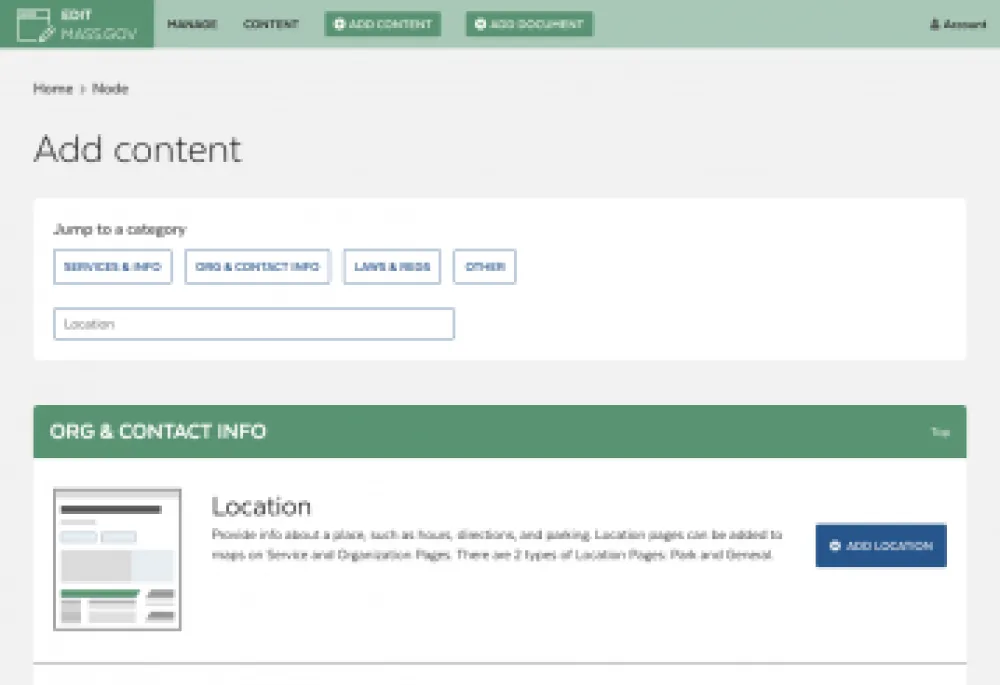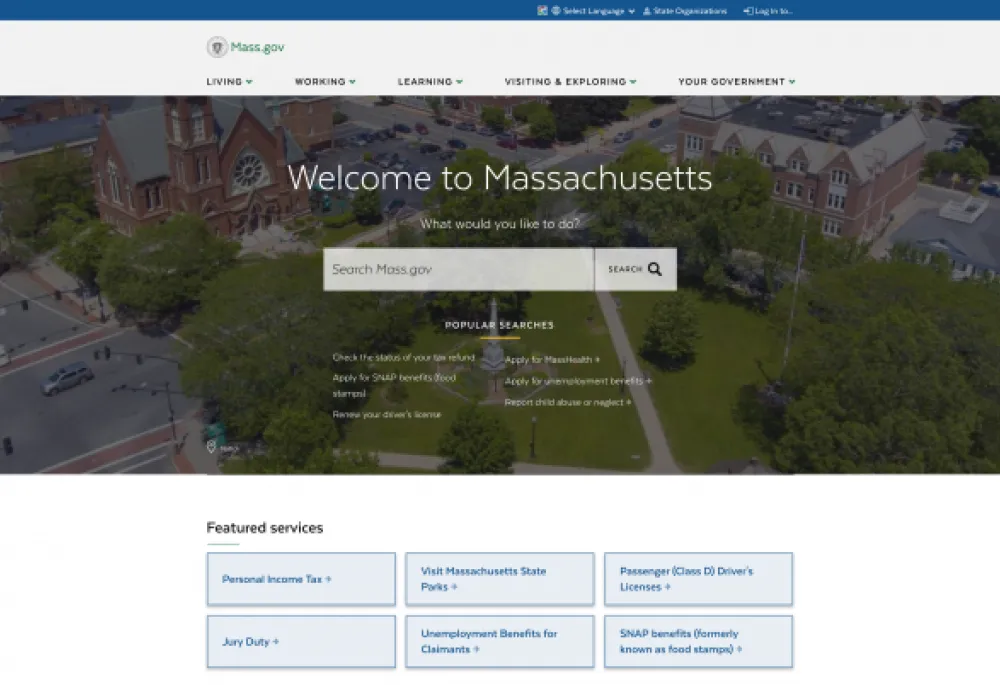
The Commonwealth of Massachusetts embarked on a large-scale web replatform to modernize and make it easier to continuously improve the way the Commonwealth engages with and provides services to its constituents online. By improving the user experience for its constituents, and providing, as comprehensively as possible, a “single face of government”, Mass.gov® has become an essential platform in the Commonwealth’s ability to serve its constituents by delivering information and critical day-to-day social services to the Commonwealth’s 6.8 million people. With 15 million page views each month, the Mass.gov platform hosts over 400+ government agencies and content to support anyone who wants to move, visit, or do business in the state. All of which is fueled by the Commonwealth’s 600+ content authors, who have been able to use the platform to improve constituent satisfaction, making a noticeable positive difference on how the public sees their organization and the services they provide.
As early adopters of Drupal 8, Mass.gov and its ecosystem of web properties are the primary platforms for the delivery of government services and information in the Commonwealth of Massachusetts.
About the project
Wicked awesome content
The Commonwealth of Massachusetts was faced with a difficult to use web experience that stood in the way of a constituent base that wanted to interact with government services through the web. The goal was set to create new primary face of Massachusetts government that was constituent centric to enable fast, easy, and wicked awesome interactions with state services.
Prior to the migration to Drupal 8, the Commonwealth’s antiquated, proprietary content management system reflected its internal hierarchical structure instead of organizing content in a way that made sense to its visitors. That meant, for example, that a visitor looking to start a business in Massachusetts had to visit four or more separate department sites in order to get started. The Commonwealth sought to improve the user’s experience by focusing on guiding the visitor through the various services the Commonwealth provides over helping them navigate the complexities often found in a massive state organization.
Massachusetts Digital Service (MassGovDigital) had two core philosophies that drove their decision making: focus on the constituent experience and use data to support all decisions. They envisioned a unified user experience, where tasks like preparing to renew a driver’s license matched the ease of use of shopping on a major retail website. The MassGovDigital team was challenged to apply private-sector data analytics savvy, like defining and tracking constituent “conversions.” Gaining access to analytics at their fingertips was key for site authors to make fully-informed decisions to optimize their content for readers. A high-performing site search would ensure content findability.
Last Call Media and the MassGovDigital teams worked together to prioritize high performance in order to deliver the next chapter of the state’s digital future. The end result represents a significant leap towards the goal of a new primary face of Massachusetts government that centers on constituents—enabling fast, easy, and wicked awesome interactions with state services.
Huge performance Gains
For Mass.gov the primary stakeholders are the constituents who visit the website and the state organizations who publish content on and visit the website for aspects of their job. It receives upward of 15 million page views a month and changes to the site are released twice weekly by a team of developers. The traffic profile for the site is interesting, yet very predictable. The vast majority of the site traffic occurs between 8:00 am and 8:00 pm during the business week. Site editors are working during the business day (9:00 am - 5:00 pm), and releases happen after the work day is over (after 8:00 pm). On analytics graphs, there are always five traffic spikes corresponding with work days, except when there is a holiday—and then there are four.
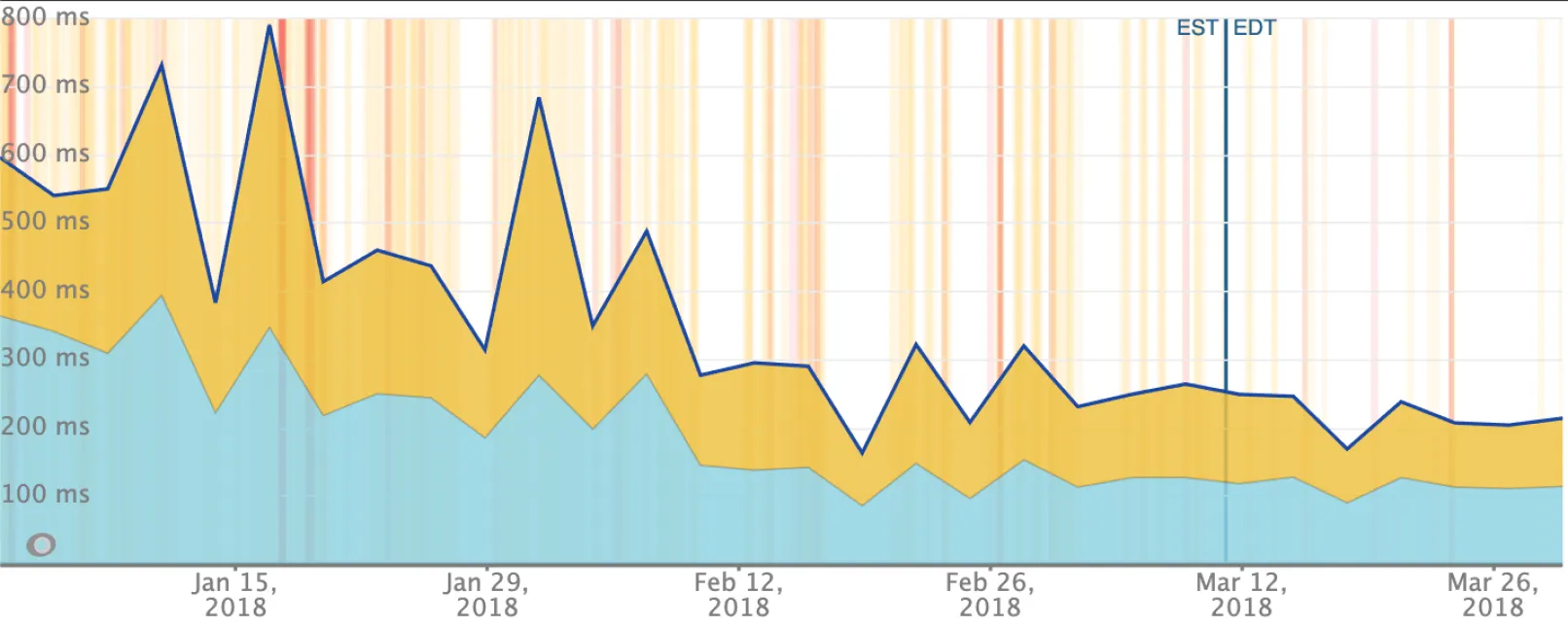
One of the most critical ways Last Call Media enabled fast, easy, and wicked awesome interactions with state services was through careful attention to the site’s performance under its consistently heavy traffic load. Last Call Media assisted in making some pretty dramatic changes on both the front and back end of the site; every action we took was in service of either site stabilization or improving content “freshness.” State employees need to be able to publish content quickly, and constituents need fast access to the information that’s being published, without disruptions while they’re visiting the site. These two needs can be considered opposing forces, since site speed and stability suffers as content freshness (the length of time an editor waits to see the effect of their changes) increases. Our challenge was to find a way to balance those two needs, and our efforts here resulted in huge improvements in both the front and back end performance of the Mass.gov site. We achieved a 50% overall improvement in the back end performance, and a 30% overall improvement in the front end performance. Read more and see our progress across an eight-month timeline for how Last Call Media did this here.
Outcomes
- Leading the Way Among State Government Websites: Mass.gov placed 3rd nationwide in a review of 400 state government websites by ITIF and was recognized for performance in page-load speed, mobile friendliness, security, and accessibility.
- Huge improvements in both the front and back end performance: We achieved a 50% overall improvement in the back end performance, and a 30% overall improvement in the front end performance all while maintaining content freshness.
Key features and functionality
DevOps maturation in automated testing and containerization.
Final Thoughts
Currently, Last Call Media is a leading digital agency working to transform Mass.gov’s digital platform and strengthen government-constituent interaction. This provided technical architecture leadership to develop and support the new digital platform, by working closely with the MassGovDigital internal team and several other vendors.
Over the past 12-months, by relying on constituent feedback and analytics and a commitment to collaboration and flexibility, the teams have been able to improve constituent satisfaction with Mass.gov month over month, according to data collected by Foresee.
Why Drupal was chosen
The Commonwealth’s vision for the new Mass.gov demanded a versatile, robust, enterprise content management framework. They knew from the beginning that they needed a platform that made changes easy, so they could adapt quickly and cost effectively as they discovered and responded to new stakeholder and constituent feedback during their first year of rapid prototyping and development, and beyond. Drupal was a fundamental piece in the Commonwealth’s ability to iterate quickly on feedback, test new ideas, and safely launch features to production.
- Drupal 8 provided an opportunity to leverage advanced web services to support the idea of Mass.gov as the content hub for the Commonwealth.
- Supported the “single face of government” goal, to provide the same look and feel and standard experience across all of the Commonwealth’s web properties.
- Drupal provides several stable tools, which meant the Commonwealth was able to focus on feature development instead of building key tools, reducing overall development costs and time to market.
- Ability to leverage native Drupal for structured content and paragraphs, without major customizations.
- Open source; opportunity and desire to share work with other state governments.
- Accessibility
- Security
- Schema.org support
Technical Specifications
Drupal version:
Key modules/theme/distribution used:
Flag: Used to notify editors about content updates.
Paragraphs: Used to guide authors in creating structured and reusable content.
Redirect: Having migrated from a very large legacy site with a long history, Redirects were a critical consideration.