Sector(s)
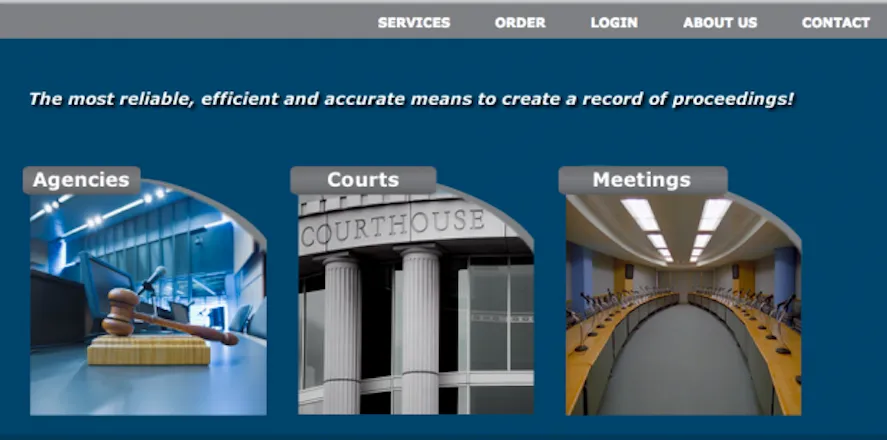
Our client is a leading verbatim transcription and electronic reporting services provider based out of Phoenix, Arizona that services courts and government agencies throughout the USA.
- Lawfirms, Lawyers place orders to procure transcriptions of court proceedings.
- Our client sources audio recordings from the federal court.
- Transcribers transcribe the data, which is then proofread and then sent to their client.
Key Highlights
- File transfer time reduced from 15 mins to less than 6 seconds
- Page load time reduced significantly
- Enabled full migration and decommission redundant servers saving more than $1,000 per month
- Over 30% increase in productivity of contractors
- On-time delivery of projects improved from 86% to over 95% each month
- Support calls from external customers reduced by 50%
About the project
The Goals:
Our client has two applications written in Drupal: a customer facing portal called the New Hampshire Storefront, and an online rich media management system called The Court Record Online v2 (TCRO2). Whenever heavy audio files had to be imported from the storefront to TCRO2, there would be a significant degradation in the website performance, bringing it to an almost halt. Files would take a long time to be imported, and failures were common or would not get reported by the system.
The goal was to solve these problems that they faced.
The Requirements:
The company approached several Drupal agencies across India. We were one of the only two companies which could understand the challenges faced by them. And, we were the only company which was ready to spend time to review the code base with respect to the problem statement. During this exploration, we identified the root cause of the issue as batch processing of files. This convinced the organization about our ability to solve the issues faced.
Once convinced about our client focus and capabilities, they sanctioned a ‘Discovery Phase’ to solve the known problems and identify improvements in specific areas of the system by following our Agile processes. At the end of this phase, we delivered a report which identified the various issues in the workflow which led to the performance degradation. We also identified more issues with the application that put it at a security risk. Because of some of these issues, the costing calculations were also not accurate. All of this had a direct impact on the productivity levels of the company's managers as the system frequently required manual intervention.
The Solution:
- Team and process: For the implementation phase, our team involved in the discovery phase, a Business Analyst and a Tech Architect, continued on the project. A dedicated development team was staffed, in addition for this phase. The manager from the customer’s side was an active participant throughout this process.
The most critical pieces of the system were taken up first leading to early demonstration of success. Through the sprints, the team took on additional tasks, while some low priority tasks were dropped from the development cycle. Having a Product Owner from the client, who was being involved daily with the team, enabled this flexibility. - Architectural changes: We replaced cron with REST API. This improved performance and brought stability to the system. Now, there is a trigger system in place that results in faster file transfer to TCRO2 from New Hampshire Storefront. The improved synchronization between the two systems has ensured that the website functions smoothly during the transfer process as well.
- Improving data maintenance: We re-wrote the code for our client's automatic data maintenance module to handle automatic file cleanup of files. This cleans the system off unnecessary data that would otherwise clog the system.
- Managing security risks: We re-configured the file settings to ensure high privacy to files and data. We also implemented OAuth (authentication), another layer of security. To improve the security further, the communication between the two systems was changed from XML to JSON.
Post-launch, as new orders were received, the bottleneck shifted to another part of the system (which was not part of original scope with us). This was unforeseen and brought the systems down. Our team responded immediately. Having a dedicated team working in the Agile model ensured that the team could react in time. Another sprint was added and the bottlenecks were eliminated.
Why Drupal was chosen
- Drupal enabled them to make a change in their architecture, replacing cron with REST API. This improved performance and brought stability to the system. They wanted to improve communication between TCRO2 and the New Hampshire Storefront systems.
- They wanted their pages to load faster, and Drupal APIs were the best bet.
- They wanted to improve security and prevent unauthorized access to files and data.
Technical Specifications
Drupal version:
Business Benefits:
- Better communication between the two systems: Implementation of REST API replacing cron improved the communication between the two systems. The file transfer time has come down from 15 minutes to less than 6 seconds.
- Performance improvement: There is a significant improvement in performance. Pages load much faster with JSON-based REST API. The new automatic data maintenance module ensures that no unnecessary files are preserved.
- Improved security: Security of the system has improved with new measures taken at various levels. Now it is not possible to get unauthorized access to files and data.
- Better productivity of our client's managers: They don’t have to wait for the systems to function properly.
- Further savings: A stabilized system has allowed the customer to complete full migration and decommission redundant servers saving more than $1,000 per month.
- Improved satisfaction: Contractor (transcribers and proofreaders) satisfaction with the site has gone up dramatically. A productivity gain of over 30% for contractors has been achieved.
- On-time delivery rates up: The smoothly functioning system has led to on-time delivery of projects improving from 86% to over 95% each month.
- Support calls down: Support calls from external customers have reduced by 50 per cent.