Initial Position
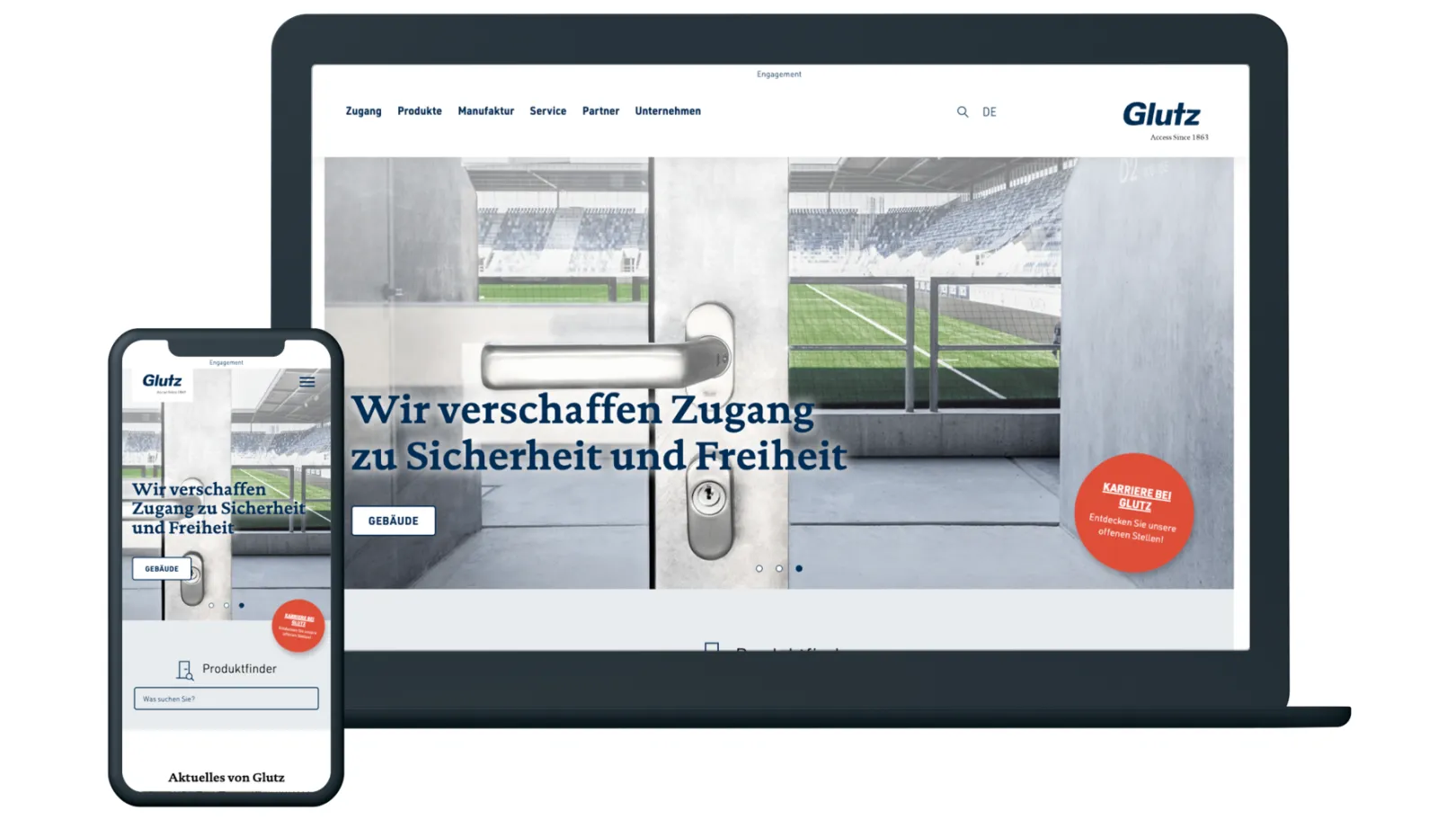
That of Glutz was definitely getting on in years and did not reflect the image that the successful company wanted to show of itself. The website was also not responsive and therefore hardly usable on smartphones. Glutz has big plans for their marketing and needs a solid, modern website that can form the basis of all future activities. The Sitewerk team said: "Challenge accepted!"
Method
Personas and Value Propositions
"Everything is for the customer." Based on this saying, personas were developed within a workshop with the help of a user-centred approach, which are intended to represent the various target groups of Glutz. For this persona, the customer requirements for the new Glutz website were then evaluated with the help of the Value Proposition Canvas .
At the same time, technical and non-functional requirements, such as the interface to the PIM or the requirements for performance and data protection, were defined with the help of the customer's various stakeholders.
The result of this concept phase was a comprehensive specification, as well as a detailed and prioritized catalog of requirements.
The Implementation
Although the thrust of the requirements catalog was relatively clear, the decision was made to adopt an agile approach. The aim was to bring the first solid version of the Glutz website online in spring, which can be continuously expanded from then on.
With a project management, requirements and design department here in Switzerland and a development team of three people in Minsk, the MVP of the website was implemented and successfully released within twelve sprints.
Features
- Drupal CMS
- E-Commerce Module
- Specific content for specific countries
- Event booking
- Multilingualism
- PIM interfaces
- Marketing Automation Interface (MailChimp)
Why Drupal was chosen
Based on the requirements from the concept phase, a CMS was evaluated, which represents a solid foundation but can be scaled and expanded in future projects.
Approaches with modern headless cloud CMS were compared, as well as the way with more traditional enterprise CMS systems such as Sitecore or Episerver. In the end, however, the open source CMS Drupal clearly won the race. No other CMS could compete with Drupal in terms of investment, expandability, flexibility and user experience.
Based on the requirements from the concept phase, a CMS was evaluated, which represents a solid foundation but can be scaled and expanded in future projects.
Approaches with modern headless cloud CMS were compared, as well as the way with more traditional enterprise CMS systems such as Sitecore or Episerver. In the end, however, the open source CMS Drupal clearly won the race. No other CMS could compete with Drupal in terms of investment, expandability, flexibility and user experience.
Technical Specifications
Drupal version: