Sector(s)
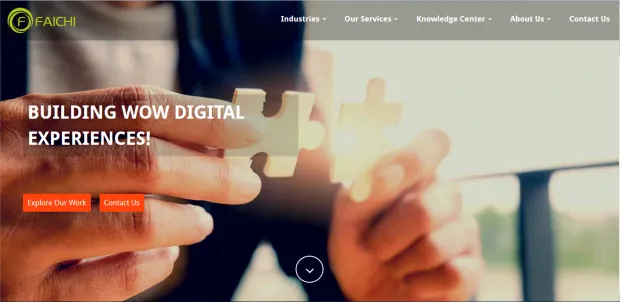
To promote Faichi’s profile, enhance its market presence, and potential, there was a need to migrate the website on to Drupal 8. The website acts as a major communication platform for marketing & sales, Promotions, Public Relations. As a result we wanted the site to look highly professional, modern, appealing, and user/SEO Friendly.
Initially migration looked like a daunting task but we systematically scoped out all the features, divided into pages sequentially and were able to successfully migrate the website from Drupal 7 to Drupal 8.
About the project
Migration to Drupal 8
Having a website on Drupal 8 is going to be beneficial because eventually you will need to upgrade it to Drupal 8 in a short span of time. Drupal 7 will continue to get support until 3 months after the release of Drupal 9. This means that you are good to go through 2018. But if you have the required resources and intend to optimize your website, now is the time to move to Drupal 8.
The biggest advantage of this migration is that you get a chance to re-architect your site and make it more streamlined.
With all this in mind, we identified that the website should feature:
- Professional and user Friendly look
- Pages and sections with content management facility
- Module/Section for news, blogs, clients, case studies publishing
- Small form (Name, Phone, Company Name) to download or view all white papers / success stories.
- Call to Action (i.e. Get Connect) on all internal pages as referred in below wireframe.
- Most internal pages using images/ infographic/ diagram to support its content.
- Banner images with relevant and self-explanatory images (eg. Banner which explains Drupal service etc.)
- Site navigation not deeper than 3 screens.
- Site load time not more than 10 seconds.
- Site includes breadcrumb throughout website.
- Hyperlinks in different color compared to content text (Eg. If black is for text color then orange for links text).
- Menus having some effect of colors or small icons which gives the appeal to click.
- Use No/less popups.
- SEO friendly/Static URL with keyword as per page name (URL for every page provided by us).
- A constant footer throughout the website which includes:
- Copyright Info
- Newsletter Signup
- Privacy Policy
- All Social Plugins
- Sitemaps
- Internal Service links with keywords
- Videos
- Custom Requirement
- Client Section/page
- Industry News
- Blog Section
- White Paper
- Newsletter
- PPT/Video in Internal Page
- Success Stories
- Home Page Banner Text
- Call to Action form in Internal Page
- Contact Form Value
- Services on Home Page/Internal Page
- Custom Blog/Success Stories Display on pages
Keeping in view the above requirements, our migration path centered around content presentation, delivery of mobile accessibility, build APIs, new ways to create data structures, and most importantly a sharp focus on user-friendliness. We used features like:
- Configuration management built at the file-system level, making it easier to move configuration elements (like content type, views, or fields, etc.) from local development to the server
- WYSIWYG editor CKEditor now bundled with the core – allowing easy authoring
- Quick edits and additions from the front-end
- Excellent support for industry standard accessibility technologies, like WAI-ARIA
- Built-in Web Services enabling Drupal 8.0 to be used as a data source, and output content as JSON or XML
- Enhanced content structure capabilities with fields in large numbers
- Improved loading speed
- Optimized site load performance for the end-user, via big pipe part of Drupal Core
Migrating to Drupal 8 gives Faichi even more room for scalability going forward. New updates will be quick to add and configure within the decoupled system so that as the site matures, it retains a dynamism and liveliness that will help bring the mountain even closer to eager adventurers.
Why Drupal was chosen
The previous site was already built in Drupal 7. This meant we could use Drupal’s existing features, and customize the code where necessary.
Technical Specifications
Drupal version:
The list above shows the basic Drupal 8 modules that were needed to support the platform. Many of these modules provided the functionality that any technology company would need on their platform including security measures and publishing workflow.