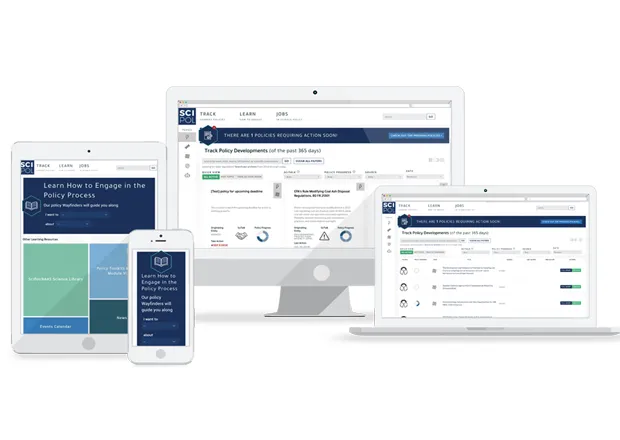
The Duke Initiative for Science & Society examines broad-ranging questions about the integral role of science in social institutions and culture. To serve that purpose, scipol.org, the Duke Initiative for Science & Society’s website, positions information in a way that educates users on science policy and promotes public engagement. The website sits at the crossroads of science and society by covering policy that touches on five distinct scientific topics including energy, genetics/genomics, nanotechnology, neuroscience, and robotics/AI. The New Target team was chosen to transform the formerly static website that acted as more of a news aggregator about science policy into a modern digital experience that is comprehensive, yet easy to use.
Scipol.org was announced at a recent World Economic Forum event in China. Visit http://bit.ly/2MPsUBb and scroll to minute 12:27 to hear about this digital experience firsthand from Duke SciPol's leadership.
About the project
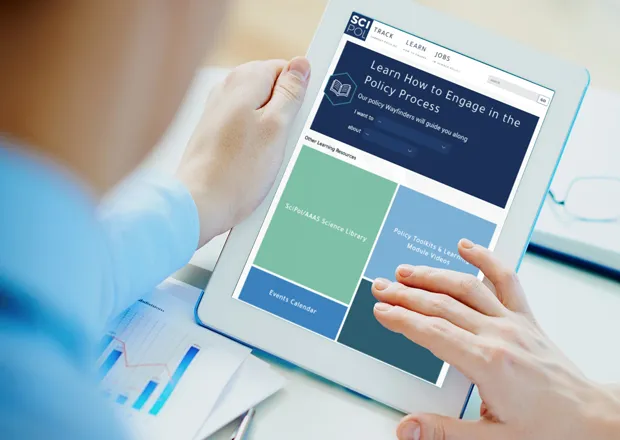
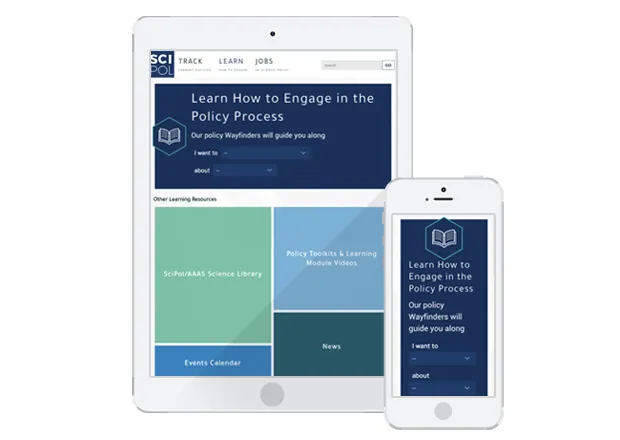
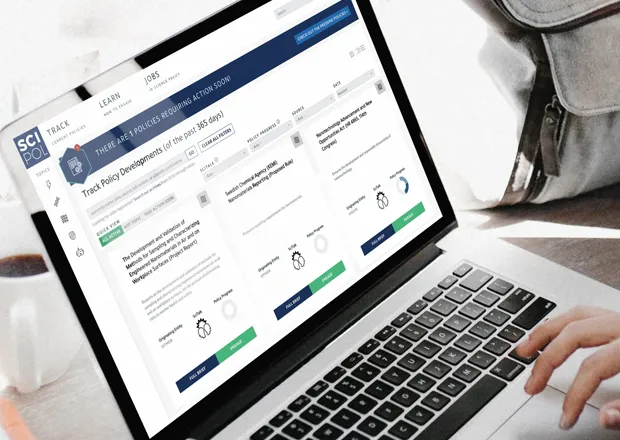
The main goal of scipol.org is to encourage users to engage with science policy both online and offline. As a means to reach that goal, the science-inspired, modern, app-like design is simple and uses motion and animation to keep text-heavy content interesting. In focusing users’ attention on relevant information, it intuitively nudges them toward engaging with the content. The digital experience breaks out into three sections including, Track, Learn, and Jobs and the simplicity of the navigation removes distraction while funneling users into the proper section where they can explore content.
Since the website was transformed from a news aggregator to a more interactive digital tool, New Target implemented a unique first-time user experience. Inspired by mobile apps that teach users how to get the most out of the tool, first-time users are dropped on a page that explains what Duke Initiative for Science & Society is and what information is available through the digital experience. From there, they are guided through the policy tracking tool using intro.js to highlight its capabilities.
This mission of encouraging users to get involved with science policy is only achieved when users of varying backgrounds know how to engage. This is where the second section of the digital experience, the Learn section, comes in. This section highlights tools and interactive educational resources aimed at showing users how to engage with the policy process. While many of the items in this section are external resources, a custom, flexible, and interactive tool called the Wayfinder, walks users through the touchpoints of policies. Using simple icons, colors, and motion, this tool shows the process in easy-to-understand stages highlighting the engagement opportunities that accompany each step in the process.
Looking to find a career in science policy? There’s a job board for you. Want to learn how to engage with Congress on a new piece of legislation? There’s information for you. Interested in seeing the latest and most relevant headlines about a specific policy? There’s news for you, too. The design of scipol.org puts a focus on the user and interactions allow them to take full advantage of the tools the digital experience provides.
Why Drupal was chosen
The Duke SciPol website had been built in Drupal 7 which allowed New Target to focus on the design and user experience. We custom built flexibility into the website which, among other tasks, enables admins to control card width, elements, and iconography. Staying in Drupal 7 also meant that the staff required less training and could start working on the site quickly after launch.
Technical Specifications
Drupal version:
Key modules/theme/distribution used:
Panelizer – Using the Panel module has become a standard in the Drupal world but Panelizer goes one step further to provide per node basis layout which can be spun out from default layout providing additional flexibility.
Paragraphs – Paragraphs is a powerful and flexible module that can provide any number of multiple entity types as a field.
String Overrides – This is a pretty handy module that allows modifying terms which are specified in any code without modifying the code itself.
Link Checker – This can detect any link issues such as 404 and list them in a report page or in individual nodes which have problematic links on. This was critical due to the amount of reorganization and linking of content.
Stage File Proxy – This is a useful module that frees the user from copying production files to dev/staging sites as it always generates production asset URLs.