Sector(s)
Team Members
Project Team
Project Manager - Matt Brooks
Designer - Gem Fountain
Visit the site
Visit the siteOrganizations Involved
Community contributions
As always at Manifesto, we used a “Don’t hack the core” and “Fix it upstream” approach. As a result, the work for alzheimers.org.uk made some big contributions to the Drupal eco-system. Among those:
Drupal Core:
Sites named with special characters cannot send mail
Saving to the private tempstore doesn't start a session for anonymous users
Add support for and to the LinkWidget UI
Incorrect order and duplicate theme hook suggestions
Scheduler Integration:
Scheduler integration with core Content moderation
Display Suite:
Some fields are not shown when DS used with Field Layout core module
8.x-3.x tests broken due field_group missing dependency3
Chosen:
Client-side-validation broken with Chosen [#2705891] | Drupal.org
A lot was also achieved on the Encrypt and Webform Encrypt side, including open sourcing the module Encrypt RSA to provide asymmetrical encryption to Drupal.
Someone in the UK develops dementia every three minutes – it’s now the nation’s biggest killer. Alzheimer’s Society is the UK’s leading dementia support and research charity, working towards a vision of a world without dementia - campaigning for change, fundraising for research, and supporting people living with dementia today. To improve digital experiences for fundraisers, donors, partners, and people affected by dementia, they needed to rebuild their main public-facing website to offer more personalised content and faster access to services.
What we did
We collaborated closely with the team at Alzheimer’s Society to translate their requirements into a backlog of development tasks. By working in an Agile way, with a focus on user experience, we ensured that the features and functionality that would deliver the most value for the organisation and its audiences were prioritised.
Ground-up rebuild on Drupal 8
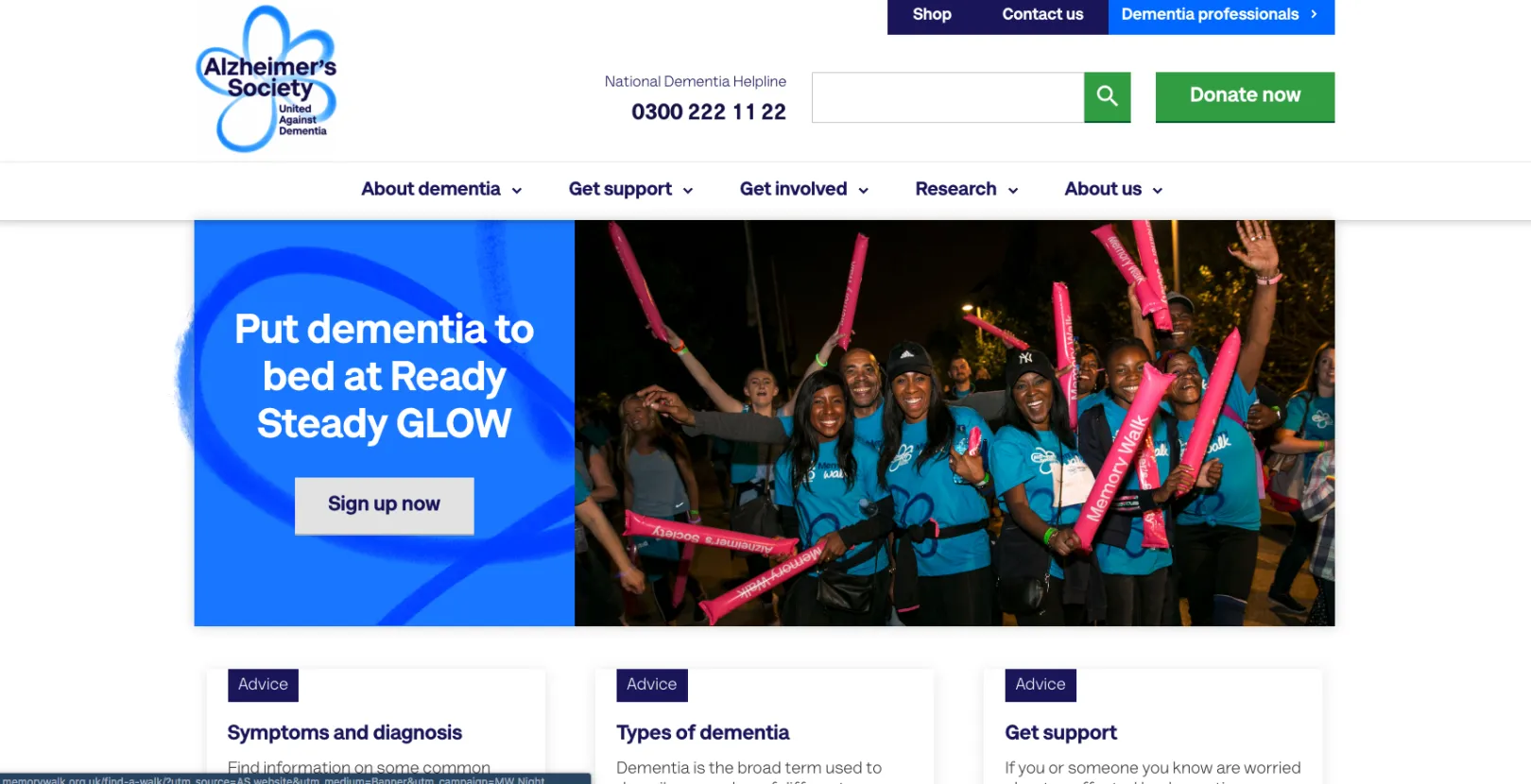
We rebuilt the site on Drupal 8, making use of Acquia Experience Platform to ensure security and stability. While no significant redesign was required – we followed the brand guidelines established in an earlier brand refresh – we called on our deep knowledge of user experience design in the charity sector to suggest and implement improvements to key interactions and journeys where appropriate.
Personalising content
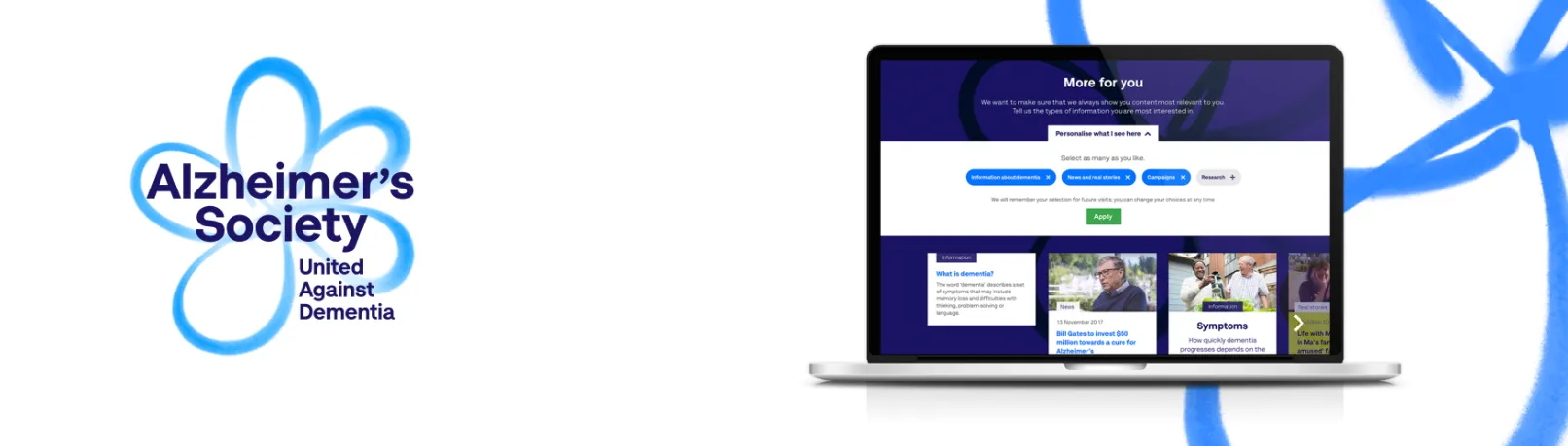
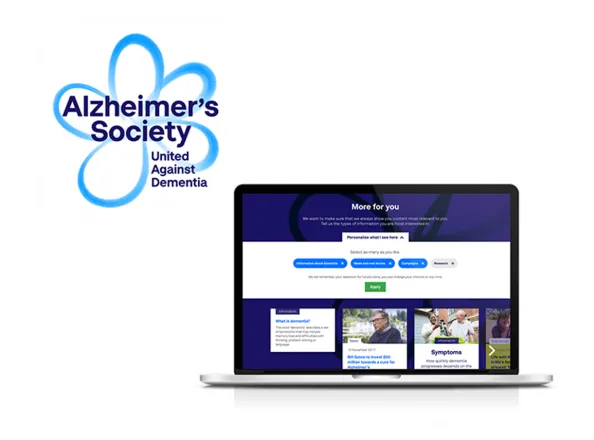
We helped Alzheimer’s Society improve engagement with website content by personalising content recommendations based on user behaviour. Utilising the extendability of the Acquia Experience Platform, we added functionality to track a user’s preferences during a session and then recommend content that matched their profile.
Building tools for service users
We helped update and extend the service finder feature for the website home page, which returns a list of local services for people affected by Alzheimer’s and dementia, based on their stated location. A smart search bar makes it easy for users to find their address with minimal typing, while search results are returned right on the home page, optimised for accessibility.
Integrating the blog and forum
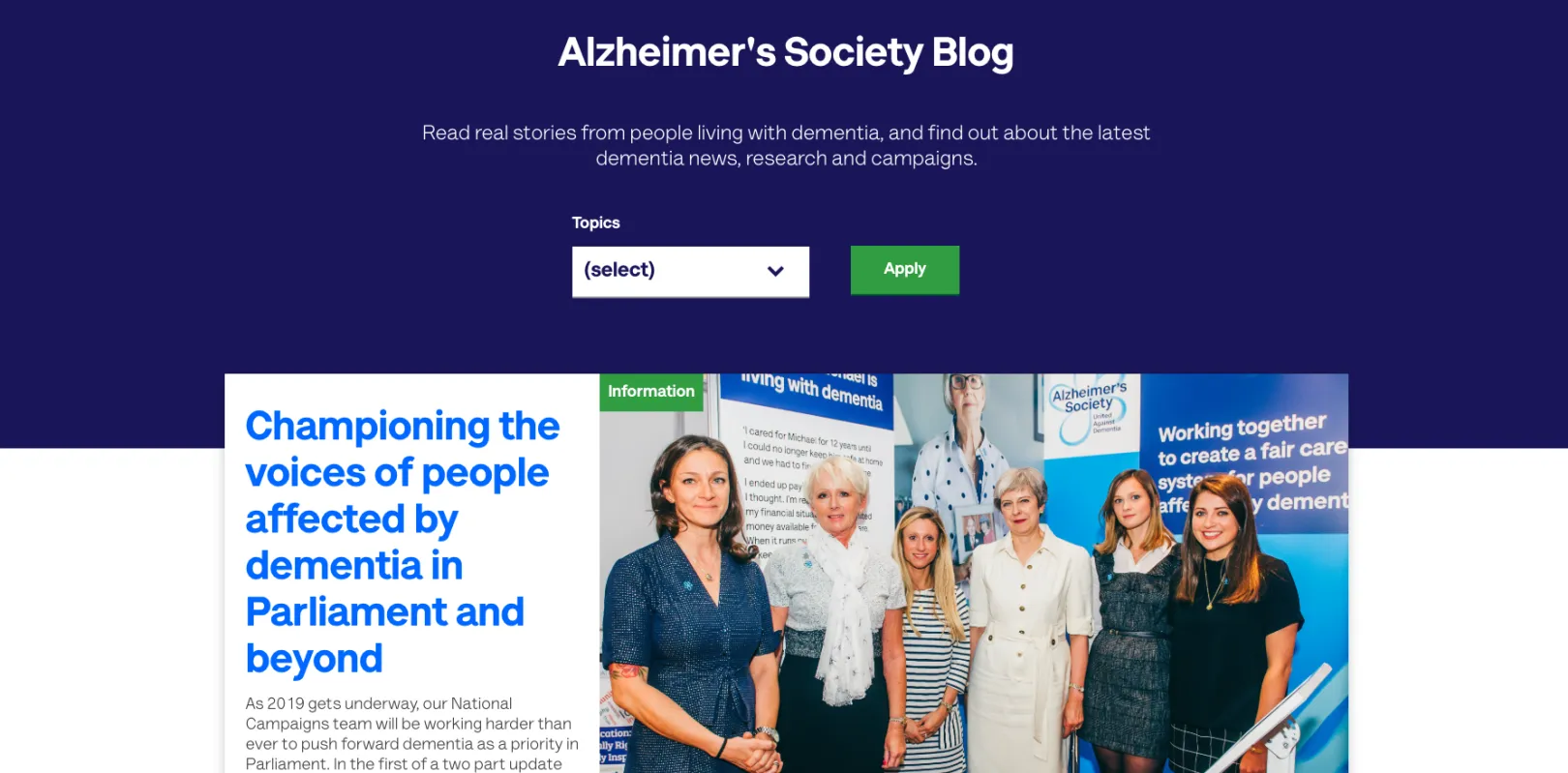
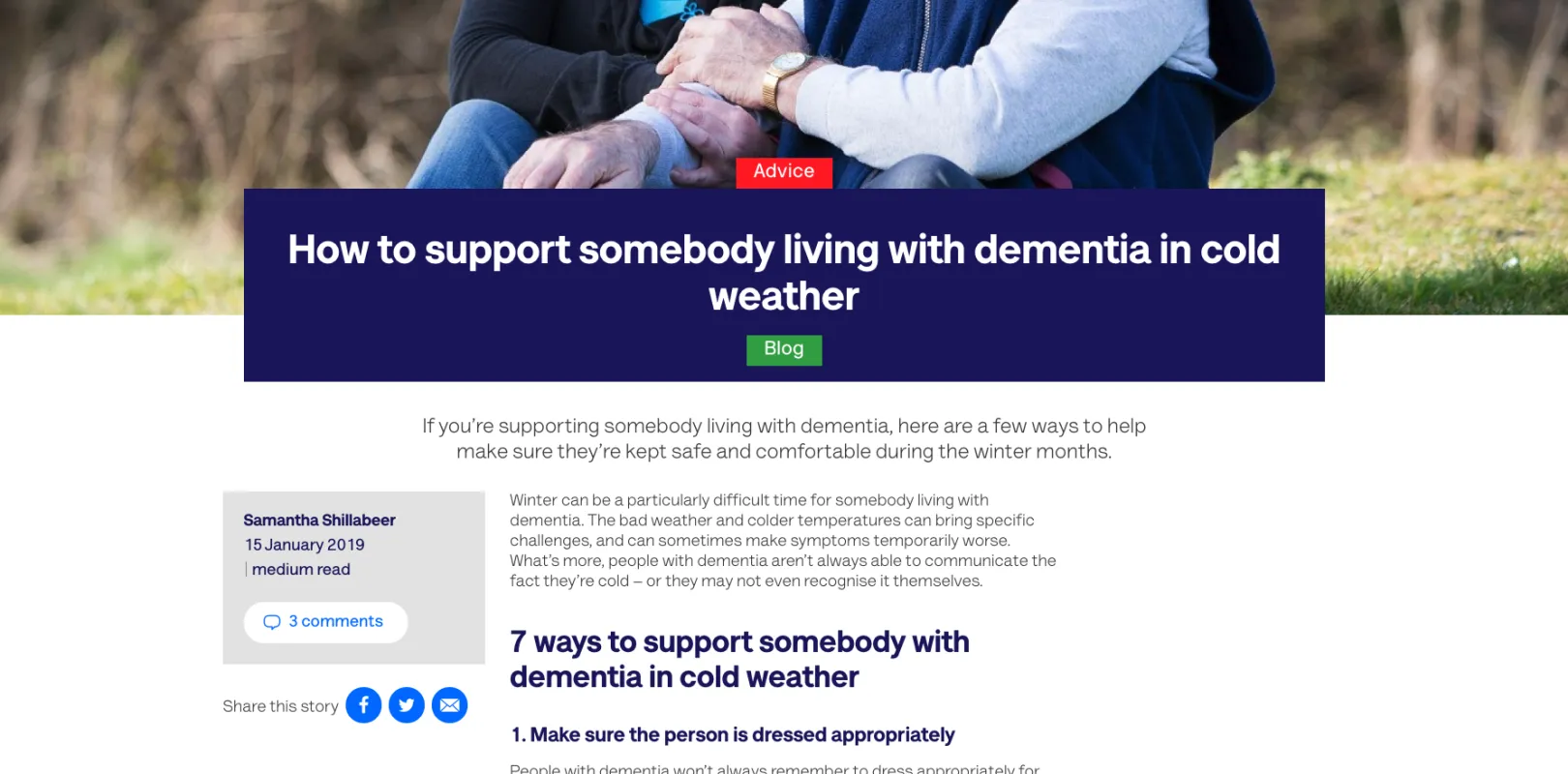
Prior to the website rebuild, the Alzheimer’s Society blog was hosted on a separate subdomain to the main website, making it hard to maintain a consistent experience across the two properties. We brought the blog into the information architecture of the main site and designed new templates for both blog posts and articles from the six-yearly Dementia Together magazine.
Similarly, the Society’s online community, Talking Points, is also hosted separately. We helped integrate the community more closely, building a journey for new community members on the main website and surfacing links to relevant forum threads within similarly-themed articles.
How it went
The new, improved website launched earlier this year after six collaborative sprints by a combined Manifesto and Alzheimer’s Society team.
Organic visits are up 28% year on year, and the number of users has increased by 30%. Alzheimer’s Society will continue to work with Manifesto on improving the site and making it more user-focused.
About the project
The charity’s existing website was built on a proprietary CMS which was difficult to extend and develop. Alzheimer’s Society wanted to rebuild the site using the Drupal content management system to facilitate continuous improvement of the site. They also wanted to improve the user experience by personalising content and helping people affected by dementia find local services more easily.
Why Drupal was chosen
The platform on which the previous Alzheimer’s Society website was built did not offer the scalability or flexibility that the charity needed. To improve experiences for both audiences and editors/admins they required a more robust, modular and easily extendible system.
Drupal has all these benefits ‘out of the box’, and its open-source nature made it easier for Alzheimer’s Society to understand the release cycle, security processes and routines, and get access to the API documentation.
Drupal was clearly the best choice for ensuring fast access to important content and services for their web audiences while minimising organisational overheads.
Technical Specifications
Drupal version:
Key modules/theme/distribution used:
Paragraphs:
One of the main pain points of the previous system was the difficulty of presenting Alzheimer’s Society content in an engaging and dynamic way. The idea of the “monolithic body” of pages was a tight and old-fashioned outfit.
We decided to use a more modern component-based approach, where the content is not only text and images, but a mix of rich text, multimedia assets (videos, images, carousels), calls to action, embedded forms, bespoke widgets, related content and feeds from other platforms.
Paragraphs is the best option when your content is actually a composition of different elements.
UI Patterns:
From the outset, the need for established and reusable patterns was agreed on by everyone.
While attempts had been made with the previous website to provide consistent elements on the page, often they were different elements that had just been forced to appear the same.
We used the amazing UI Patterns for both describing the Alzheimer’s Society Patterns Library, as well consuming the atoms, molecules and compounds from either the twig template or directly from the Drupal rendering layer.
Using UI Patterns removed the everlasting prejudices and barriers between Backend and Frontend developers, making processes better, faster and much more fun.
Webform Encrypt + Encrypt RSA:
Like any charity website, alzheimers.org.uk requires a large number of data-capture forms - for registering supporters for events and campaigns, for ordering fundraising materials or for making enquiries. Privacy was an important consideration for Alzheimer’s Society, so we used Webform Encrypt to make sure users’ submitted data was encrypted on submission.
However, to make the architecture bullet-proof, we also used Encrypt RSA for Asymmetrical Encryption of user data. This way ONLY authorised people and systems owning the right secret key could decrypt the data. Neither Drupal, nor any web users (including potential attackers) could decypher personal details.