Sector(s)
Visit the site
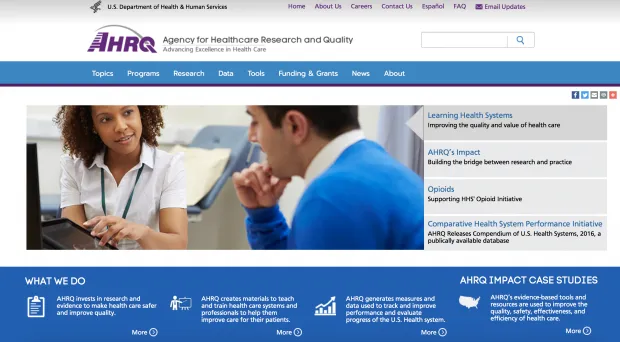
Visit the siteFig Leaf Software was hired by Booz Allen Hamilton (BAH) to work with Acquia, Inc. to assist in architecting a new web site for the Agency for Healthcare Research and Quality (AHRQ) using the Drupal Social Publishing system and the OpenScholar Drupal distribution. Fig Leaf and Acquia conducted a Drupal architecture and planning workshop with the AHRQ development team to define the architecture for the new system. The Fig Leaf and Acquia Technical Architects worked with the BAH team for five days in workshop sessions to define the architecture of the new system. The scope of the workshop focused on four major areas: requirements review, component architecture and high level design, content-type architecture, and deployment architecture.
About the project
As a result of our work, the Fig Leaf / Acquia team provided the following deliverable as part of the services:
Architecture and Design Document. The Fig Leaf / Acquia team, prepared a document describing the recommended candidate architecture and high-level design aspects for the new site. The design included sections describing the outcome of each of the major areas covered in the workshop.
Delivery Timeline. The Architecture Workshop Services were delivered over a period of up to five consecutive days: four (4) continuous days onsite; one (1) remote. Architecture and Design Document was completed and delivered within one week of the completion of the on-site Services.
Custom Module Development. The Fig Leaf/Acquia team delivered a custom module to integrate with a LDAP system and offered code reviews for AHRQ’s Drupal development team.
Why Drupal was chosen
As a foundation for the architecture, the Fig Leaf / Acquia team reviewed the scope of the system being planned by AHRQ. The Fig Leaf / Acquia team elaborated high-level requirements for the system including the overall capabilities of the web system and the integrations with any external systems to be integrated with. The Fig Leaf / Acquia Architects led component architecture and high level design sessions with the AHRQ team to identify the major components of the new system and identify how the system capabilities will break down into Drupal modules, both those that are already available from the Drupal community and those that would need to be developed as part of the development effort. The high level design also included the following activities:
Drupal module selection. Once the high level requirements were identified and the capabilities mapped to Drupal modules, the Fig Leaf / Acquia team worked with AHRQ to select the available Drupal core and contributed modules that provided the basis for the features of the site that could be implemented using existing capabilities. The module selection effort included a gap analysis to determine how module behavior would need to be adapted to the specific requirements of the new system.
Custom module design. The Fig Leaf / Acquia team identified that some capabilities would not be able to be implemented with existing modules. The Fig Leaf / Acquia team identified the custom modules that would be required and prepared a high-level design overview of the custom modules. The component architecture also defined the integration points with any external systems and defined the approach to integration including the message format and protocol for the integration.
Deployment architecture. The Fig Leaf / Acquia team worked with AHRQ to define a physical deployment architecture for the system that meet the performance requirements. Deployment architecture sessions focused on:
Deployment infrastructure. Fig Leaf recommend the deployment architecture for the Drupal product. The deployment recommendations included suggestions for deployment of a content-distribution network, web server configuration, load balancing, and database replication.
Performance and scalability plan. Fig Leaf defined a process for performance and scalability testing, including recommended software tools. The process used the functional requirements and expected load on each component of the system to recommend focus areas for testing and suggest the design for load testing scripts. At the conclusion of the workshop, Fig Leaf prepared an architecture recommendations document that captured the candidate architecture and high-level design aspects for the new site.
Technical Specifications
Drupal version:
Key modules/theme/distribution used:
Feeds API