Sector(s)
Team Members
Project Team
Ainsley Harewood, Kendal Fontenelle, Delisa Lewis, Roslyn Khan Cummings, Choy Felix, Kevon Gervais, Kasey Gordon, Clint Ramoutar
Visit the site
Visit the siteTrinidad and Tobago achieved Independence on August 31st, 1962 and is observed 50 years of Independence in 2012. The Government of Trinidad and Tobago remembered and celebrated this important milestone with a series of fitting initiatives. These aimed to recognize and celebrate some of the important events, people and places that helped shaped the country’s rich and diverse history. It is within this scope of events that this website was born. The purpose of the website was twofold in that it was to serve as a "one-stop-shop" for all information pertaining to anniversary events in 2012 as well as being a media archive of the celebrations and important moments in our history.
About the project
Project Goals:
- Implement a content management system that would allow The Ministry of Planning and Sustainable Development to easily keep track of, update, and display to the public of Trinidad and Tobago, events that would be taking place over the period of celebration.
- Create a record of events preserved for posterity. (As such having a website that was developed with valid markup was of utmost importance to us).
- Create a media archive of events and historical moments in our past.
- Develop a website that can be easily scaled to include new features should they be required during the period of the celebrations.
Choice of D6 over D7
This choice was just a matter of skill and time constraints as opposed to any feature set. I was leading this project and at the time I was very familiar with D6. D7 was definitely an option but with limited time we eventually had to go with D6 as it would have taken a longer time to develop had we gone with the D7 due to lack of experience with that version.
Outcome
Each of the above goals were achieved. Drupal enabled us to meet our targets and then some. The Ministry of Planning and Sustainable Development was very pleased with the product as well and based on the feedback from the website the citizens of Trinidad & Tobago were pleased as well.
We were able to complete this project in just under two months and the flexibility and easy of use of the platform is what allowed us to achieve all of this in such a short time. Though the site was very basic in terms of functionality through the flexibility that theming allowed we were able to accomplish quite a lot in terms of design.
The website was wildly popular since the different government ministries held events every week until November of 2012. The most number of hits was of course on the anniversary of our Independence, August 31st.
Drupal not only allowed us to get our official website for the 50th Anniversary of Trinidad & Tobago's Independence up in a short time but it allowed us to quickly update even with all the customizations. We didn't want to have content editors thinking about image sizes and shadows or borders so we built all of that in during development. All the content editors had to do was create content. Overall the project was a success and we would definitely use Drupal again.
Design
The graphic design part of the project was very intense. We came up with three different mock-ups using Adobe Fireworks as it allowed us to prototype the design easily. In the end the third design was selected.
The Homepage
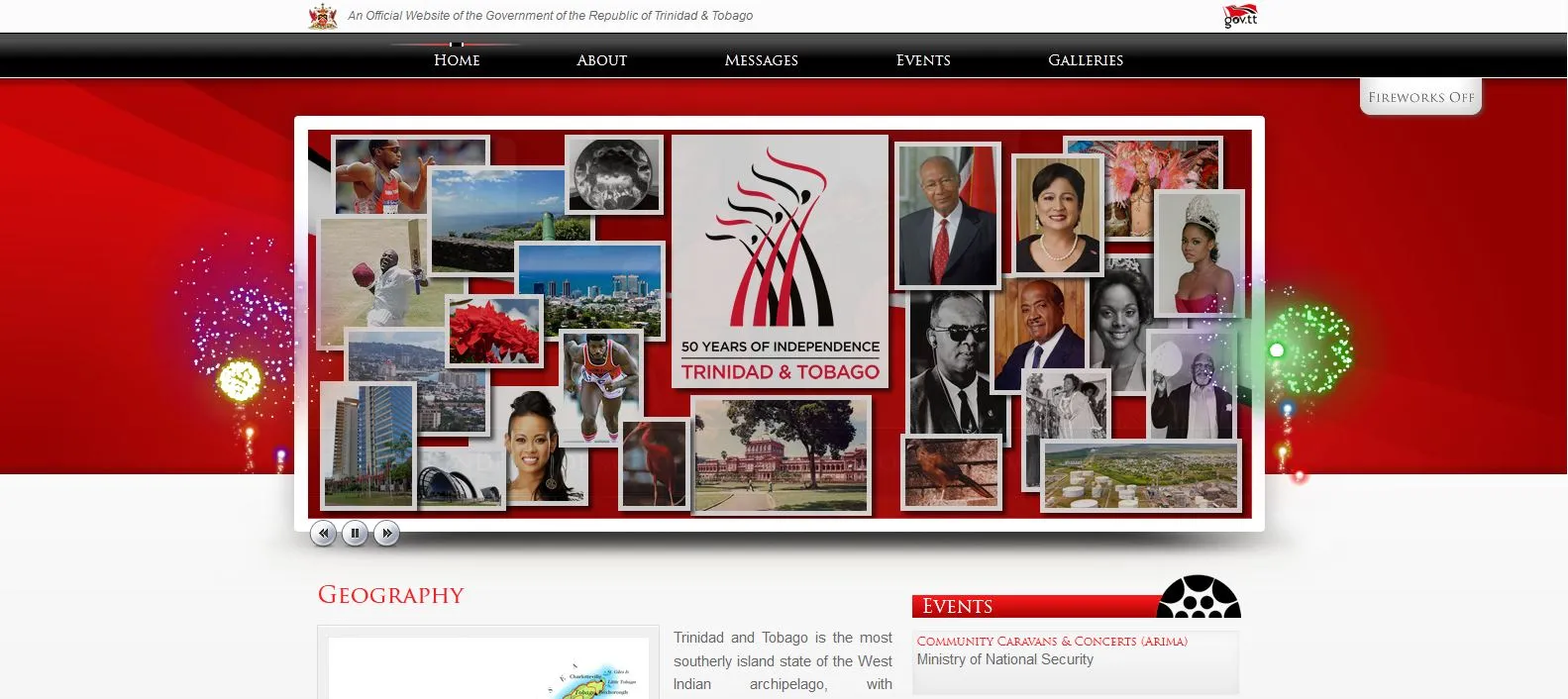
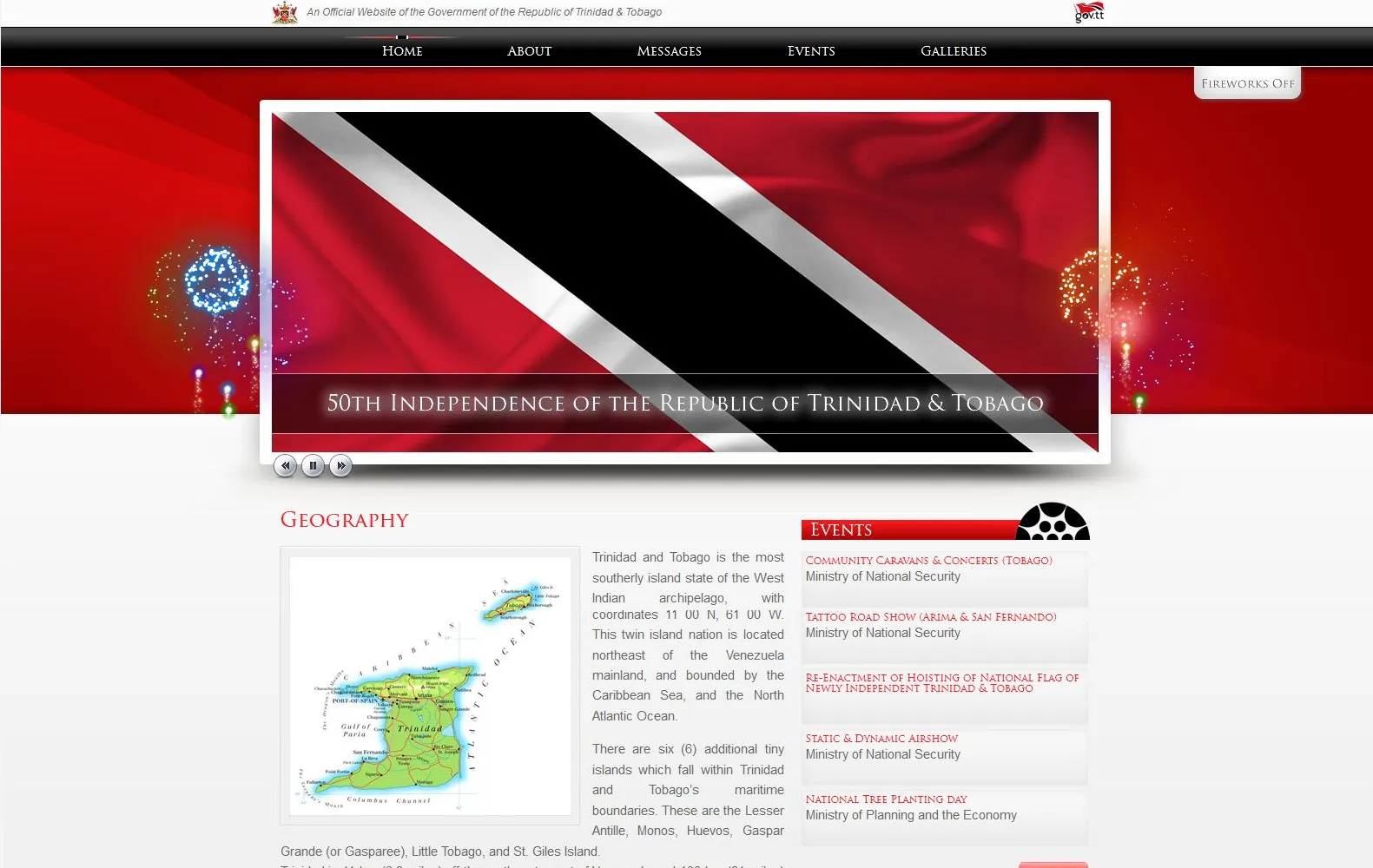
We wanted a "bang" for the homepage so our enthusiastic Corporate Communications director asked "Can't we have fireworks?". My initial thought was "Of course we can't" but once we started developing I got to thinking that a little flash could probably make that happen. The "fireworks effect" was actually purchased from an online video library and edited in Adobe Flash to have just the right amount of explosions. It's the same .SWF file both on the right and left of the banner positioned absolutely with a transparent background. They were positioned just in the right place to look as though they were rising from the white line. There's a little toggle button that turns it off just in case it got too annoying after the first couple of times. I wouldn't usually endorse this but because fireworks are a huge part of the celebrations of Independence Day in Trinidad & Tobago I thought it was appropriate. All other graphics were done in Adobe Fireworks.
Internal Pages
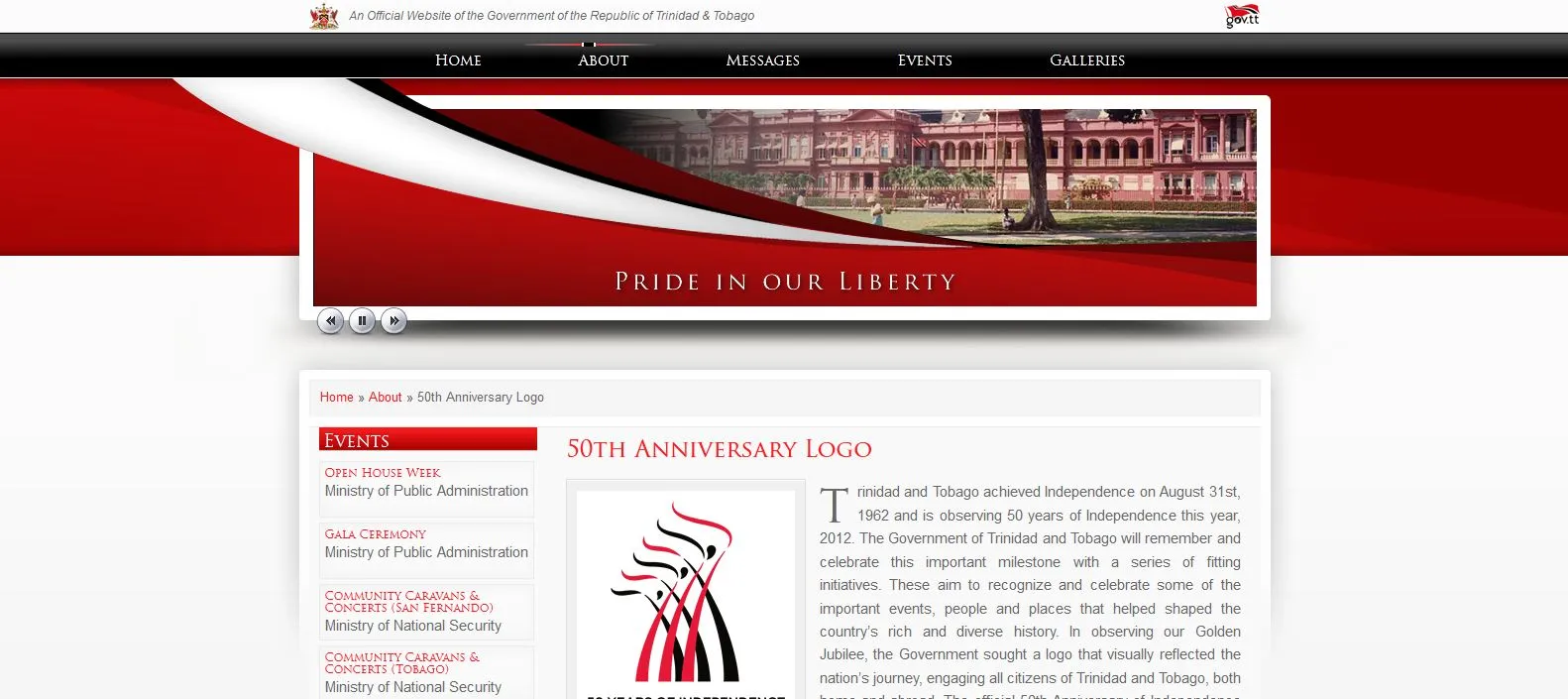
I didn't want the internal pages to fall too far behind from the "bang" that the homepage would have made so I incorporated the "swoosh" which goes over the banner slideshow itself. It was just a really to add to the aesthetics of the design and not have a flat slideshow. This was achieved with a little CSS trickery. The swoosh is a transparent PNG that fits snug within the white border of the slideshow even though it is not within the DIV of the slideshow .i.e. it floats over the slideshow and covers part of it. While the slideshow is looping in the back of it, the swoosh covers just a portion of the slideshow and the other part shows through its transparent background.
All images were given a border that looks sort of 3-dimensional with shadow effects and borders in the right places around the image.
The Gallery
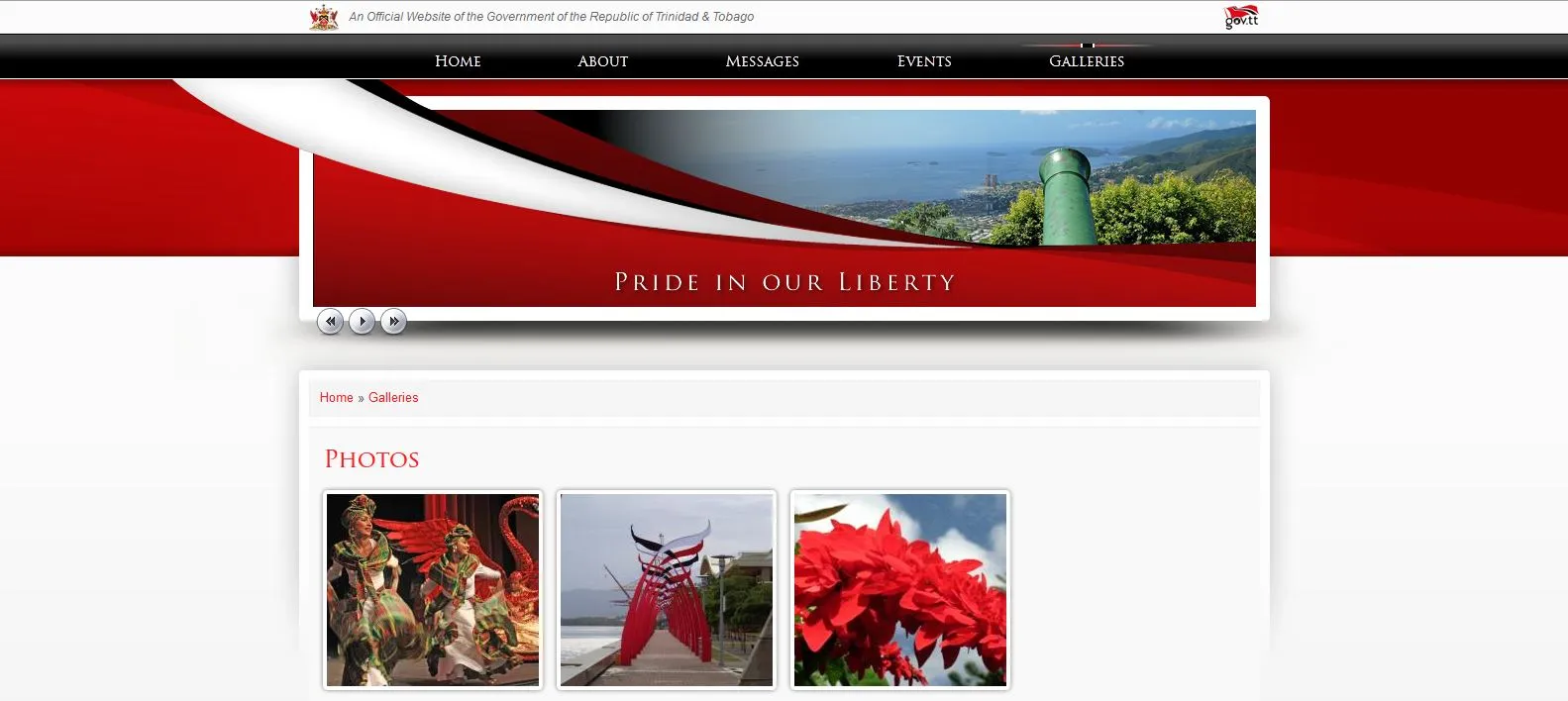
This was another intense part of the design using the "lightbox" script. Instead of using a module we used the bare script and Views to get this done. It allowed for more control of the output as we needed to manipulate the output of the view quite a bit to achieve this effect. Drupal provided the ease of manipulating the view but the gallery itself was more about the CSS and jQuery.
Menu Hover
The LavaLamp script was used to create the hover effect over the menu. We just swapped out the default image with our own.
Event Customization
The event customization was a lot of work as well. By default event has its own colour scheme so we needed to find all the colors and override them to match our own color scheme. All background graphics were created in Adobe Fireworks.
Why Drupal was chosen
At the Ministry of Planning and the Economy (now the Ministry of Planning & Sustainable Development), which was the Ministry responsible for the development of the TNT @ 50 website, we are always striving to incorporate proven technologies into our I.T projects. We were aware of the use of Drupal in government and its resounding success. We were also looking for a stable platform to develop our website on and once we started our comparisons, we didn't have to look very far. Drupal has the flexibility, and the ability to scale well and these were two key factors in our decision making process.
Technical Specifications
Drupal version:
Key modules/theme/distribution used:
CCK
We needed to have more custom fields for each content type created. These fields essentially make management of the website easier.
Views
Views allowed us to create a stunning photo and video gallery integrated with Prettyphoto.js
ImageCache
ImageCache allowed us to customise the images that were uploaded for the slideshow and in other parts of the websites so that website content managers wouldn't have to do that work. We wanted to have as much control over the way the images were displayed as possible so this meant creating several ImageCache presets and associating them with different views or node displays. A content editor should have been able to upload an image and have it displayed in two or more different ways in different parts of the website because of the ImageCache presets.
Megamenu
Megamenu gave us the ability to have a clean menu that was uncluttered even though the amount of links are expected to grow. Initially the site was supposed to have a much larger menu and this was the main reason that the megamenu module was selected.
jCarousel
This was used to allow the events to scroll up on all the pages. The key point of the website was the events. Events were being added daily and this needed to be prominent to users landing on the homepage. The jCarousel allowed us to easily add events from the event module to a scrolling "block" view which was then placed on the homepage.